The contract is ready. The colleague who needs it is ready. Somewhere between them sits a queue of requests for the legal team. Summize has built a business around shortening that queue, with an appealing concession to office life: employees can keep using the software they already know.
Its contract lifecycle management system, or CLM, handles the journey from a request to a signed agreement and the obligations that follow. Word, Teams, Outlook, Slack and sales software become entrances to that process. The Manchester company’s pitch is about where work happens as much as what artificial intelligence can do.
The distinction matters. A contract contains decisions about money, deadlines and responsibility. When those decisions are hard to retrieve, the lawyer becomes a search engine with a meeting calendar. Summize wants colleagues across the business to find routine answers themselves, while legal retains control over the rules.
First, make the paperwork shorter
One of the clearest examples comes from banking software company Thought Machine. Before automating document creation, its legal team redesigned its templates. The NDA templates shrank from 29 pages in total to four. Then it introduced self-service creation in Slack, supported by training and designated business “superusers.”
The company’s published case study reports more than 300 NDAs generated in under six months after the January 2023 rollout. In one department, roughly eight of every ten NDAs had previously needed negotiation. With the new template and process, only one or two needed minor legal input.
That is an unusually useful detail in a software success story. Several things changed together: the document, the route to getting it and the people supporting the process. Treating the result as an AI-only productivity gain would miss the practical lesson. Simplify the work before making it move faster.
Thought Machine’s reported experience; several process changes contributed.
The first wrong turn was the customer
Co-founders Tom Dunlop, a lawyer, and David Smith, a software developer, started Summize in 2018. The initial product summarized contracts; its ambitions grew to cover their full lifecycle. The combination gave the company both familiarity with legal work and the technical ability to change how it was done.
In a SaaS Club interview, Dunlop recalled reviewing roughly 500 contracts, then having to revisit them for an additional clause. He described an early £250,000 raise, spent largely on development, and about six months getting a sellable product ready.
Selling brought a different problem. For roughly 18 months, Summize pursued too many buyer types. Law firms wanted client-facing features; in-house teams wanted business integrations. Encouraging conversations disguised a confused market. The sales team’s traction with mid-market legal departments helped settle the focus. A self-service growth experiment was also abandoned after three or four months because users needed configuration and support.
For another founder, the distinction is worth copying: a compliment is weak evidence of demand. Watch which customers buy, how much help they require and whether their requests point toward the same product.

Huel wanted an easier front door
Nutrition business Huel had already used another CLM provider. As it grew, it sought something more intuitive for procurement: a way to create agreements, route approvals and find the contracts already signed. The problem was usability within an existing operation.
With Summize, Huel built pre-approved templates using the Word add-in, centralized its contract portfolio and enabled standard contract creation through a Slack question-and-answer flow. Renewal reminders helped turn stored documents into work people could act on. Its case study says searching for contract information went from hours to less than two minutes.
“Now it takes less than two minutes.”
Steven McGeagh, Huel’s head of global sourcing, on finding contract information
These are customer-reported results published by the supplier. Even with that qualification, they describe a recognizable improvement: fewer requests landing with procurement simply because someone else cannot find a document. For a buyer evaluating software, that is a concrete task to test during a demonstration.
A separate example, Day Wireless Systems, started without a formal contract process. It introduced a Teams-based entry point, review playbooks and a centralized repository. Its contracting director reported moving from roughly four reviews a week to 25. That is one person’s reported capacity gain, rather than a universal benchmark for every legal department.
A legal desk inside the tools you use
Summize’s product now organizes the work into three layers. A knowledge layer holds contracts, playbooks and organizational material. An operations layer runs the steps of contracting. AI agents make the resulting knowledge accessible through questions and assistance. The useful idea is continuity: the rules used to create an agreement should remain available when someone later asks what it means.
The Word integration illustrates the approach. Lawyers can review against their organization’s standards, identify departures and consider suggested redlines without moving their document work elsewhere. The product supports drafting and rephrasing, but the organization still supplies the commercial position that those changes should reflect.
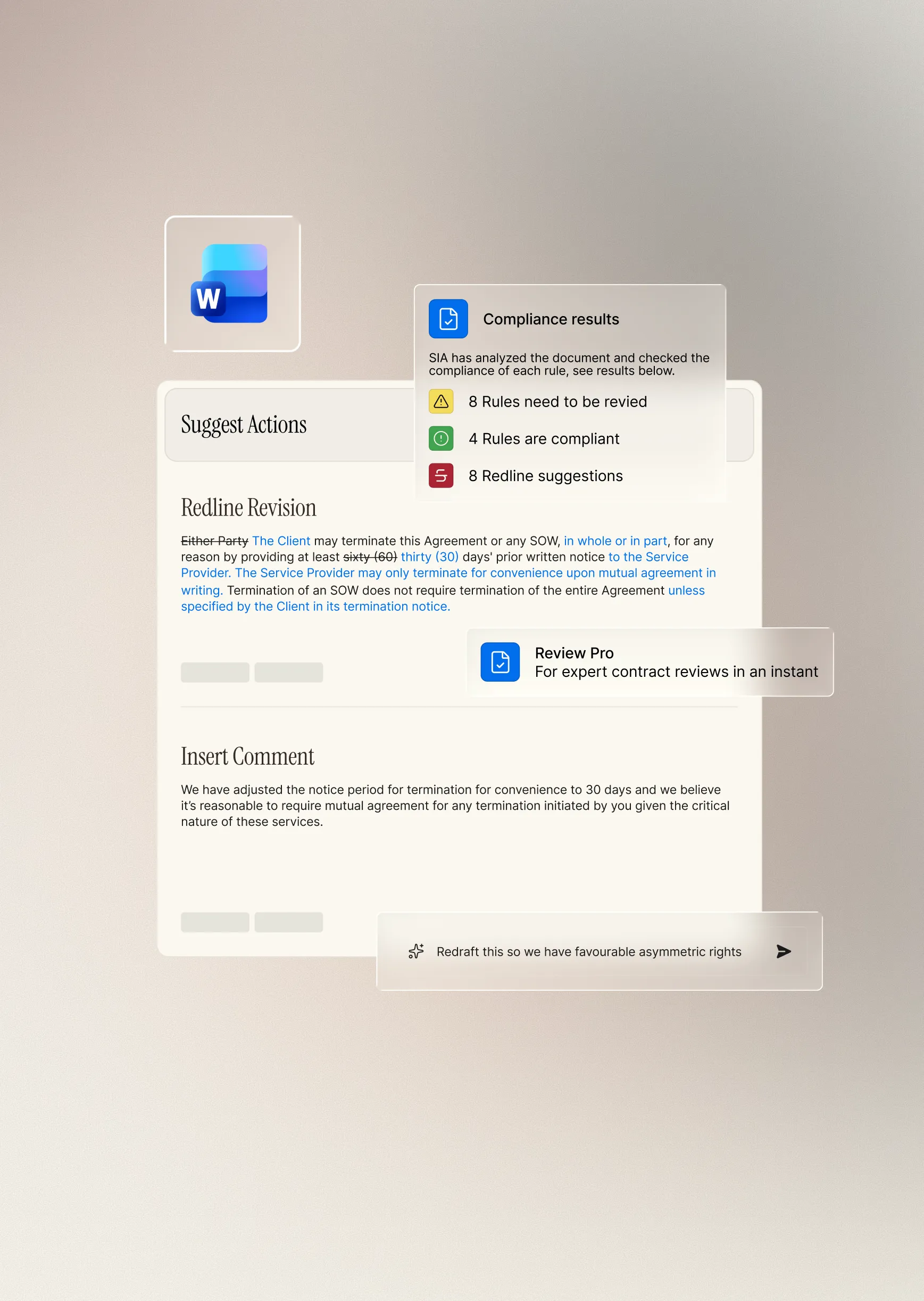
For a salesperson, the relevant job may be creating a standard agreement or checking a renewal. Procurement may need a supplier’s termination terms. Finance may want payment information. Summize’s SIA agents are designed to answer those questions from company knowledge and contract data. The expertise being packaged is the organization’s own, made easier to reach.
That puts Summize in the business software market for in-house legal operations, with users well beyond lawyers. Its customer roster spans food, banking software, manufacturing and sports. The common thread is repeatable contracting work spread across departments, where passing every small request through a specialist creates delay.
The bill includes the work of getting ready
Summize sells a bespoke subscription, with pricing based on users and contracting needs. Its public explanation describes three license levels that distinguish power users from requestors. The commercial logic is straightforward: occasional employees asking for a contract need different access from the people administering the system.
Rollout is part of the proposition. Summize describes implementation in three-to-four-week sprints using its HERO methodology to establish priority use cases and value measures. It says a full rollout typically takes 12 weeks or less. That is a planning expectation from the supplier, not a timetable every customer should assume.
The buyer’s cost calculation should therefore include time spent choosing templates, assigning approval responsibility and preparing records, alongside the quoted subscription. Thought Machine’s preparation makes that work visible. A fast interface cannot settle an internal disagreement about who may approve a supplier’s terms.
There is competition for this budget. Ironclad also offers workflows, AI review, a searchable repository and Microsoft Word access. Summize’s embedded approach is a positioning emphasis, not proof that rivals lack integrations. A meaningful comparison follows one real contract through each system and counts the handoffs, exceptions and administrative steps.
- RequestCan a colleague start in a familiar tool?
- ReviewDo your rules reach the right approver?
- RetrieveCan the next person find the signed answer?
Test a complete journey with your own documents.
America becomes the bigger business
The company has raised progressively larger sums to pursue that market. A £5 million Series A from YFM Equity Partners and Maven Capital Partners in 2022 supported product development and US expansion. Boston followed in 2023; a San Diego office opened in November 2025.
In January 2026, Summize announced $50 million in investment, with Kennet Partners and Federated Hermes Private Equity joining its existing investors. YFM describes the financing as a Series B. Summize earmarked the money for global expansion, people and AI contract intelligence.
The latest annual figures change the scale of the story. For the fiscal year ended June 30, 2026, Summize reported 75% ARR growth, with 70% of its business coming from the US. It also reported 65% headcount growth. Those percentages describe a business expanding quickly; they do not establish profitability.
Internally, its GROW values translate into some concrete rituals: professional development funding, employee groups and quarterly recognition. A particularly specific one offers the chance to win £1,000 or $1,250 for implementing a one-percent business improvement. It is a modest unit of progress for a company selling relief from accumulated administrative work.
The next question comes through Claude
On August 20, 2026, Summize announced a connection to Claude through Model Context Protocol. Users can ask the assistant about structured contract data held in Summize. At launch, that access is read-only and follows the permissions already assigned in Summize.
The boundary is consequential. A question about payment terms should draw on agreements the user is allowed to see. Summize also says it isolates customer AI data and does not use it to train underlying models. Its security materials cite ISO 27001 accreditation and third-party penetration testing. These controls address handling information; they do not make every generated interpretation correct.
September brought Power Counsel, a customer advisory board chaired by Matillion’s general counsel, Kimberly Trull. The announcement includes early access to SIA Analytics ahead of general availability, giving legal leaders a role in testing what comes next.
The opportunity remains grounded in ordinary work. Give people a reliable route to the approved document, the right reviewer and the answer inside a signed agreement. Where records are incomplete or responsibility is unsettled, those problems still need an owner. Summize’s most persuasive customers show that useful automation begins with someone doing that homework.