At GB Railfreight, even organising compliance training had become a problem. Departments ran their own programmes. Spending overlapped. Nobody had a single view to put in front of a regulator. Completion sat around 60%. VinciWorks’ account of the project describes a familiar corporate muddle: plenty of activity, insufficient coordination.
The two companies brought learning into one hub, made material editable by the customer and put courses on iPads for frontline staff. Training could fit around shifts. VinciWorks reports that completion moved through 96% to 100% within two quarters. Its browser editor let the railway’s team revise material without waiting for the supplier to do it.
That is a useful introduction to VinciWorks, a company selling into one of working life’s least loved rituals. Mandatory training must compete with actual work. Its products address both sides of that inconvenience: getting people to learn something and helping their employer manage the resulting records.
Two quarters. One customer programme. A completion measure, not a test of everything employees retained.
Lawyers sharing their homework
VinciWorks’ current history dates its beginnings to 2002 and credits Howard Finger, a lawyer with experience in London, Australia and Hong Kong. The more revealing date is 2004. That year, the company gathered 14 international and UK law firms into the Online Compliance Consortium, or OCC, to share anti-money-laundering knowledge.
The premise was economical: firms could compete for clients without separately reinventing the same compliance material. Shared expertise could spread development costs and help establish common practice. It was an unusually cooperative foundation for a business serving a competitive profession, and it gave VinciWorks access to people who knew where generic instruction fell short.
In a retrospective marking the consortium’s first decade, Finger described growth from 14 to more than 150 client firms and largely double-digit annual revenue growth. He also pointed to a learning management system designed to combine learning administration with compliance. The company was already broadening the job it wanted to do.
“One of the strengths of VinciWorks is facilitating the collaborative process.”
Guy Powell / Hogan Lovells
Customer testimonial
Today its company page reports 2,000 customers and 1.2 million users, alongside six million annual course completions. Those are company figures, but they make the direction clear: the legal consortium became a much wider training operation. Its named customers still include law firms such as Hogan Lovells and DLA Piper.
The course is only part of the purchase
The catalogue reaches beyond lawyers into financial crime, information security, data privacy, workplace safety, inclusion and leadership. An organisation can buy instruction on bribery or money laundering alongside material about difficult conversations and mental health. The buyer is typically an employer’s compliance, HR or learning team; employees are the people who eventually encounter the course.
There is a practical reason to bundle these subjects. Employers face several kinds of workplace risk, while the same administrator may be responsible for assigning training across them. A library covering different departments can reduce the number of supplier relationships that person has to manage. Breadth becomes useful when it simplifies an actual workload.
The Portal provides access to licensed courses, review tools and browser-based editing. Customers can duplicate a course for a department, adapt its content and circulate it for approval. They can then export it in SCORM formats used by compatible learning management systems, or deploy it into VinciWorks’ Astute LMS.
That compatibility matters to an employer with an existing learning system. The purchasing decision can concern content and administration without requiring an immediate replacement of every training tool. Equally, the ability to edit a course has an organisational consequence: somebody inside the customer must take responsibility for those edits and their approval.
VinciWorks supplies tools for both. The employer still owns the decisions.
After the quiz, somebody has to chase the form
Omnitrack, launched in 2019, takes the business into that second job. It collects information, routes approvals, sends reminders and produces reports. Customers can use prepared workflows or configure forms and conditional logic around their own processes. Dashboards and flags help an administrator see which submissions need attention.
The workflow catalogue is revealingly mundane. Gifts and hospitality, annual declarations, complaints, incident reports and client onboarding all appear. These are the recurring records that otherwise drift through email threads and spreadsheets. Teaching employees about a policy and recording what they disclose under it are related tasks, with different software requirements.
Supplier onboarding offers a concrete example. Omnitrack can adjust questions to the supplier’s profile, request documentation and flag higher-risk responses. Different administrators can review the information, while reminders pursue outstanding submissions. A supplier register keeps the collected material together. The value lies in having a repeatable process and a retrievable record.
The limits follow from the design. A workflow can route the wrong question very efficiently. Buyers need to decide what information matters, who reviews an exception and what happens when nobody responds. VinciWorks supplies configurable machinery; an organisation has to supply the authority and attention that make its output useful.
A tutor with an answer for pizza
In June 2025, VinciWorks launched Conversational Learning, an AI training format built around dialogue. Learners respond to scenarios and receive follow-up questions or feedback. The stated aim is to address disengagement and weak retention in conventional modules. Asking someone to explain a choice creates a different interaction from asking them to select an answer.
The company’s account of development says its team used material from more than 800 courses and thousands of scenarios, with compliance experts reviewing the results. Designers worked on questions, decision points and guidance. Testing included unexpected inputs and attempts to pull the conversation off topic, including questions about pizza toppings.
It is a small, rather human detail in an otherwise serious product. A learner can wander; the tutor is supposed to bring the discussion back. The company describes repeated testing and expert review, although those development practices should not be confused with an independently established improvement in long-term knowledge retention.
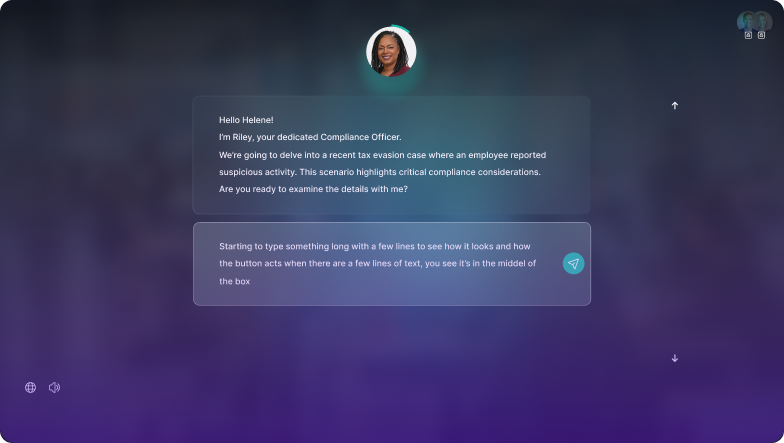
A sensible evaluation would put familiar workplace misunderstandings into the trial: an ambiguous gift, an incomplete client explanation, a request to bypass a policy. Does the dialogue expose the misunderstanding? Can the training owner review what happened? These are practical buying questions suggested by the format, rather than promises that every deployment will produce the same result.
The price of keeping the material useful
VinciWorks earns subscription revenue from e-learning and compliance software, with bespoke course creation and advisory services extending the offer. The continuing work includes updating content and supporting customer use. A compliance library is perishable inventory: changes in legislation, policy or workplace practice can make yesterday’s adequate course require another edit.
Public Omnitrack documents offer a glimpse of pricing, with important differences in scope. One licence brochure lists annual tiers of £4,000, £9,750 and £25,000, excluding VAT. It specifies an initial three-year term and says prices are valid for 90 days. Those figures describe the document, rather than a current quotation for a particular buyer.
The UK government’s Digital Marketplace listing gives a much broader £5,000-to-£100,000 range per instance. Hosting can also change the arrangement: VinciWorks offers cloud and on-premises options. Customers choosing their own servers take on operational responsibilities such as monitoring and backups. The useful budget conversation starts with users, workflows, integrations and support requirements.
The business itself attracted an acquisition price measured in tens of millions. Marlowe’s October 2021 announcement set out £39 million upfront and roughly £15 million contingent consideration. Later annual accounts reported £57.5 million total consideration, including £42.1 million cash and £15.4 million contingent payments. These are acquisition disclosures with different accounting presentations, not a venture funding round.
In 2024, Inflexion backed the carve-out of Marlowe’s GRC business into Axiom GRC, the group that now includes VinciWorks. Its wider offering reflects acquisitions spanning DeltaNet, Cylix, EssentialSkillz, Skill Boosters and Compliance Office. Together they brought additional learning content and legal-sector advisory capabilities into the operation.
The evidence worth keeping
VinciWorks competes in a market where a course library and an LMS are available elsewhere. Skillcast, for example, offers compliance libraries, learning management and customisable content. VinciWorks’ case rests on the combination of its legal-sector experience, customer editing tools, workflow products and newer conversational format. Each part deserves examination against the buyer’s existing systems.

The railway project supplies evidence beyond a product tour. The award organiser confirmed gold for compliance and risk management, and judges specifically praised the reduction in phishing success rates and the credibility added by external auditing. That distinction matters: finishing a module and behaving more securely are separate outcomes worth measuring separately.
The transferable lesson is to organise the work around the people doing it. Give training a clear home, make the material relevant, provide access during the working day and establish who follows up. Where staff lack time, managers ignore exceptions or content goes unreviewed, software features alone offer little reason to expect the same result.
VinciWorks’ September 2026 Astute release supplies a fitting final detail. Alongside a Visual Dashboard entering customer beta, the update lets administrators rename report packs and choose how many rows appear. Customer suggestions helped drive those changes. Even in a business selling AI conversations, somebody still needs to find the right report.