The first version of Litmos did not emerge from a grand theory of education. It emerged from an Auckland contact center with roughly 200 employees and a repetitive headache: the company needed to create online training every day, while the available systems felt complicated, costly and designed for much larger enterprises. In 2007, Rich Chetwynd began building the lighter answer. Developer Dan Allen and marketer Nicole Fougere joined on sweat equity. The team bootstrapped for four years, went without salaries in year one and recycled subscriptions into growth.
That frugality mattered because it forced the product to make itself useful quickly. Litmos had to let an administrator build a course, send it across the internet and see who finished. It could not ask a small customer to assemble a consulting army first. Chetwynd later distilled the purpose to four words: “To make people smarter.” The delivery mechanism was deliberately less philosophical - simple software, charged by subscription, that did the administrative chores around learning.
“Learning technology should work for the people using it - not the other way around.”Litmos, on the belief behind the product
The quiet machinery of a course
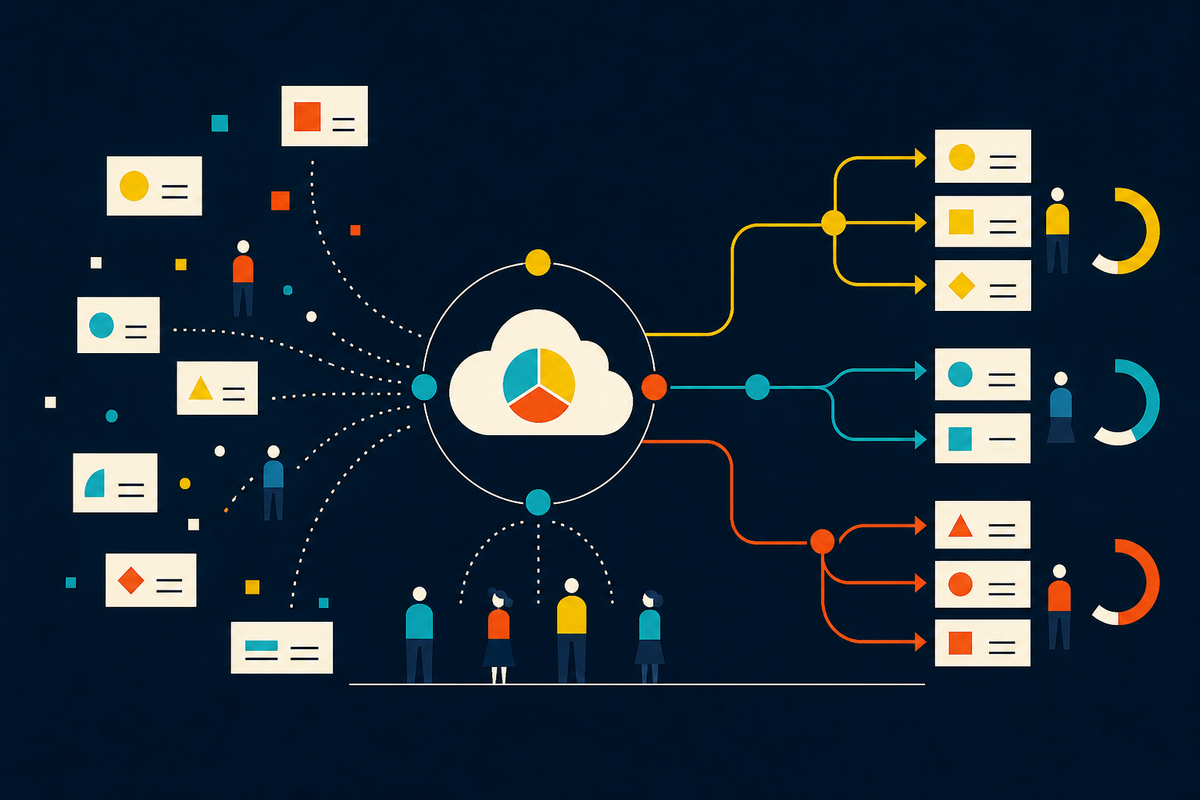
Today Litmos is a cloud learning platform used by companies to train employees, customers, partners, volunteers, members and frontline workers. Its core learning management system assigns courses, manages groups, builds learning paths, tracks certifications, records assessment results and gives managers reports. A mobile app and offline access take lessons away from desks. Multilingual support and a multi-tenant architecture help one organization run distinct programs for different regions, brands or audiences.
Around that core sits the work that determines whether an LMS becomes infrastructure or shelfware. Litmos includes responsive authoring tools, standards such as SCORM, a library of ready-made courses, gamification, video assessments, virtual instructor-led sessions and more than 100 packaged connectors. Its APIs and integrations connect learning records to systems such as Salesforce, Microsoft Teams, Shopify, HR software and identity tools. Built-in eCommerce lets an organization sell its expertise instead of treating every course as a cost center.
The customer is usually not the learner buying a class for personal enrichment. It is the learning, HR, compliance, customer-success, channel or operations team trying to move knowledge through an organization. The immediate problems are mundane but expensive: onboarding takes too long; certification dates vanish in spreadsheets; partners tell an outdated product story; customers ask support questions already answered in a manual; managers cannot tell whether training changed performance.
Training beyond the employee directory
Litmos becomes more interesting at the edge of the org chart. TTEC uses the platform in customer-service operations and has described deploying an LMS for a client over a weekend. NAVBLUE, an Airbus subsidiary now known as Skywise, created more than 250 customer accounts and hundreds of courses, reducing basic product questions reaching support. The Trevor Project connected Litmos with Salesforce to monitor training for volunteer crisis counselors working around the clock. OneOC used it to extend nonprofit education to thousands of learners across hundreds of organizations.
External training can also create revenue. Hewlett Packard Enterprise says more than $50 million in annual training registrations flow through its Litmos program. USA Volleyball reports serving 300,000 members while course revenue helps bring training cost to roughly 18 cents per user per year. Those examples are customer-reported and unusually scaled, not promises for the average buyer. They still reveal why an LMS can belong to customer success, channel sales or a membership organization as readily as it belongs to HR.
AI joins the administrative shift
Litmos now places AI inside content production, discovery and administration. An author can turn a topic into a course outline, draft modules and generate knowledge checks, then review the result before publishing. Recommendations use a learner's role, history and goals to surface relevant material. Video assessments evaluate recorded pitches or presentations. Enrollment triggers, reminders and compliance workflows reduce the recurring chase work that consumes a learning team's calendar.
The distinction Litmos tries to draw is practical rather than theatrical: AI is embedded across ordinary tasks, not sold as a separate destination. Its AI Assistant is designed to answer from the learning material an organization makes available inside its own tenant. Litmos says customer training data is not used to train third-party models. For buyers handling proprietary product knowledge or regulated material, those boundaries are part of the product, not a footnote.
The useful question is not whether AI can write a quiz. It is whether the company can move from a new requirement to competent behavior before the requirement changes again.
Three owners, one durable constraint
The company story contains an unusual amount of corporate travel. CallidusCloud acquired the bootstrapped startup in 2011. SAP bought CallidusCloud in 2018 for about $2.4 billion, and the product became SAP Litmos. Francisco Partners purchased Litmos from SAP in 2022 and made it a standalone company again. The deal values for Litmos itself were not disclosed.
Ownership changed the route to market, available resources and brand around the product. The original constraint survived: complexity suppresses adoption. Litmos now expresses that idea as speed to launch, clean administration and one platform for every audience. The company says its platform is trusted by more than 11,000 organizations across 150 countries. Elsewhere on its current site, it uses a lower count for organizations on newer AI capabilities, so the figures describe different scopes rather than a neat, single customer census.
Where Litmos sits in a crowded market
Corporate learning software has no shortage of alternatives. Cornerstone and SAP SuccessFactors sell broad talent suites. Docebo emphasizes an AI-forward enterprise learning platform. Absorb and LearnUpon compete on polished administration and external learning. TalentLMS courts smaller teams, while 360Learning leans into collaborative course creation. Moodle Workplace offers an open-source-rooted route for organizations that value customization.
Learning bundled with a larger talent and workforce system.
Faster self-service tools aimed at smaller or simpler programs.
Enterprise reach, packaged content and external audiences, with simplicity as the wedge.
Products optimized for collaboration, academies, skills or open customization.
Litmos sits between lightweight self-service products and sprawling human-capital systems. It offers enterprise controls, content and services, but its argument begins with operational speed. Implementation, consulting, managed administration and technical account management are available for buyers who need help. The commercial model remains B2B SaaS: subscription plans, generally quote-based, expand with capability, content, services and learner scale. A 14-day trial gives smaller evaluations a door in.
That positioning carries a tradeoff. A platform broad enough for onboarding, compliance, customer education, partner certification and commerce must keep many kinds of administrators happy. Competitors can go deeper in talent management, collaborative authoring or a single vertical. Litmos must keep proving that breadth does not recreate the complexity it was founded to remove.
The business lesson hiding in plain sight
The founders did not begin as eLearning insiders. Chetwynd later called that inexperience an early mistake: it took years to learn the market, and the first pricing was too low. Yet an outsider's impatience with accepted complexity also helped define the product. The team sold annual subscriptions at a discount to improve cash flow, used consulting briefly to support the business, then dropped the distraction and concentrated on recurring software revenue.
There is a portable lesson here. Litmos entered through a narrow complaint - training tools took too much effort - then expanded along the paths its customers already traveled. A course needed content. Content needed authoring. Delivery needed mobile access and integrations. Completion needed reports. Customers and partners needed separate portals. Some organizations wanted to charge. AI now attacks the next layer of friction. Each expansion makes sense only if the system still feels simpler than the pile of tools it replaces.
That is where Litmos fits in the market and what customers can do with it: turn scattered knowledge into a repeatable program, bring that program to people inside and outside the company, and connect learning activity to the systems where work is measured. The software does not make a weak course wise or guarantee that a completed module changes behavior. It can make the surrounding operation less chaotic. For an LMS born in a busy contact center, that remains a sensible job description.