The most revealing Tovuti LMS customer story begins with something disappearing. At Partners In Health, courses built for country teams lived on separate Moodle sites and expired after 90 days. A program in Malawi could not easily travel to Sierra Leone. External engineers were needed to build new material, facilitators emailed feedback by hand, and useful work kept getting rebuilt. The problem was not a shortage of lessons. It was that the lessons behaved like rented furniture.
Tovuti's answer was one branded, cloud-based place where administrators could create, deliver and measure training themselves. Partners In Health put more than 30 administrators on the system, supported English, Spanish and French, and began sharing material across a network of 18,000 employees in 11 countries. A clinical course on the use of oxygen was reused six times. That modest number explains the product better than a long feature grid: make it once, adapt it, and keep it.
“The courses we create don't just disappear. They're easily replicable if another cohort of students wants to go through it the next year.”Liberty Wickman, Partners In Health
Forty-plus ways to keep a learner from walking away
Tovuti is a business-to-business learning management system founded in 2017 and based in Eagle, Idaho. Organizations use it for employee onboarding, compliance, career development, sales enablement, customer education and partner training. Administrators can build courses and assessments, arrange learning paths, automate assignments and certificate renewals, run live virtual sessions, monitor progress, segment access by role and sell courses or memberships. Learners get branded portals, mobile access, badges, leaderboards, social features and interactive material.
The bundle matters because workplace learning is rarely one job. A compliance manager needs an audit trail. A product team wants customers to learn without filing support tickets. A manufacturer needs dealers to hear the same sales story. An association may sell certification and events. Tovuti puts these audiences in the same system while keeping their portals, permissions and content distinct.
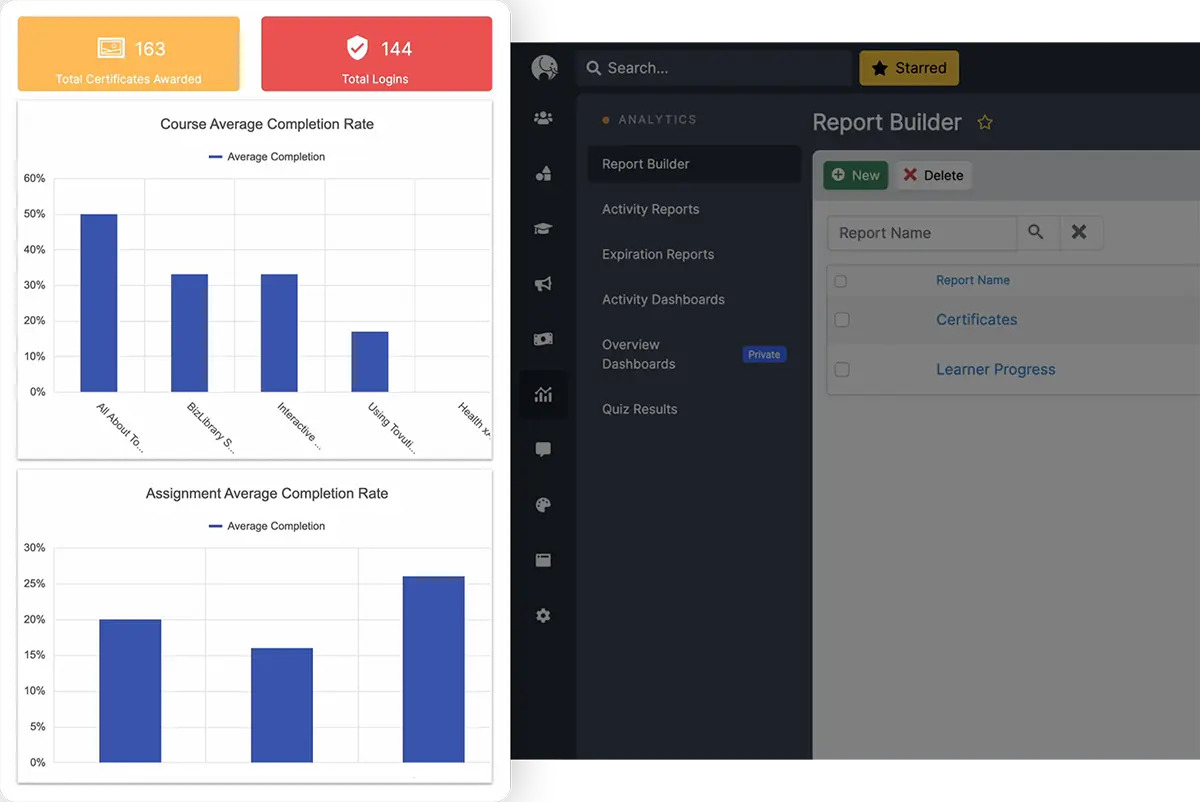
The differentiator is accumulation, not a single trick. There are more than 40 interactive formats, including branching scenarios, hotspots, memory games and questions embedded inside video. Course libraries can bring in pre-built material. Integrations connect identity, HR and business systems. White-label controls turn one platform into multiple audience experiences. Customers can import SCORM packages, but native editing avoids exporting and re-importing a file for every change.
The old LMS became an engineering project
TomTom's map-partnership team had been using an open-source LMS. The software was not the immediate villain; the continuing back-end engineering work was. TomTom moved to Tovuti for a friendlier interface and a better cost-to-value calculation, folded webinars into the same platform and created three separately branded sites for partner, enterprise-customer and employee training. Its community and partner audience grew tenfold in a year.
Hexure hit a different wall. Its existing LMS could support external client certification or internal employee development, but not both at once, and its content structure was already hard to navigate. The company wrote down its deal breakers, must-haves and nice-to-haves. Tovuti checked the most boxes. With old-platform license fees looming, Hexure used SCORM to migrate and began training clients about six weeks after purchase. It later passed 100 courses and quadrupled the reach of its client program.
What changed minds was operational pain with a deadline attached: expiring courses, duplicate production, a growing audience the old tool could not serve, or another licensing bill. This is an important condition. A small team with ten static videos and no reporting requirement may be happier with a lighter product. Tovuti earns its keep when audiences, permissions, certifications and content versions multiply.
Stop hiring an accidental LMS administrator
Software consolidates tools, but it does not eliminate operations. Someone still configures roles, migrates data, loads content, investigates reports and remembers the renewal logic. Tovuti has made that hidden job explicit through Managed LMS, an LMS-as-a-Service offer in which its team handles administration, configuration and ongoing optimization. Professional-services hours can cover one-off or recurring work without a project minimum; launch-readiness reviews inspect courses, portal design, permissions and automations before rollout.
This changes Tovuti's competitive frame. Against LearnUpon, Docebo, Absorb, TalentLMS, 360Learning, Litmos, Cornerstone and open-source alternatives such as Moodle, the pitch is no longer merely “our screen has more controls.” It is “you may not need to staff all those controls.” Buyers should still price the full arrangement, define who owns data and workflows, and avoid outsourcing the learning strategy itself. But for a lean L&D team, handing off the mechanical work can be the product.
The copyable sequence
WayPoints can leave the building
Tovuti first put generative course production inside its LMS through an assistant called Dizi. Its newer WayPoints product is more interesting because it can stand alone. A subject-matter expert supplies a document, slide deck or prompt; a seven-step workflow maps outcomes, drafts lessons and quizzes, creates interactive tours and can add narration or translation in 20 languages. The finished course can publish directly to Tovuti or export as SCORM 2004 or standalone HTML to another LMS.
That is a sensible bit of self-disruption. The company can now sell to organizations that like their current learning system but hate producing content for it. Accessibility is designed around Section 508 and WCAG 2.1 AA, while enterprise and federal configurations add identity controls, audit logs, custom data retention and customer-controlled AI endpoints. Editors remain responsible for accuracy, tone and instructional judgment. “Generated in minutes” describes production speed, not whether the lesson deserves anyone's attention.
The company has raised a reported $14 million: an $8 million Series A led by Blueprint Equity and ScOp Venture Capital in 2021, followed by a reported $6 million round in 2023. Robbins Research Institute later announced a strategic investment and content partnership. In May 2025, SaaS executive Matt Baker became CEO while McClain moved to Executive Chair. The stated expansion lanes were generative AI, federal buyers and healthcare compliance.
A regulated-market shortcut with real limits
Federal sales require more than a clever course builder. In spring 2025, Tovuti selected Knox Systems, whose managed cloud platform supplied a FedRAMP-ready boundary. Forty-five days later, the companies announced Tovuti's authorization. The route compressed a process they said can otherwise take years and cost millions. Tovuti now markets a controlled environment for federal civilian agencies, defense workloads at Impact Level 2, contractors and national laboratories.
The copyable lesson is partnership design: rent proven compliance infrastructure when building the entire boundary yourself is not the strategic advantage. The caveat is equally practical. Authorization is not an agency contract, and a prepared cloud boundary does not remove procurement, implementation or security review. This approach fits vendors whose application can live inside the partner's controls and whose federal demand is strong enough to justify the operating discipline.
Multiple audiences, recurring certifications, regulated records, many content owners, branded portals or a training team short on system administrators.
A tiny, static catalog; a school seeking a student-information ecosystem; deep in-house engineering preferences; or a budget that only works at commodity LMS pricing.
Change the teaching before blaming the learner
Tovuti's origin gives the feature list a human test. McClain says the first version was built for his sister Dora Lynn, a Special Olympian who is profoundly deaf and developmentally delayed. Interactive, gamified lessons tailored to her learning helped her pass a driving test. The conclusion became a company belief: when a learner struggles, examine the way the material is taught.
That does not make every badge meaningful or every generated course good. It does explain why Tovuti keeps combining formats, portals and services instead of reducing learning to a video player with completion ticks. The strongest version of its idea is not “everything in one LMS.” It is a system in which a country team can reuse a lifesaving course, a software company can train clients and employees without two platforms, and an administrator can see what changed without asking an engineer.
There is the company in one line: Tovuti sells a place for learning work to remain useful after the first cohort. The software stores it. The automation moves it. The service team maintains it. The AI drafts more of it. Customers still have to decide what is worth teaching.