A corporate training course has an unusually easy way to declare victory: somebody reaches the end. The employee gets a tick. The manager gets a dashboard. Whether anyone can do the job better is a more awkward question. Sponge, a British learning company whose clients include Tesco, Snap and Kraft Heinz, has built its pitch around closing that gap.
Its work ranges from compliance microlearning to customer tutorials and corporate academies. The common assignment is to translate a business problem into something people can practise, understand and use. That can mean a polished film. It can also mean fixing who receives which lesson, and when. The unglamorous plumbing matters as much as the pixels.
Consider Tesco. The retailer needed to coordinate more than 60 microlearning modules across over 9,500 learners and 36 cohorts. Separate campaigns and manual administration made delivery cumbersome. Sponge helped bring that activity into one continuing programme, using its Spark learning management system to allocate content and make progress visible.
The published Little Learning Leaps case reports completion above 90% across the content. The interesting part is the mechanism: lessons targeted to people’s needs, accompanied by notifications and usable reporting. The buyer was asking for less disruption and less administrative effort. A prettier course alone would have left much of that problem intact.

The agency hiding inside the training supplier
Sponge occupies a busy intersection between a learning consultancy, a creative agency and a technology supplier. Its in-house consultancy, The Practice, works on strategy and experience design; its Creative Studio produces the material. Digital courses sit alongside facilitated sessions, communication campaigns and programmes that mix independent study with human contact.
That combination is the commercial argument. A client can work with the same organisation on the initial business question and the resulting experience. Sponge says its typical customers employ at least 20,000 people. At that scale, a learning brief may have to survive different languages, departments, systems and internal expectations before a single employee opens it.
The alternatives depend on the assignment. An internal learning team can build its own material. A content library can cover common topics. An agency can make a film, while a consultancy can diagnose organisational problems. Sponge’s proposition becomes more relevant when those jobs need to connect, especially when the experience must feel recognisably like the client’s brand.
That is a positioning argument, rather than a claim that every company needs bespoke learning. A narrow, standard requirement may justify a simpler purchase. Custom work earns its place when the subject, audience or intended behaviour demands choices that a generic course cannot comfortably accommodate.
A fine-art founder, then a buying spree
Louise Pasterfield started Sponge in Plymouth in 2004 with a staff of two. Her background included fine art, an unusual route into the machinery of corporate training. By 2016, when she won a national Venus Award for online business, Sponge reported 64 employees and annual turnover above £3 million.
The early workforce mixed learning designers with illustrators, graphic designers and developers. That combination helps explain the company’s continuing emphasis on how learning looks and feels. There was a production business here as well as an educational one, built outside the London orbit that Pasterfield described as dominating the custom-learning market.
Private equity changed the structure. Aliter Capital began assembling the wider group in 2019, first buying Bolt Learning and then investing in Sponge. Skill Pill followed in 2020, bringing subscription-based microlearning content. Idox Compliance joined in 2021, adding specialist compliance expertise and ready-made modules.
The logic was breadth: consulting and custom production alongside technology and reusable content. Adam Poulter’s appointment as chief executive in June 2021 came with a remit to integrate the four investments. For customers, that created more ways to buy; for the owner, it combined project work with offerings that could generate recurring business.
Snap’s classroom has a dark mode
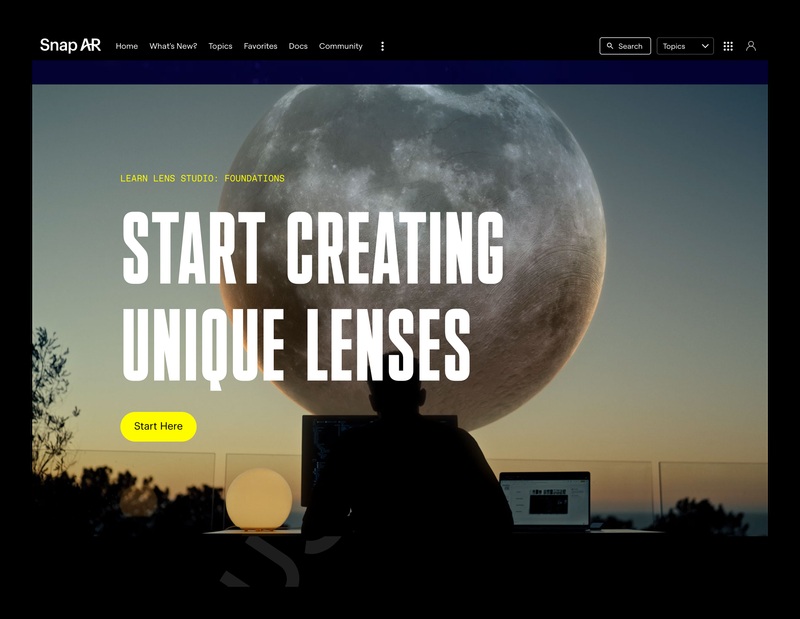
At Snap, the learner could be someone trying to make an augmented-reality Lens for the first time. Sponge helped design a public learning hub for a creator community then described as more than 350,000 strong. That figure describes the community, rather than a count of people who completed the courses.
The work included the interface, learning paths and foundational Lens Studio tutorials. Lessons moved from explanation to guided practice and fuller walkthroughs. Short screen recordings showed how to perform particular tasks. The site also connected people to community resources, giving learners somewhere to go when the lesson ended.
One pleasing detail: developers requested dark mode, and Sponge included it. That is a small design decision with a useful lesson for training buyers. Audience research becomes more convincing when it changes the product. Sponge’s case study reports that 96% of participants recommended the courses and 79% felt confident applying the learning. Those are participant responses, not measures of subsequent commercial success.
Customer education is now an explicit Sponge service, sold through project or retained engagements. Its Atlassian relationship dates to 2020 and covers learning for products used in everyday work. The commercial purpose differs from mandatory employee training: help customers understand the product well enough to use it, keep using it and recommend it.
Fifteen specialists, six months, one supply chain
Kraft Heinz presented a different problem. Its procurement organisation had more than 400 professionals sourcing from 25,000 tier-one suppliers, while the central procurement sustainability team numbered five. After earlier work on sustainability fundamentals, the 2023 priority became developing a smaller group of people who could advocate for sustainable procurement across regions.
Sponge helped create a six-month programme designed for an initial cohort of 15 Sustainability Masters. It combined digital learning, peer groups, an in-person experience week and applied projects. More than 100 employees expressed interest, and 56 submitted applications endorsed by their managers.
The shift was from broad awareness toward a concentrated investment in internal expertise. It gives a reader something concrete to copy: define what a specialist must be able to do, then connect lessons to opportunities to practise. The programme’s value depends on whether participants can carry that expertise back into actual supplier conversations and purchasing decisions.
- 01 Digital foundations
- 02 Peer learning
- 03 Experience week
- 04 Applied projects
Programme design described in Sponge’s Kraft Heinz case study.
The dog is virtual. The delivery round is real.
Royal Mail’s dog-safety project makes the case for choosing a medium around the task. Sponge filmed realistic situations with a 360-degree camera, placing learners in the role of an experienced postal worker accompanying a new colleague. They had to spot hazards and decide how to respond.
The experience worked through a VR headset or as interactive video on a computer. That second option matters: a training programme distributed across locations cannot depend entirely on everyone having specialist equipment. Piloted in 2018, the experience subsequently rolled out across the UK.
James Barton, Royal Mail’s online learning manager, credited the approach to filming with delivering “a quicker result, a cheaper result”. It is a useful cost lesson about production choices, rather than a price list. The company’s conventional guidance remained part of the experience; the simulation gave people a setting in which to apply it.
“a quicker result, a cheaper result”James Barton, Royal Mail
On the approach to filming 360-degree scenarios
The same respect for practical experience appears in Sponge’s work with the International Powered Access Federation. Its operator course combines theory, delivered digitally or in a classroom, with practical training at an approved centre. In August 2025, the partners announced two Gold awards and one Silver from Brandon Hall. Digital delivery sits inside a broader training process.
The bill includes more than production
Sponge’s business model reflects those different assignments. Bespoke projects and retained relationships fund consulting and production; the wider group also has learning technology and subscription content. A buyer approaching through an enquiry or proposal request is buying a scoped piece of work, with requirements that shape the engagement.
The useful budgeting question is therefore what the organisation must contribute as well as purchase. Subject experts need to check the material. Managers need to make room for participation. Somebody has to keep content relevant after launch. This is an inference from the work involved, but an essential one: even carefully designed learning needs an operating home.

Sponge’s own careers material emphasises initiative, accountability and supporting colleagues, with advertised hybrid, remote and flexible working. Those are employer commitments, rather than an independent verdict on office life. They do, however, fit a business whose output depends on consultants, designers and production specialists making decisions together.
A bigger test than the completion tick
In March 2026, Sponge announced its fifth consecutive year as a Core Leader on Fosway’s Digital Learning 9-Grid. Its current public agenda also includes AI adoption and a workforce worn down by constant change. The market context supports that direction: Fosway’s July 2026 research describes AI as the leading corporate learning priority.
The question is how much of that demand becomes useful work. The cases suggest a disciplined brief: identify the decision someone must make, the conditions in which they will make it and the evidence that would indicate improvement. Then choose the format. Copying a six-month academy without giving learners time, or deploying a simulation without opportunities to apply its guidance, would miss much of the design.
Sponge’s most persuasive work gives corporate learning a specific job. A creator needs to build a Lens. A procurement specialist needs to influence sourcing. A postal worker needs to recognise danger. Each is a better starting point than a request for another course. And each makes the final completion tick the beginning of a more interesting conversation.