A new manager has a peculiar problem. The job begins immediately; knowing how to do it may take rather longer. At Elliott Group, a maker of industrial turbomachinery, management training meant a four-day classroom program offered only a few times a year. The course could be useful and the arrangement inconvenient at the same time. Responsibility obeyed one calendar. Instruction obeyed another.
- ExpertusONE combines course administration, learner experience and skills management.
- Its customers train employees, partners and customers across complex organizations.
- The practical lesson: measure how soon people can begin learning, then check what they can do.
The course was useful. The wait was expensive.
Elliott changed the arrangement with ExpertusONE. Twelve online modules preceded a two-day workshop devoted to practice. Its published case study reports that the average interval between a manager’s hire date and program start fell from 3.5 months to one week. That measures access to training, rather than the time required to master management. A small distinction, with a large bearing on what the number means.
There is an appealing idea here: a training problem can live outside the training itself. Before rewriting every slide, inspect the queue. A company may have perfectly sensible lessons that arrive after the learner has already improvised an answer.
The consultants decide to build
ExpertusONE’s founders had spent years close to that sort of friction. Ramesh Ramani and Mohana Radhakrishnan began with corporate learning consulting. In a later interview, Ramani recalled working with companies including Cisco and Mueller. Around 2010, he said, learner expectations were changing in ways the legacy platforms they used could no longer accommodate.
People wanted easier access. Managers wanted flexibility. Customers wanted more support. The founders recruited a technical team and developed their own LMS. It is an origin story with remarkably little romance: experienced consultants encountering enough recurring inconvenience to decide that another recommendation would be insufficient.


That background helps explain the company’s market position. ExpertusONE sells into organizations where training involves more than uploading a course: regional rules, different audiences, historical records and systems that need to exchange data. The company identifies migration from Saba, SumTotal and Cornerstone among its capabilities. Its appeal rests on managing those complications without handing learners all the complications.
“Build a platform that feels intuitive, even at a massive scale.”Ramesh Ramani / ExpertusONE leadership page
Three jobs under one roof
The product combines three functions that buyers often encounter separately. The learning management system handles the administration of training. The learning experience layer organizes discovery and personalized content. Skills management connects learning to the capabilities an organization wants to develop. Think of them as the registrar, the guide and the examiner sharing an office.
In October 2024, ExpertusONE announced an integrated skills platform with a library of more than 25,000 skills. It maps skills to jobs and courses, creates learner cohorts and supports assessments. The attractive promise is specificity: a person needs a particular capability, rather than another undifferentiated helping of professional development.
The scale of a skills catalog is only the beginning. A buyer should ask whether its own roles are represented accurately, whether course tags are useful and whether assessors can verify the result. An algorithm can make a recommendation quickly. Deciding whether someone can perform the work remains an organizational responsibility.
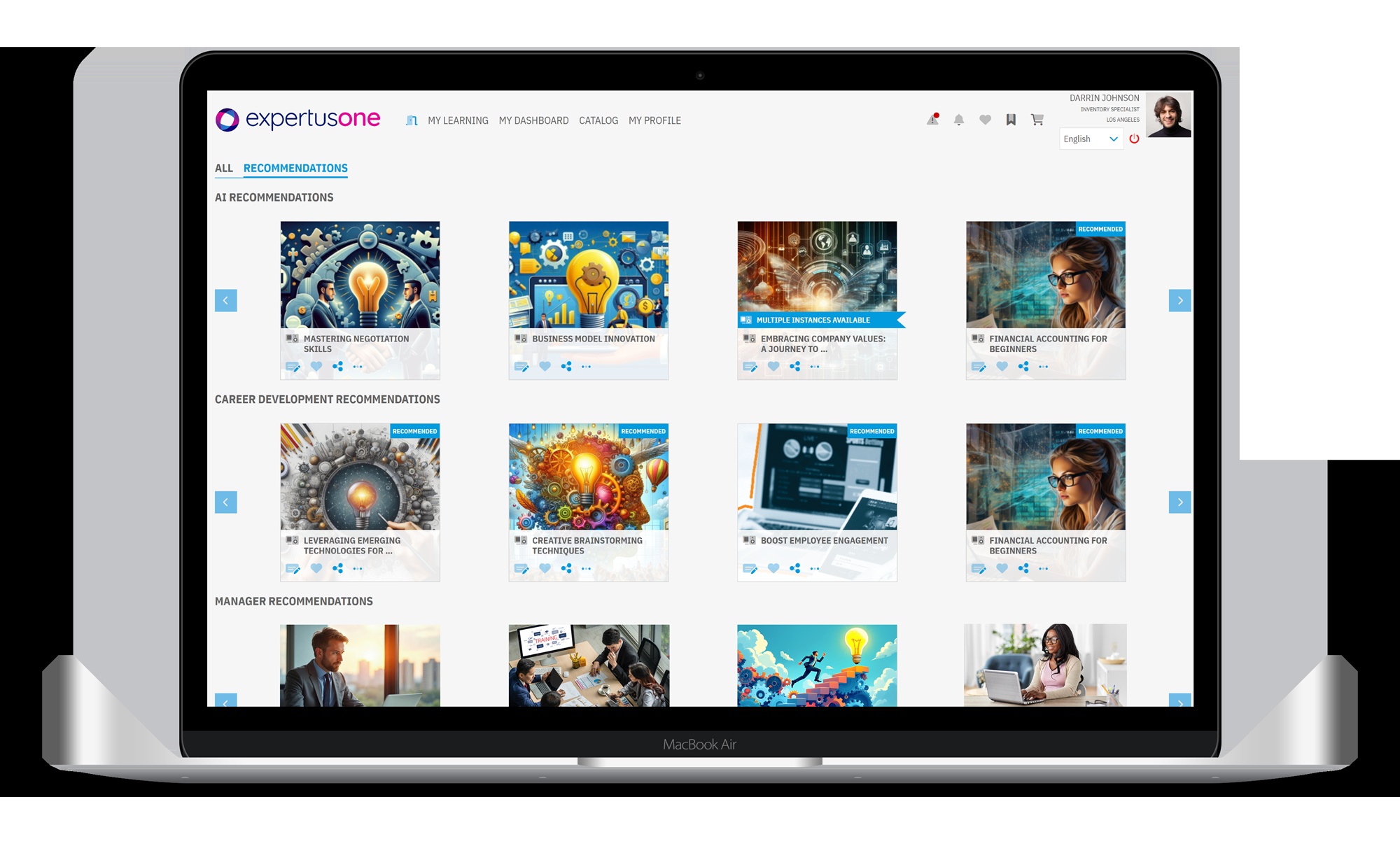
Other features address the everyday journey to that recommendation. Integrations connect learning with Salesforce, Slack and Microsoft Teams. Interaction Studio adds quizzes, images and links to existing presentations and videos. Its author can insert a checkpoint into material that would otherwise invite the learner to press play and mentally depart.
Employees are only part of the audience. Partners need product knowledge; customers need help using what they have bought. ExpertusONE’s commerce tools let organizations sell training through branded portals, accept different payment methods and sell seats in bulk before every learner has been named. Customer education can be a service, a revenue stream or both.
The invoice has more than one line
The business model is enterprise subscription software, accompanied by services for getting it working and keeping it useful. ExpertusONE describes configuration, migration and integration as parts of onboarding, alongside support, administrator education and outsourced administration. Buyers should distinguish the license from the labor surrounding it. Records must move, permissions must make sense and somebody must own the catalog after launch.
One company-published case summary offers a concrete economic claim. An unnamed event-management app provider reports saving $60,000 annually on onboarding because it no longer needed specialists to deliver that training. The figure describes that customer’s reported savings. It does not establish a subscription price or promise the same return to another buyer.
Alternatives include enterprise learning suppliers such as Cornerstone, SAP SuccessFactors Learning and Docebo. Feature lists alone make an unsatisfying contest. A useful demonstration would follow one learner and one administrator through a real assignment, completion, assessment and report. Add an external partner with different access rights. The awkward moments are the informative ones.
Copy the sequence, then choose the software
ExpertusONE announced a ground-up platform overhaul in May 2024, followed by the skills launch that October. Its subsequent announcements report recognition for skills intelligence and placement as a Potential Leader in Fosway’s 2026 learning systems analysis. Such signals help locate the company in the enterprise market; a buyer’s own workflow still supplies the decisive test.
The lesson readers can borrow is wonderfully ordinary. Find the delay. Give people useful material when their responsibilities begin. Reserve practice for the tasks that need practice. Check capability as well as completion. A business with a small audience and a few straightforward courses may need less machinery; complex audiences and integrations make the fuller architecture more persuasive.
Software can shorten the trip to a lesson. Making the lesson worth the trip is still somebody’s job.