The first thing to understand about BizLibrary is that the library is almost a decoy. Yes, the Chesterfield, Missouri company offers more than 13,000 training titles, from annual harassment modules to coaching a first-time manager. But a giant shelf of videos is not the job its customers are trying to finish. A lean HR department has to get a new hire into the system, assign the right material, nudge the procrastinators, document completion, survive an audit, and then show a skeptical executive that something changed.
BizLibrary has spent nearly 30 years absorbing those chores. The result is part catalog, part learning management system, part integration layer, and part outsourced L&D colleague. It is not a clean, single-purpose software story. That messiness is exactly the point.
A VHS-era company learns to stream
Founder and CEO Dean Pichee started Business Training Library in 1996, when distributing workplace instruction often meant shipping physical media. The name made literal sense. As delivery moved online, the company built software around the catalog. When YouTube trained everyone to expect shorter video, workplace courses got shorter too. BizLibrary became an aggregator and a producer, mixing its own studio output with material from topic specialists.
That history matters because the company has repeatedly followed the bottleneck. First, employers needed access to material. Then they needed a place to deliver it. Then they needed discovery, reminders, reporting, skills maps, and links to the rest of the HR stack. In 2015, BizLibrary acquired AKLearning and kept its BoosterLearn reinforcement product. The deal addressed an awkward fact the industry still wrestles with: clicking “complete” does not mean anybody remembers the lesson.
“Client experience + client outcomes = client success.”Jason Wirick, BizLibrary client success leader
In December 2018, Primus Capital made an undisclosed growth investment. Management stayed involved, and the stated plan was to widen both product and reach. At that point the catalog held more than 7,000 titles. It has since grown past 13,000, while the software around it has expanded more aggressively than the name “library” suggests.
The product is the whole annoying workflow
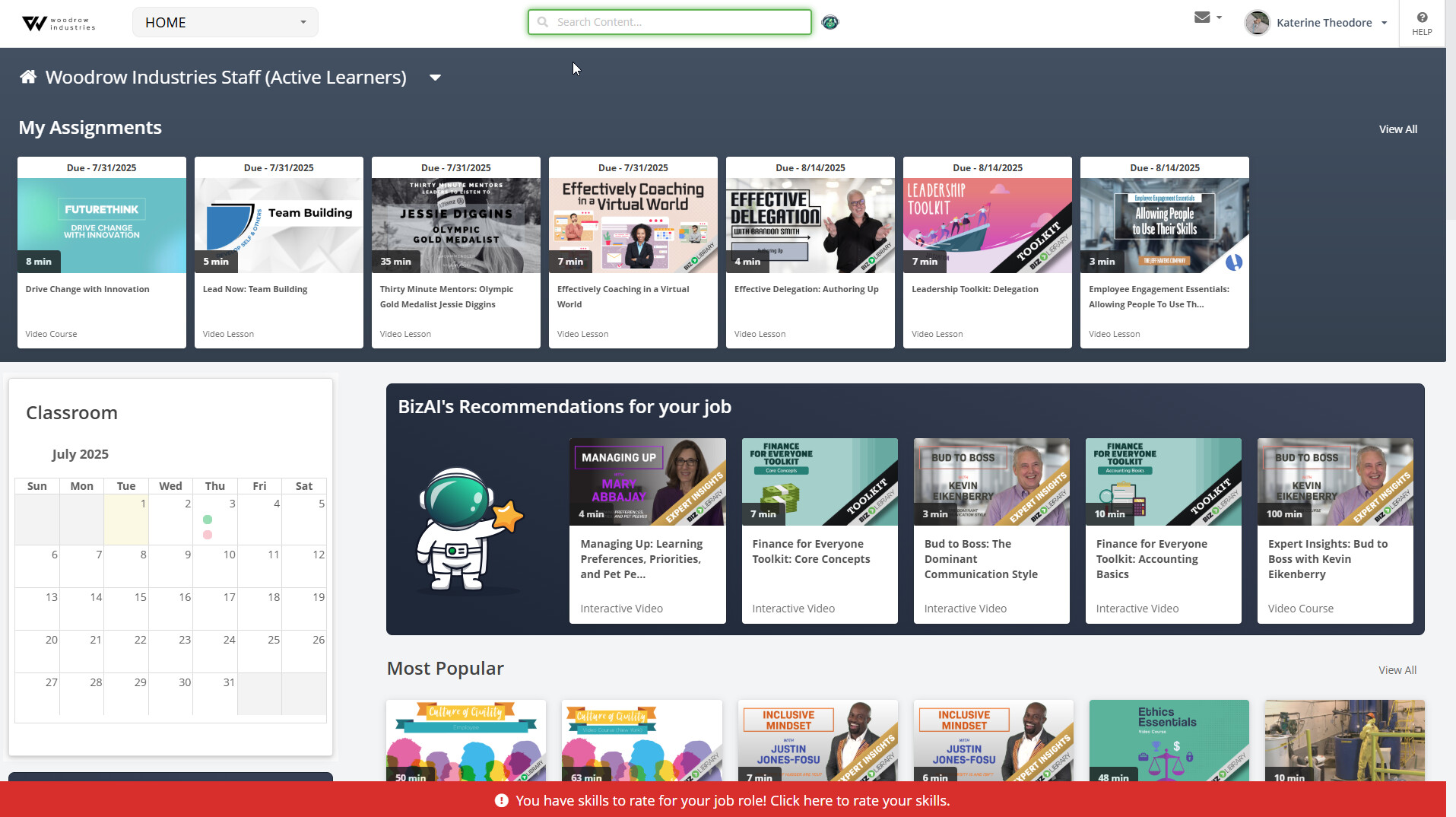
BizLMS handles the administrative center: users, assignments, automated reminders, branded learner pages, qualifications, hybrid classrooms, custom content, and scheduled reports. The content catalog covers compliance, safety, onboarding, leadership, business skills, software, sales, service, cybersecurity, and more. Material is available in more than 30 languages, and the company says it adds over 100 courses a month.
BizSkills maps more than 500 job roles and 1,500 skills to relevant courses. An employee and manager can rate capability, then build a development plan around the gap. BizConnect handles the plumbing, with more than 60 connections across HRIS, HCM, payroll, identity, and learning systems. New hires created in an HR system can appear in the LMS without somebody nursing a CSV every Friday.
The newer AI products are sensibly narrow. BizCreate turns a script, webpage, or PowerPoint into an editable narrated video lesson inside BizLMS. That is useful for the material no vendor can stock: a company’s expense policy, machinery procedure, or peculiar approval ritual. BizReady follows video lessons with simulated conversations and feedback, aimed at skills such as coaching, customer service, and difficult conversations. Neither requires the buyer to adopt a separate authoring or roleplay system.
Curation is the quiet expertise underneath the inventory. BizLibrary says its in-house team monitors demand, accepts client requests, retires dated titles, and supplements its own productions with work from more than 40 specialist producers. That hybrid model gives buyers different instructors, formats, and points of view without sending an administrator shopping across dozens of catalogs. It also creates a maintenance obligation: compliance language changes, software interfaces age, and a leadership lesson can begin to look antique long before its file stops playing.
Who buys it - and what they are escaping
The natural customer is a small or midsize employer with a surprisingly large training obligation and a surprisingly small team to run it. Think a multi-location operator, manufacturer, bank, utility, healthcare group, or professional-services firm. The buyer may own compliance, onboarding, safety, management development, and retention at once. A “best-of-breed stack” sounds attractive until that person becomes its unpaid systems integrator.
One verified mid-market reviewer described trying several LMS platforms before BizLibrary. The first failure was not missing software functionality. It was abandonment after setup: previous vendors got the system live, then the customer felt “lost in the abyss.” The organization also had more than 70 locations across four states, making uniform training and centralized reporting the practical test. What changed the buyer’s mind was sustained, hands-on help plus content broad enough for a distributed workforce.
A different example shows how the catalog can become raw material rather than a finished program. During a merger, Pyramid Global Hospitality needed an inclusion initiative for more than 14,000 associates. Its people leader first aligned executives around inclusion, then searched BizLibrary’s catalog for relevant titles. The sequence is worth noticing: stakeholder agreement came before course selection. Software did not invent the objective.
The price of the easy button
BizLibrary does not publish dollar prices. Buyers request a quote for packages such as BizComply, BizEssentials, and BizSkills. The variables include workforce size, content access, contract length, and modules. Public product pages describe a progression from a 200-course compliance plan to unlimited content, AI-assisted discovery, skills development, and integrations. Content can also be licensed into another LMS.
The missing rate card is a real drawback. A buyer cannot compare a shortlist over lunch, and smaller organizations may spend time in sales conversations before learning whether the economics fit. Third-party marketplaces similarly list custom quotes, not a reliable starting number. The 2018 investment amount and the company’s valuation are also undisclosed.
What is included helps explain the selling motion. BizLibrary says implementation is free, assigns specialists for launch and ongoing success, and says most organizations can go live within 45 days. That service has a cost even when it is not itemized. The economic argument is that a guided bundle costs less than several tools plus the internal labor required to connect and operate them.
A credible rollout still has homework on the customer side. User records need owners. Required courses need deadlines and escalation rules. Managers need to know which reports they will receive. Elective learning needs promotion rather than a launch email and a prayer. BizLibrary’s implementation model is useful because these decisions are operational, not technical. The product can automate the resulting plan, but somebody has to make the plan first.
A crowded aisle, a different shelf label
The alternatives are plentiful: LinkedIn Learning, Skillsoft Percipio, OpenSesame, Go1, TalentLMS, Litmos, Absorb, Docebo, LearnUpon, Cornerstone, and homegrown combinations. Some have larger brands, deeper enterprise workflows, cheaper self-serve entry points, or stronger specialty content. BizLibrary’s distinction is cumulative rather than dramatic: broad content, its own LMS, skills maps, AI authoring and practice, integrations, and an assigned human relationship.
It also does not insist that every learner visit BizLibrary. Its content supports common delivery standards, and the company documents integrations with Cornerstone, Oracle, SAP SuccessFactors, Schoox/UKG Learn, Absorb, and Workday. In 2025 it partnered with Meridian Knowledge Solutions to embed the catalog for government and commercial users. In February 2026 it joined Workday Cloud Connect for Learning, allowing Workday users to discover, consume, and track BizLibrary material inside the system they already use.
That move may be strategically more important than another dashboard. Training usually fails at the seam between intention and attention. Putting a useful lesson where an employee already works removes one small excuse.
What to copy - and when not to
Other companies can copy four ideas. Sell the completed job, not the component. Include implementation when adoption determines product value. Connect to the customer’s source of truth instead of demanding duplicate data entry. Keep the catalog visibly alive by retiring old material and adding new work on a predictable cadence.
It fits when…
- A lean HR team owns several programs
- Compliance records must survive audits
- Employees span locations or shifts
- Content and administration are both missing
It may not when…
- A mature L&D team already has specialist tools
- A tiny workforce needs only a few courses
- Transparent self-serve pricing is mandatory
- The organization will not curate or promote learning
The conditions matter. A 13,000-title catalog can become 13,000 ways to avoid making a decision. AI-generated internal training still needs an accountable expert to verify policy and procedure. Skills maps are only as honest as the ratings entered. Integrations do not repair dirty employee data. And no client success manager can rescue a program that lacks executive backing, protected learning time, or a business problem worth solving.
BizLibrary’s most credible claim is therefore not that it makes learning effortless. It makes the operational burden legible, puts much of it in one place, and assigns people to help. In the theatrical world of enterprise software, that is refreshingly close to a useful product description.