A customer service team needed to learn another team’s job before the holiday rush. The usual training took fourteen weeks. In Hickory’s account, the representatives learned the material in six. Their subsequent customer satisfaction score was 93%, roughly matching the people who normally did the work. The client is unnamed, and the numbers are company-reported. Still, the example poses a useful question: how much training time goes into learning, and how much goes into recovering what has already slipped away?
- The job: keep employee knowledge available after onboarding.
- The method: short lessons followed by individually scheduled reviews.
- The catch: good content, practice and manager attention still matter.
Most organizations can tell you whether somebody completed a course. Hickory is interested in a less convenient measurement: whether that person can retrieve the right information later. A completion record sits obediently in a database. Memory has other engagements.
93% CSAT afterward. An unnamed cross-training example, not a controlled comparison.
An appointment with forgetting
Hickory emerged from Y Combinator’s Summer 2015 batch. Brian Tobal, its founding CEO, and co-founder Arnaud Meunier, its early CTO, aimed the product at sales and customer service staff. These are jobs where knowing an answer matters precisely when another person wants it. A product detail remembered ten minutes after the call is a small professional tragedy.
The launch description explained that the app would predict when an employee was likely to forget material and send targeted quizzes. Reading time, previous answers and reported confidence helped inform the schedule. Reviews were described as taking about three minutes a day. Later instructional guidance describes roughly two-minute reviews and five-to-eight-minute lessons. The unit of training shrank; the period of reinforcement stretched.
The company’s scientific explanation draws on spaced repetition and active recall. It also emphasizes examples, associations and fitting new information into existing knowledge. Its proposition depends on timing and personal differences: difficult material returns sooner, while easy material moves farther into the future. Two employees can study the same subject and receive different review schedules.
The price of keeping it handy
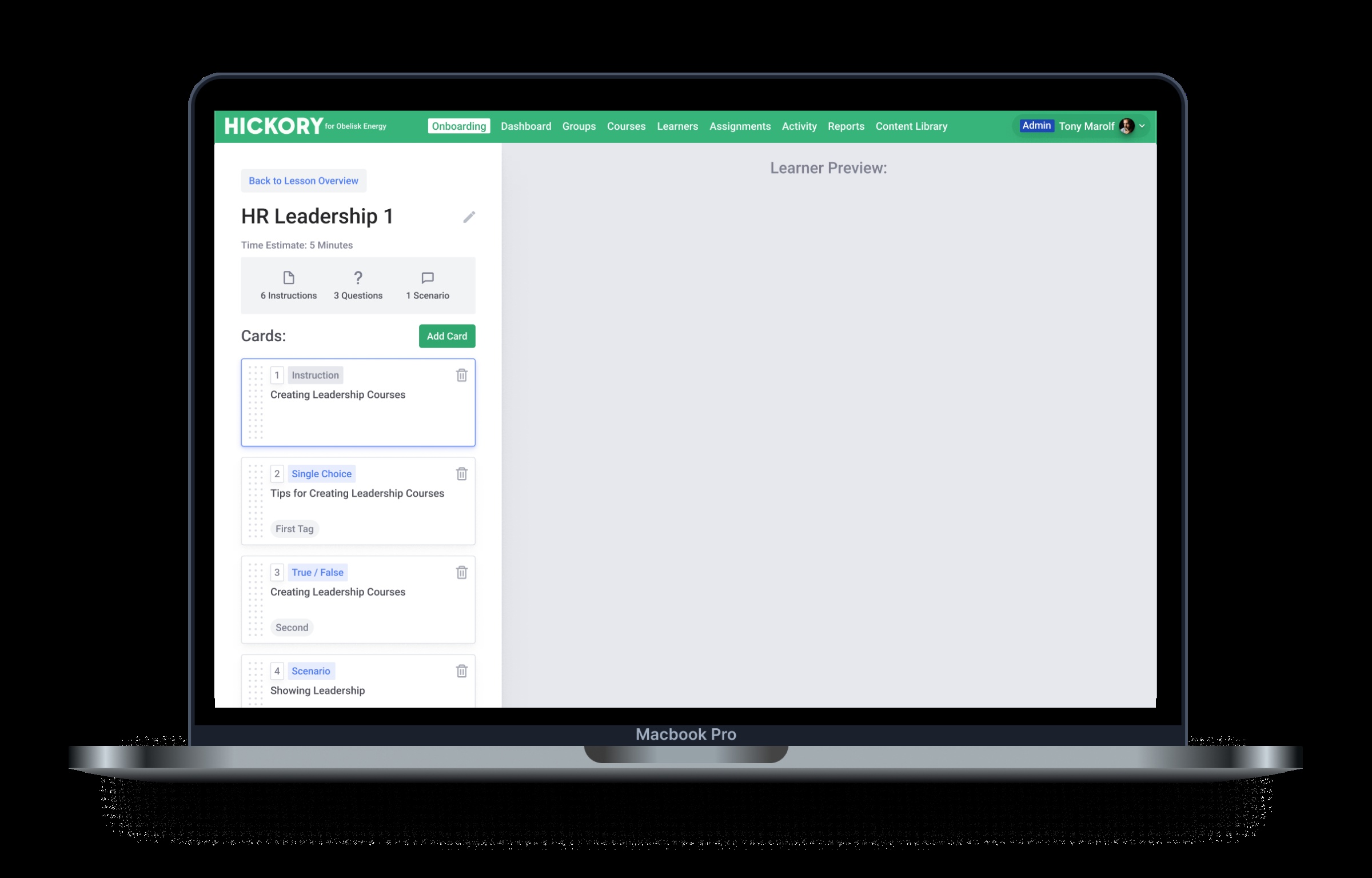
Hickory sells a learning management system, with lessons and reinforcement at its center. The published site offers content creation and imports, scheduling and reporting. Its older product page describes a Zendesk integration that places lessons inside the support agent’s existing workspace. That is a sensible place to put a small task: near the work it is meant to improve.
The commercial model is per-user software subscriptions. Publicly listed monthly prices are $4 for Essentials, $8 for Premium and $15 for Enterprise. For an illustrative 100-person team, that means $400, $800 or $1,500 a month before any other charges. Content preparation and employee time belong in the budget too. Published subscription arithmetic cannot tell you whether a particular rollout saves money.
These figures describe the website’s offering. Y Combinator currently marks Hickory inactive, while its public site still displays prices. Treat the page as a record of the product’s approach, and verify availability before planning a purchase.
First the rule, then the reason
Software explains only part of the six-week story. Hickory’s instructional design guidance describes mapping reinforcement into existing curricula over six to eighteen months. Short cards sit within a much longer plan: basic knowledge first, application later, then more demanding examples. A lesson can prepare people for a classroom session or help them retain what happened afterward.
Tobal’s advice on questions makes the distinction concrete. Teach the employee a refund rule, check that they know the action, then explain the business reason and ask why the rule exists. The next step is a scenario. Someone who understands the principle has a better starting point when the customer presents a situation the script never anticipated.
“I’m obsessed with questions.”Brian Tobal, writing on training design
In another post, Tobal recommends models of good and bad execution, mock scenarios and role-playing with immediate feedback. Memory gives an employee material to work with. Rehearsal gives them experience using it. Hickory’s position in corporate learning is therefore more specific than a library of courses: it organizes repeated contact with knowledge while leaving trainers a substantial role.
The manager is part of the machine
A review can be short and still be postponed indefinitely. Hickory’s engagement guidance asks managers to introduce the program, follow up and use learner responses during coaching. One example involves short written answers about the tone of customer emails; a coach can inspect the actual responses and discuss patterns. The dashboard becomes preparation for a conversation.
The company also describes team competitions that reward consistent participation rather than simply correct answers, with a minimum score to discourage mindless clicking. That choice matters. If practice is meant to expose weak spots, a leaderboard devoted entirely to accuracy gives people a reason to conceal them.
There is room for absurdity. Its advice includes fictional customers such as Dracula, exaggerated situations and jokes about company jargon. The humor is contextual: some organizations and subjects allow it, others do not. Corporate prose often seems designed to pass through a mind without disturbing anything. A memorable example at least leaves fingerprints.
A smaller lesson, a longer memory
The most useful instruction may be what to omit. Hickory’s content guidance recommends leaving out information employees already rehearse through everyday work. Repeating it adds irritation. It also says soft skills still need coaching and role-plays. A review system earns its place when the knowledge matters, fades between uses and can be reinforced through worthwhile questions.
A manager can copy the approach without first buying software: choose one troublesome process, write a brief lesson, ask a factual question and a scenario question, revisit both over time, and discuss mistakes. Fit the exercise around a real training milestone. Check later recall and actual work, rather than congratulating everyone at the first quiz. Hickory’s enduring question is modest enough to ask tomorrow: when the training ends, what happens next?