A real estate education business has an unexpected occupational hazard: becoming a software business. Adventures in CRE, known as A.CRE, teaches financial modeling. Yet its custom learning system demanded development cycles, bug fixes and conversations about whether a new feature could be built. The classroom was becoming an engineering project. Disco AI sells an escape from precisely this predicament.
- One academy: courses, conversations, events and payments share a home.
- A measurable claim: A.CRE reports 520 hours saved annually after switching.
- The human job remains: software handles logistics; someone still has to teach.
The accidental software company
A.CRE’s problem was less a lack of ambition than the administrative price of it. Its learning management system needed developers; its wider operation needed separate event, discussion and email tools. Peer interaction lacked a built-in home. Each improvement came with another round of coordination. Ownership had acquired a rather demanding personality.
According to Disco’s customer story, A.CRE consolidated four platforms, migrated more than 8,000 members and eliminated the need for a full-time developer. The reported annual saving was 520 hours. Divide that by 52 and you get ten hours a week: a substantial appointment with work that actually serves learners.
“We no longer burn cycles managing tech.”
Spencer Burton, co-founder, A.CRE
These are results published by the vendor, rather than an independent experiment. Still, the sequence is instructive. Custom development became a bottleneck; a hosted platform offered ready-made community features and continuing maintenance. The copyable decision is to inventory recurring technical work before commissioning another feature. The customer’s reported gain came from changing the operating arrangement.
A classroom with a social life
Disco’s original premise preceded its AI pitch. Candice Faktor and Chris Sukornyk founded the business in 2020, initially calling it Mastermind. At its 2021 seed announcement, the offering combined branding, live learning and group chat, with the aim of extending a course into an ongoing community. A workshop could have an afterlife.
The founders brought experience from other internet businesses: Faktor had been a general manager at Wattpad; Sukornyk founded advertising technology company Chango. Their early proposition concerned the relationship between a creator and an audience. In March 2022, Disco announced a US$15 million Series A led by GSV Ventures to support product development, distribution and hiring.
Today the buyer is often an organization: a training business, bootcamp, accelerator, association, or a team educating customers and employees. Disco provides branded academies with curriculum, assignments, quizzes, learning pathways, events and discussion. An operator can run a scheduled cohort or a self-paced program. The software supplies a place where lessons and other learners can both be found.
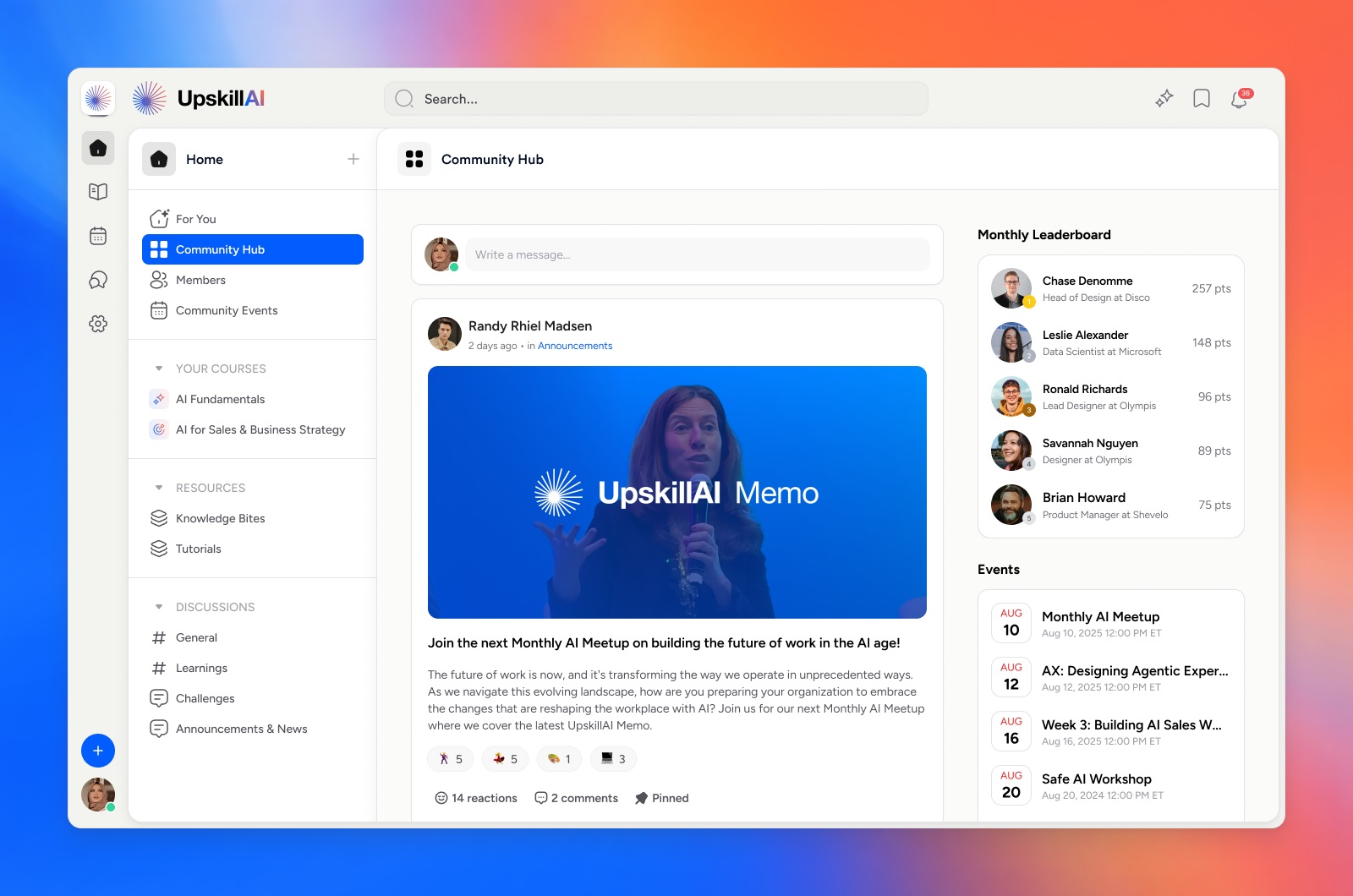
This places Disco between several familiar purchasing decisions. Circle and Mighty Networks are alternatives for community builders; Teachable and Kajabi enter the course-business conversation. A corporate buyer may consider a conventional LMS. Disco’s distinguishing proposition is the combination: structured learning, community operations and AI within an academy the customer brands. Buyers should test that combination against their own workflow.
Give the AI a reading list
A generic AI answer can be fluent and thoroughly unhelpful to someone asking about an employer’s policy. Disco’s Ask AI addresses a more bounded task: answering learners from organizational knowledge. Its companion, AI Sources, lets administrators curate the material behind those answers, combining internal content with external knowledge bases and making the source of an answer visible.
The July 2025 release described daily or on-demand synchronization for external knowledge bases. That detail matters more than a clever chatbot greeting. A useful answer depends on the reading material staying current. Operators still need to decide which documents belong in the collection, who should see them and when those documents need revision.
Elsewhere, Disco’s AI tools help draft programs, quizzes and content; video features include transcription and summaries. Automations handle repeatable steps in a learning journey. Together, these functions can reduce the work between possessing expertise and delivering a course. They leave the operator with an essential editorial responsibility: checking that the material teaches what the organization actually means.
The price of fewer moving parts
Disco is a subscription software business. Its advertised Organization plan starts at US$399 a month equivalent, billed annually, for up to 500 members. That is US$4,788 a year. Enterprise pricing is custom, with features including SAML single sign-on, API access and dedicated onboarding support. An academy can also sell courses and memberships through Stripe.
USD per year. Compare with your own admin and maintenance bill; customer savings are not a forecast.
Kids & Company supplies a different example of the operational problem. Disco’s case study describes training more than 3,000 employees across over 180 childcare centers in Canada and the United States. Role- and region-specific learning pathways helped organize the experience. The customer reports an 85% completion rate and more than 90 hours saved annually.
The Council of Canadian Innovators offers another version: a two-person team running five educational programs and four summits. Its Disco case study describes reusable program shells, automated onboarding and access segmented by learning level. The attraction is quite concrete. The next cohort can inherit a working arrangement rather than an operator’s heroic memory.

The unglamorous toggle
The April 2026 release included a small, revealing control: administrators could assign a program without immediately notifying its members. Other changes covered event targeting and custom curriculum labels. March brought enterprise email domains. These are the details that distinguish running an academy from demonstrating one. Someone must care about the email arriving before the course is ready.
Disco’s approach makes particular sense when courses, events and discussion already belong together, and a team is spending time moving people between them. A simple video library may need less infrastructure; unusually specialized workflows may justify custom development. A community also needs people willing to participate. Buying a room does not guarantee a conversation. The useful lesson is to make the next learner interaction easier to run, then measure whether it helps.