The contractors had a safety-training problem, although the safety lessons themselves were perfectly serviceable. Their insurer liked BLR’s 7-Minute Safety Trainer documents. The trouble was where those lessons were supposed to happen: remote job sites, without a regular classroom or computers for online courses. A document sitting comfortably in an office was being asked to do fieldwork.
- BLR pairs workplace compliance guidance with software and training.
- Its three main products serve HR, safety, and employee learning teams.
- Its customer stories reward a simple buying habit: test the delivery and documentation, too.
BLR built a web portal and companion mobile app around the material, with scheduling, attendance, photos, signatures, and access to 350 topics. In the company’s published case study, roughly a quarter of the insurer’s clients using the app were not contractors. Promotion expanded to other businesses, including dealers and metal fabricators.
The interesting detail is the quarter. A product designed for one audience had found another. The insurer had removed an obstacle shared by more businesses than it expected. For anyone buying workplace software, that is a more useful observation than another handsome screenshot.
outside the original contractor audience
A publisher learns to travel
BLR’s history begins in 1977, when attorney Robert L. Brady founded a business explaining state and federal laws to executives. It was called Business and Legal Reports. There is a pleasing lack of mystery in that name: the laws were complicated, and somebody had to make them readable.
The current company describes a progression from compliance publishing into HR, environmental health and safety, and training tools. Its staff mix includes legal experts, HR practitioners, safety engineers, and technologists. That combination matters because software for this work has two separate obligations. The answer must be sound, and the person responsible must be able to use it.
Ownership and capabilities changed along the way. A 2016 recapitalization provided liquidity to Brady. That December, Leeds Equity Partners combined BLR with three other businesses to form Simplify Compliance. BLR acquired custom-learning provider Navis Learning in March 2017, adding instructional designers, eLearning developers, and trainers.
Then, in January 2021, BLR announced that its initials would stand for Business and Learning Resources. The rebrand explicitly reflected employers’ growing training and talent-development needs. A name change can be ceremonial. Here, it also described an enlarged job: explaining the rule, teaching the people, and helping the organization carry the work through.
Three products, one awkward handoff
The handoff between knowing and doing is where BLR’s main products sit. HR Hero supports the person who must interpret employment requirements, compare jurisdictions, and keep policies current. It combines legal analysis with tools for handbooks, job descriptions, classification audits, compensation research, and expert questions. A multi-state employer can compare requirements before trying to make one policy fit several places.
EHS Hero serves safety and environmental teams. Regulatory information shares the platform with incident reporting, audits, inspections, and corrective actions. That is an important pairing. Looking up a requirement and assigning someone to address a finding are related tasks, even when an organization stores them in entirely different systems.
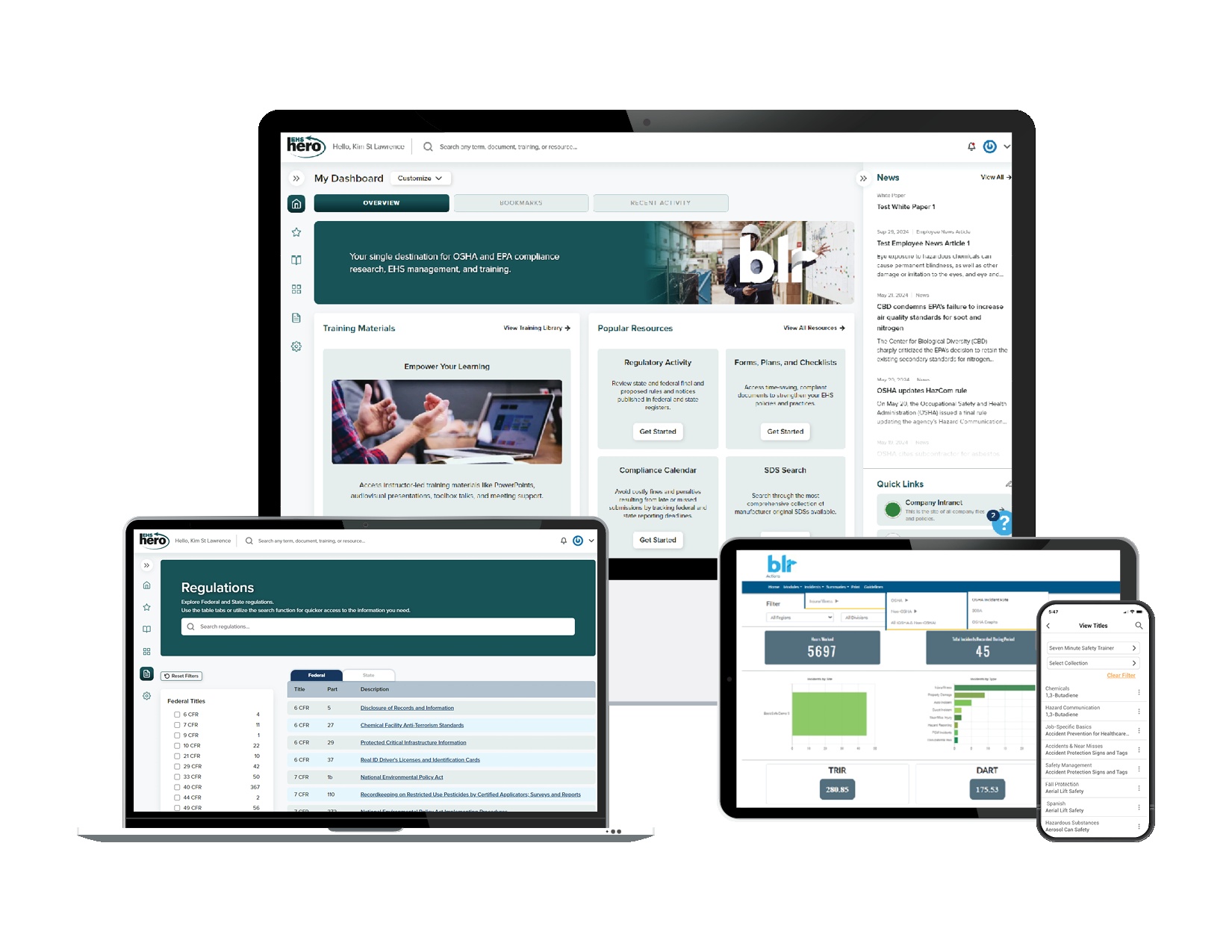
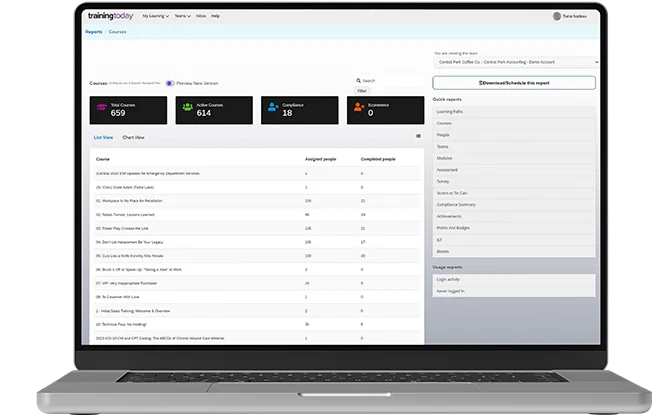
TrainingToday handles the learning side, with compliance and professional-development courses spanning HR, workplace safety, leadership, business skills, and several industry settings. English and Spanish libraries appear in its catalog. Buyers can use BLR’s learning management system or license SCORM-compliant course files for an existing LMS. Keeping a workable learning platform is therefore a real option.
BLR occupies a market where customers can also buy safety resources from J. J. Keller or EHS software and training from KPA. Its useful distinction is the combination of compliance publishing, practical workplace tools, and learning services across HR and safety. That breadth is worth examining when several teams share the problem. It becomes less persuasive if the buyer needs only one narrow function.
The course was fine. The administration wasn’t.
Ruffalo Noel Levitz, the higher-education services business, already used TrainingToday harassment content in its proprietary LMS. Its users complained about the platform, and tracking completion required manual intervention. In 2020, Cindy Brown began a three-month vendor search for a system serving more than 1,300 internal and external users.
RNL chose TrainingToday’s LMS, worked with BLR to brand the portal, and developed onboarding, manager, and role-specific learning paths. It also created client-facing training for its own software. Brown’s assessment included the price agreement as well as customization and compliance content.
“Without the customizable LMS, compliance training, and price agreement, we would be stuck with a less effective solution at a higher price.”
Cindy Brown, Ruffalo Noel Levitz
BLR-published customer account
Notice what made the old arrangement burdensome: finding out whether people had finished. An administrator could have excellent content and still spend the afternoon chasing the consequences of an awkward system. The case study’s next step was refining assignment rules by employee title. Buying the tool had left RNL with useful design work to do.
The invoice buys more than a library
BLR sells subscriptions to information, tools, training libraries, and learning software, with custom learning and optional LMS administration alongside them. Its LMS store specifies an annual subscription and directs buyers to sales for pricing. The buying decision needs to account for the work around the content: user setup, assignments, integrations, branding, reporting, and ongoing administration.
There is also a route through intermediaries. HRDelivered, a professional employer organization, uses HR Hero internally and offers TrainingToday to clients as part of its broader service. Its published account describes leaving BLR for another provider, then returning after a fresh review. Director Brad Morton pointed to scalability, content, cost benefit, service, and an improved LMS.
That makes BLR both a direct workplace vendor and a supplier behind somebody else’s offering. For a PEO, the calculation includes whether useful training can be added without upsetting service margins. For an employer, it includes whether recurring spending replaces enough research and administrative work to justify the contract. The sensible comparison is the whole operating bill, including the people doing the follow-up.
Watch what people do after the demo
Recent product changes return to this same practical territory. In May 2025, BLR announced an enhanced EHS Hero with content collections, dashboard customization, and bookmarks. June updates added regulatory filtering, configurable permissions, and changes to corrective-action tables and exports. Those are features for people trying to retrieve, organize, and act on information repeatedly.
In April 2026, BLR announced a redesigned Employee Handbook Builder informed by customer feedback and usage data. Version history, visible policy changes, centralized notifications, and an enterprise view of multiple handbooks addressed maintenance and collaboration. Attorney-reviewed policies continued to be developed with Jackson Lewis employment lawyers. The handbook’s life after publication had become part of the product brief.
A buyer can copy that habit immediately. Bring a real task to the demonstration: a policy change affecting two states, a safety finding needing an owner, or a course required for one job role. Ask the vendor to take it through assignment, revision, completion, and retrieval. Watch where somebody has to leave the system or remember an unwritten step.
The approach depends on accurate content, access that fits the workplace, and someone maintaining the rules and following up. A completion report cannot establish that an employee understood a lesson or changed a habit. The software helps organize the work; the organization still has to do it. BLR’s most instructive customer story starts with a lesson that could not reach the job site. The worthwhile question for any training purchase is how far the lesson gets after it leaves the library.
Take the tools for a look
Explore BLR, HR Hero, EHS Hero, and the training catalog. Browse company news and workplace articles.