The small-business owner does not usually decide to become an HR director. It happens by attrition. A cook texts about next Thursday. Somebody cannot remember how much holiday is left. A manager edits a rota, forgets to tell payroll and discovers the error after payday. Then an employee asks a perfectly reasonable legal question at 9:47 on a Sunday night. This is the unlovely terrain BrightHR chose to map.
The Manchester company packages the daily mechanics of employing people - records, leave, sickness, shifts, documents, time, expenses, performance and payroll - with health-and-safety software and access to human advisers. The dashboard is familiar SaaS. The more consequential part is the trapdoor beneath it: when a form becomes a judgment call, a customer can reach employment-law or safety help around the clock.
A software company with a law firm in the family
BrightHR launched in November 2015 inside Peninsula Group, the employment-law, HR and safety specialist. Contemporary coverage named two former Sage executives, Paul Tooth and Paul Harris, as its co-founders. Tooth served as chief executive; Harris was its marketing chief. Alan Price, a long-time Peninsula executive and employment-relations specialist, now leads BrightHR while also serving as the group’s chief operating officer.
That parentage explains the strategy. Plenty of HR systems can hold a contract or count annual leave. Peninsula supplied decades of cases, questions and anxious phone calls. BrightHR could turn repeated advice into templates, prompts and workflows - then retain advisers for the situation that refused to become a dropdown menu. Its stated goal was blunt: small employers were losing hours to HR chores, so make the chores quicker.
This is also what separates the company from narrower UK SME tools such as BreatheHR or CharlieHR, and from broad international suites such as BambooHR, HiBob and Personio. BrightHR is not trying to win on a single dazzling employee-experience screen. It sells a bundle of local compliance, ordinary operational software and backup. Sage HR, Employment Hero, IRIS and Cintra People can overlap with much of it; the particular BrightHR wager is that an owner wants fewer suppliers and a knowledgeable voice when the risk gets real.
The first crack is usually a handoff
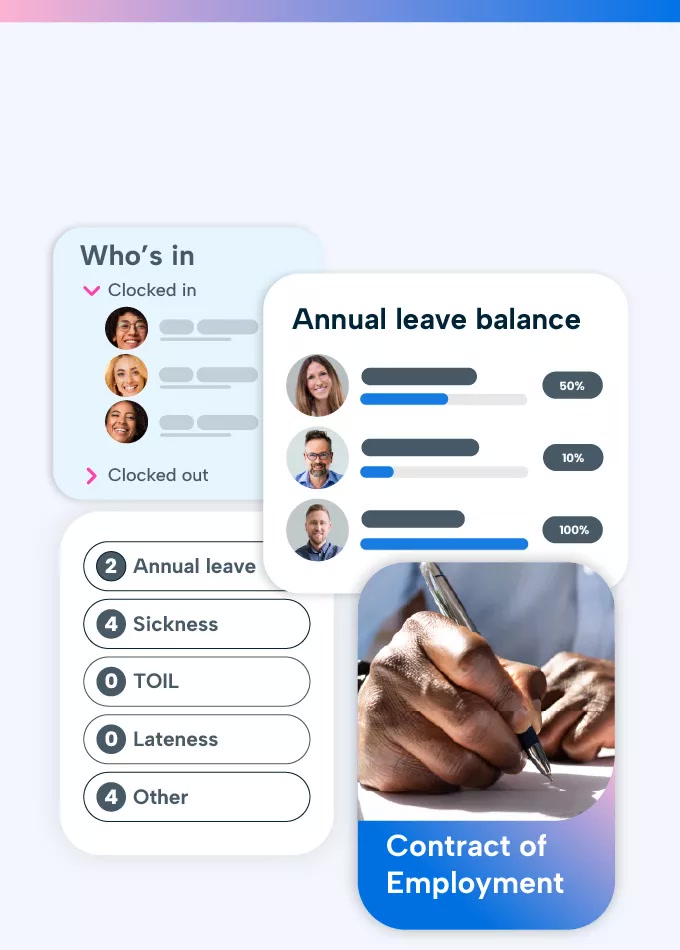
What fails first in a growing small company is rarely “HR strategy.” It is a handoff. A holiday request lives in email while the rota lives on a wall. Hours live in one app and payroll in another. The accident book is in a cupboard precisely when somebody needs it on site. A policy was sent, but nobody can prove it was read. BrightHR’s product history is a ten-year campaign against those seams.
One shift, four records
The original release handled regular employees, seven-day working patterns and iPhone access. Android and unlimited document storage followed in 2016; shifts and schedules in 2017. In 2018 came Blip, a clock-in app with reminders and optional location controls. PoP, the receipt-and-expense app, arrived in 2019. BrightSafe added risk assessments, hazard records, accident and near-miss reporting in 2020. Payroll navigation, learning, employee recognition, recruitment and performance management filled more of the gaps.
The names are jauntily unserious - Blip and PoP sound like cereal mascots - but the records are not. Blip passed one million clock-ins in 2019, ten million in 2021, 30 million in 2022 and 40 million in 2023. That curve is the best evidence of BrightHR’s product discipline: make the smallest repeated action tolerable, then connect it to the next person who needs the information.
What the bundle costs - and buys
BrightHR sells fixed-term subscriptions priced by headcount and package, with payroll and other services available as additions. The UK pricing journey currently displays a five-employee core example at £83.35 a month before tax, or £16.67 per employee. Enhanced HR support in the same example is £106; the fuller HR, safety and employee-assistance package is £156.50. Elsewhere on the page, BrightHR says per-person prices can begin at £3 depending on business size. Translation: the useful number is the quote for your headcount, term and support appetite.
core HR example for five employees
What changed customers’ minds was often less abstract. Wild Hearth Bakery said the easy layout and fair cost mattered, but having rotas and employee clock-ins together clinched it. Primary Care Workforce Academy wanted to automate payroll tasks and reduce errors. R.E.D.S Cafe owner Andy Reid described the service as a “godsend” because it replaced late-night internet searches for HR answers with app access and advice. These are not moon-shot use cases. They are Tuesday.
The human escape hatch survives the AI
BrightHR now markets Brainbox, an AI assistant that answers thousands of HR and safety questions at any hour. It is a logical extension of the old playbook: find repeated questions and shorten the route to an answer. Yet the company is careful to wrap the feature in Peninsula’s expertise and keep its advice lines. Employment disputes and safety incidents have context, evidence and consequences. An instant answer is useful; accountability still needs a person.
The same combination appears in integrations. Customers can connect services through Zapier, sign in through Microsoft Entra ID and link common tools such as Xero, Slack and HubSpot. Payroll connects with NEST for enrolment and contributions. A public API and enhanced permissions sit on the 2026 roadmap. The aim is not to replace every system. It is to stop the employee record being retyped into all of them.
A culture that says the quiet part loudly
BrightHR’s published values are care, action, innovation, useful information and doing the right thing. Its careers language is more revealing. The Peninsula “compass” describes a hard-working, sales-driven organisation that likes challenge, risk and accountability. It says employees do not clock-watch, operate on maybes or work in isolation. That bluntness will energise some candidates and send others politely toward the exit - which is arguably what honest culture copy should do.

The company has publicised an employee-assistance programme, profit-related pay and investment in personal growth. It has also appeared in Best Companies workplace rankings. The interesting tension is right there in the product: BrightHR sells clocking software while telling its own staff not to watch the clock. One is an operational record; the other is a statement of appetite. Buyers and job candidates should understand the difference.
Three things worth stealing
BrightHR also shows the value of shipping around a stable problem rather than a fashionable technology. Leave conflicts appeared in 2016. Rota costs arrived in 2025. Performance goals and reviews came late, after the company had earned its place in daily administration. Even its eccentric 2017 Alexa skill contained the command “brewlette,” which randomly selected who should make tea. Silly, yes. But it revealed a useful instinct: put the product where workplace rituals happen, not where software categories say it belongs.
The fit check no demo can skip
The bundle works best when a business has enough staff for spreadsheets and group chats to wobble, but not enough specialist headcount to maintain separate HR, safety and employment-law functions. Shift-based hospitality, retail, care, construction and education are natural territory. Local rulebooks matter, which is why the company operates distinct offers in the UK, Ireland, Canada, Australia and New Zealand.
Good conditions
- Recurring leave, rota and timekeeping admin
- A need for local compliance guidance
- Managers and employees willing to use self-service
- Value in one broad supplier relationship
Look harder before buying
- Operations outside BrightHR’s five markets
- Highly customised multinational HR workflows
- A preference for month-to-month, à-la-carte software
- Needs already served by deep specialist systems
It is a less convincing fit for a multinational demanding intricate global payroll, extensive custom workflows or a single system across countries BrightHR does not serve. A tiny team that wants only a leave calendar may find the advice-and-compliance bundle excessive. And a buyer who prizes transparent self-serve checkout should compare the final contract, add-ons and renewal terms rather than relying on the lowest per-person line.
Still, the larger insight holds. BrightHR grew by treating administration as a chain reaction. A missed clock-out becomes a bad timesheet; a bad timesheet becomes a payroll correction; a poorly documented correction becomes a dispute. Put the records together, attach expertise, and a dull software category starts to look like infrastructure. The company did not make employing people simple. It made the awkward bits arrive in one place - which, for an accidental HR director, is close enough to magic.