At Baker’s Burgers, the problem was not a shortage of things to learn. It was what happened after the lesson left the printer. Training materials went out to employees across Southern California. Then came the awkward part: working out who had actually completed them. A restaurant can count its orders. Counting its learning proved rather less tidy.
- KnowledgeCity connects training content with assignments, assessments and records.
- Its buyers include employers, government agencies and public libraries.
- The current catalog advertises 60,000+ videos, not 60,000 courses.
- The useful idea to borrow: decide what improvement looks like before assigning the lesson.
Thirty-nine locations, one missing trail
KnowledgeCity’s Baker’s Burgers case study describes 1,800 employees across 39 locations. Printed training could take days to distribute, and completed paperwork was difficult to track. The chain wanted a consistent system and a place to create material quickly. It selected KnowledgeCity’s learning library and learning management system, with customized content and accounts for its workforce.
“We did not have a consistent training system to track team member training or a training portal to create training material,”
Ana Ruiz · Learning and Development Manager, Baker’s Burgers
The revealing detail is the absence of a consistent record. Read this as a coordination problem: a headquarters sends something out, dozens of locations receive it, and the return journey gets murky. A new video alone would leave that journey unfinished. The chain chose content together with delivery and tracking. The company case study reports more efficient training, without a quantified savings figure.
The catalog is only the beginning
KnowledgeCity, a Carlsbad business founded in 2007, now describes itself as an intelligent workforce platform. Its proposition is to connect learning, skills, performance and compliance. The customer is usually an organization; the person watching the lesson may be a manager, a machine operator, a new hire or someone preparing for a different job.
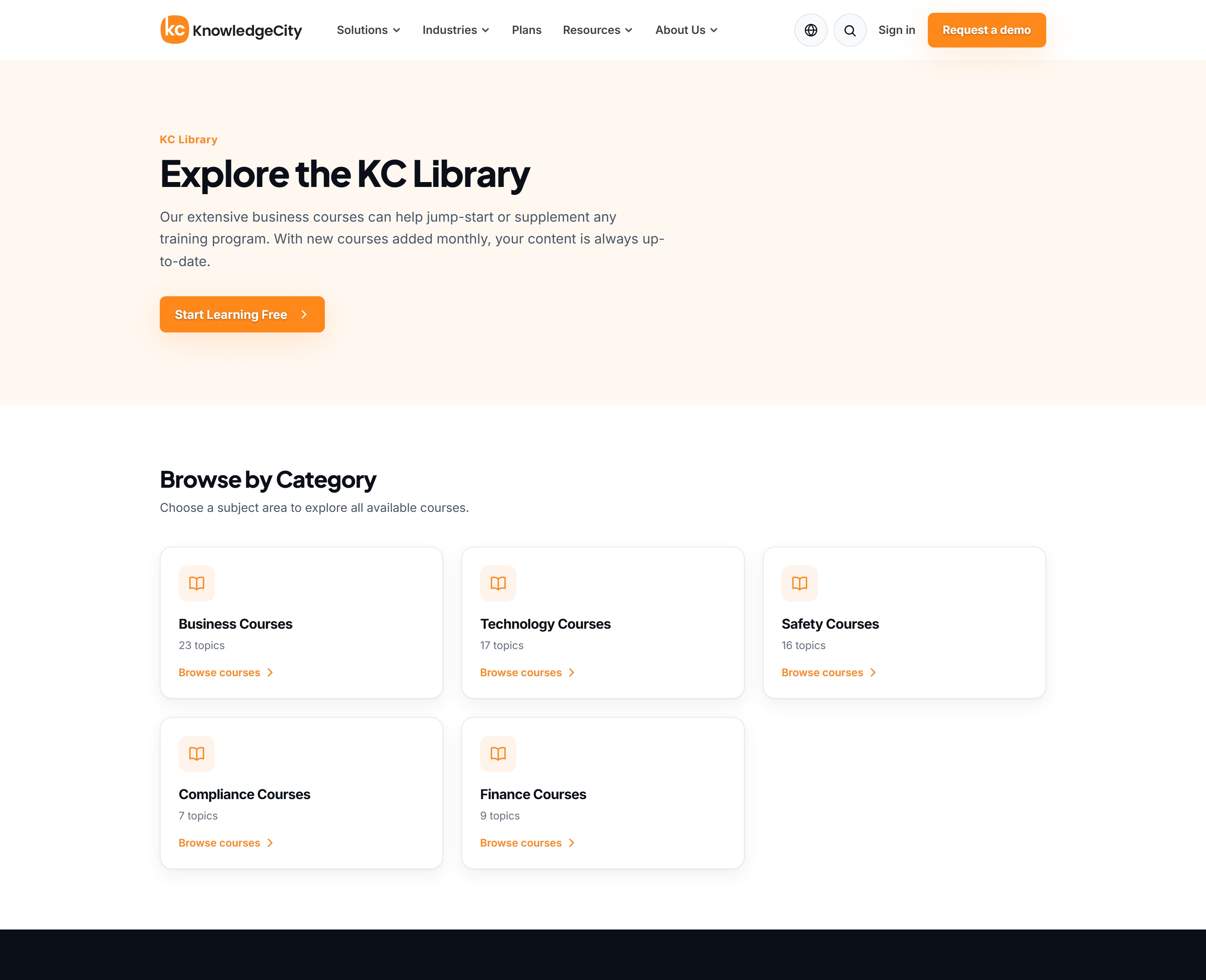
KC Library supplies the material. The current website advertises more than 60,000 videos across business, technology, finance, safety and compliance, with new content added monthly. That number describes videos. A course can contain several lessons, so comparing it with another vendor’s course count would produce a splendidly confident mistake. KnowledgeCity lists professional education relationships with PMI, SHRM, HRCI and IIBA, and appears in Training Industry’s 2026 Top 20 Online Learning Library selection.
KC LMS handles the administrative work: assigning training, sequencing learning paths, collecting assessments and issuing certificates. Its help documentation describes both library content and an organization’s own videos, PDFs and imported course packages. Learners use a branded browser portal or mobile apps. Administrators get permissions and reporting. The division is sensible: the employee needs the next lesson; the administrator needs to know whether it happened.
There is also a route for companies that already have a learning system. KnowledgeCity advertises SCORM, xAPI and API delivery options for its content. Buying the library need not mean replacing every existing tool. That gives its market position two sides: a content supplier for one buyer, a connected workforce platform for another.
A test should lead somewhere
KC Skills makes the next part of the proposition explicit. Pick the skills to assess, generate an assessment, identify gaps and assign training. Then reassess. A proficiency matrix can show the pattern by person, team or role. The attractive part is the second test. Completing a course supplies an administrative fact; reassessment asks a different question about what the learner can now demonstrate.
- 01AssessEstablish the starting point.
- 02AssignMatch gaps with training.
- 03LearnComplete the selected path.
- 04ReassessCheck what changed.
KC Map starts one step earlier, with the requirements of a role. It supports competency frameworks including O*NET and SFIA, or an employer’s own model, and ranks courses against those requirements. Learning paths can then move into KC LMS. The practical benefit is a translation: from “this role requires these capabilities” to “these are the lessons to assign.”
KC Performance brings development into reviews, with goals, KPIs, self and manager assessments, and multi-rater feedback. KnowledgeCity describes native links to training, so the review can include assigned courses and completion. My reading of the proposition is simple: the performance conversation becomes more useful when an identified weakness comes with a concrete next step. Whether that step changes performance still requires judgment.
The policy has a memory
KC Docs addresses a familiar office mystery: which version of the policy did everyone read? It maintains document versions and acknowledgment histories. Publishing a new version can trigger another sign-off, with deadlines, reminders and escalation. A shared folder can hold a document. A policy workflow also needs to remember who received which version and when they accepted it.
KC Safety applies a similar logic to incidents and near-misses. KnowledgeCity advertises reporting, risk routing, investigation, corrective actions and recordkeeping, with training connected to the response. The design is aimed at making an event lead somewhere: somebody owns the action, the fix is followed through, and relevant people receive refresher instruction. These are advertised capabilities; they should be tested against a buyer’s actual process.
The breadth explains why learning and development is only one audience. Safety staff care about incidents. Operations cares about consistency between sites. HR cares about development and onboarding. KnowledgeCity’s current product menu also includes recruiting, talent assessments and phishing simulations. The appeal of a shared system increases when those teams need information from one another.
The price hiding in the minutes
Enterprise software prices often arrive after a conversation. KnowledgeCity’s current model is an annual subscription per seat, with a quote determined by workforce size and selected products. An employer can begin with a suite and add more. The useful buying question is what is included: content access, delivery, authoring, integrations and the surrounding workforce tools have different jobs.
Sterling Heights approved 650 catalog licenses for one year.
That public purchase offers a real figure without pretending it is a universal tariff. It also shows why the scope matters. A catalog license cannot stand in for a price comparison covering policy management, safety investigations or performance reviews. Ask vendors to price the same intended workflow. Otherwise the cheapest proposal may simply contain fewer of the things you need.
KnowledgeCity competes in a crowded learning market. LinkedIn Learning and Udemy Business are alternatives for content; BizLibrary and Skillsoft also appear in the wider learning-library field. Its own pitch emphasizes connections between content and workforce administration. That is a positioning claim worth examining in a demonstration, rather than accepting as proof that one platform will suit every department.
The library card and the Saudi cloud
There is a quieter customer than the enterprise HR team: the public library. KnowledgeCity’s 2019 library announcement describes patrons taking self-paced courses through library-card access. Oxford Public Library currently lists the service among its online resources. Here the institution pays for access and the individual chooses what to learn. Someone seeking a job need not first persuade an employer to buy training.
Global reach adds another kind of work. Naseej’s 2025 partnership announcement describes KnowledgeCity content for Saudi and GCC institutions, available in Arabic and English, with National eLearning Center accreditation and local Saudi cloud hosting. The instructive detail is the hosting. A global catalog still has to fit local procurement, language and infrastructure requirements. Translation is one part of the job.
What a manager can borrow
Spartronics’ company-published case study supplies a practical sequence. The manufacturer had inconsistent training between locations and difficulty monitoring completion. It assessed needs across sites, adapted the platform to its requirements, rolled it out across U.S. locations and communicated at corporate and local levels. Tracking then supported the rollout. The account describes improvements qualitatively; it offers a sequence to examine, rather than a numerical return to promise.
Borrow that order of operations. Choose one role or recurring problem. Establish the required skill, the relevant training and the evidence you will accept afterward. Put an owner on the record. Only then widen the rollout. This is editorial advice drawn from the documented workflow, and it works as a purchasing test too: ask for a demonstration using your own example.
KC Studio adds AI drafting, dubbing, captions and quiz generation to the mix, with editable outputs. That can reduce production work. It also makes the review step consequential: a subject expert still needs to decide whether the course is accurate and relevant. Likewise, a useful assessment requires a sensible definition of the skill being measured.
A connected platform will disappoint if the role requirements are vague, the employee data is wrong or nobody has time to practice. Course completion can coexist quite happily with poor performance. KnowledgeCity’s appeal is that it gives organizations more ways to follow a lesson into the work. The manager’s task is to follow it the rest of the way.
Take a closer look
Browse the products, inspect the catalog, or watch the company’s learning videos.
Website ↗KC Library ↗Request a product demo ↗Company blog ↗LinkedIn ↗X ↗Instagram ↗Facebook ↗YouTube videos ↗Naseej partnership news ↗