A spreadsheet is an agreeable servant until it acquires four thousand dependants. At Close Brothers, the merchant banking group, compensation planning had become a laborious exercise in checking numbers and assembling reports. The sheets still worked. The people around them were doing rather a lot of work too.
- PeopleFluent handles pay planning, performance, learning and workforce visualization.
- Its appeal is configurable software for complicated organizations.
- Customer cases show gains from familiar workflows and fewer manual handoffs.
- Implementation needs data, administrator time and decisions about how work should run.
In 2017, Close Brothers started looking for a replacement. The interesting requirement was continuity: staff should be able to recognize their existing process inside the new system. PeopleFluent proposed doing just that. The bank later added its performance product in 2022. In the published customer account, the improvement is less checking and more room for compensation discussions. There is a modest lesson here. A successful change can look uneventful to the people using it.
“Our processes could stay the same.”
Ben Ward, Close Brothers · customer account
The feature that saves a minute
One detail in the bank’s account deserves attention: autosaving every minute. It is a tiny feature to place beside the language of talent strategy. It also answers a question any employee understands: will the work still be there when something goes wrong? PeopleFluent sells software into that practical territory, where an organization’s elaborate rules must survive everyday use.
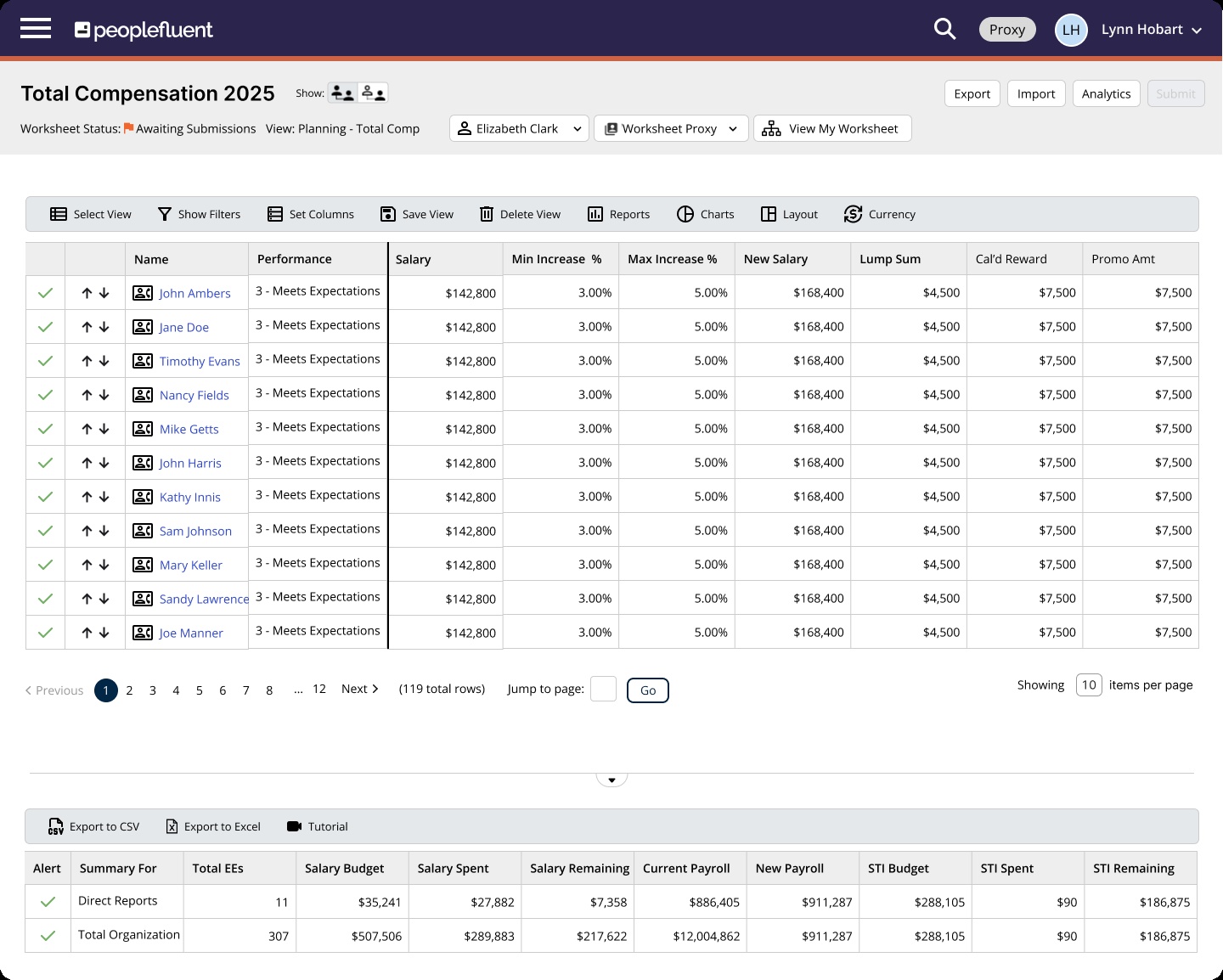
Its compensation product supports salary, bonus, stock and other reward cycles, with configurable worksheets, approval structures and scenario modeling. A planner can examine the effect of changing a budget or salary guideline before committing to it. Pay-equity analytics help surface potential disparities for review. These are tools for making and inspecting decisions; a chart cannot supply the compensation philosophy on its own.
The register, the reminder, the record
At L&Q, the housing association, the awkward object was a classroom register. Attendance passed from a learner’s signature to an instructor’s spreadsheet and onward to the next person. Different roles needed different safety and compliance training; external learners added another layer. The customer case describes replacing those manual handoffs with assigned learning, deadlines, reminders and reporting.
L&Q’s learning and development managers estimate at least 50% time savings from PeopleFluent Learning. The account also reports a 3.5% increase in completion rates for a health and safety initiative monitored in 2023, attributed partly to deadlines and automatic reminders. These are customer-reported results from a particular implementation. Their value is the mechanism they reveal: a person no longer has to chase every next step.
At least this much time saved for L&Q’s learning and development department, according to its published account.
The historical HSE case from Ireland adds a different constraint. Healthcare workers cannot conveniently abandon wards and clinics together for a class. HSE wanted an accessible learning portal with assessments and development tools. It selected NetDimensions LMS through competitive tendering and deployed it with Aurion Learning. The case says delivery was on time and on budget. The underlying problem was availability as much as administration.
There is a useful connection between the bank and the classroom: the work already had a purpose. Compensation decisions had to be made; training had to be delivered. The opportunity was in the circulation of information around that work. Better records can save an employee from another email, and an administrator from another afternoon reconstructing what happened.
A company assembled around the awkward bits
PeopleFluent’s history helps explain its breadth. The business combines earlier software companies rather than following a single tidy founder story. Authoria’s founder was Tod Loofbourrow. Peopleclick and Authoria came together under Bedford Funding in 2010; the PeopleFluent name followed in June 2011. Its pedigree contains several distinct kinds of HR work.
In 2018, Learning Technologies Group announced a $150 million acquisition on a cash-free, debt-free basis. That figure describes buying the company, rather than a venture round or a customer subscription. The transaction completed on May 31. In October, NetDimensions was integrated into PeopleFluent Learning. LTG’s corporate history also records the separation of Affirmity and VectorVMS as standalone brands.
This matters when reading old product lists. A company’s historical footprint is not a guarantee that every former division remains in today’s catalogue. PeopleFluent’s current offering emphasizes compensation, learning, talent management, organizational charting and Reflektive. At the ownership level, LTG’s take-private became effective in March 2025, placing it within General Atlantic.
Four ways to ask a better workforce question
The talent management suite brings performance, succession and development together through employee profiles and configurable processes. A profile can connect job history, goals, skills and career ambitions. That helps a manager ask who might be ready for a role, or which development opportunity fits a gap. Collecting that information consistently remains a human responsibility.
OrgPublisher makes the workforce visible. Leaders can consolidate organizational data, examine reporting relationships and model changes before carrying them out. During a merger or reorganization, that offers a way to discuss overlaps, vacancies and management spans with a common picture. An org chart becomes a working document when people can ask what happens if they move a box.
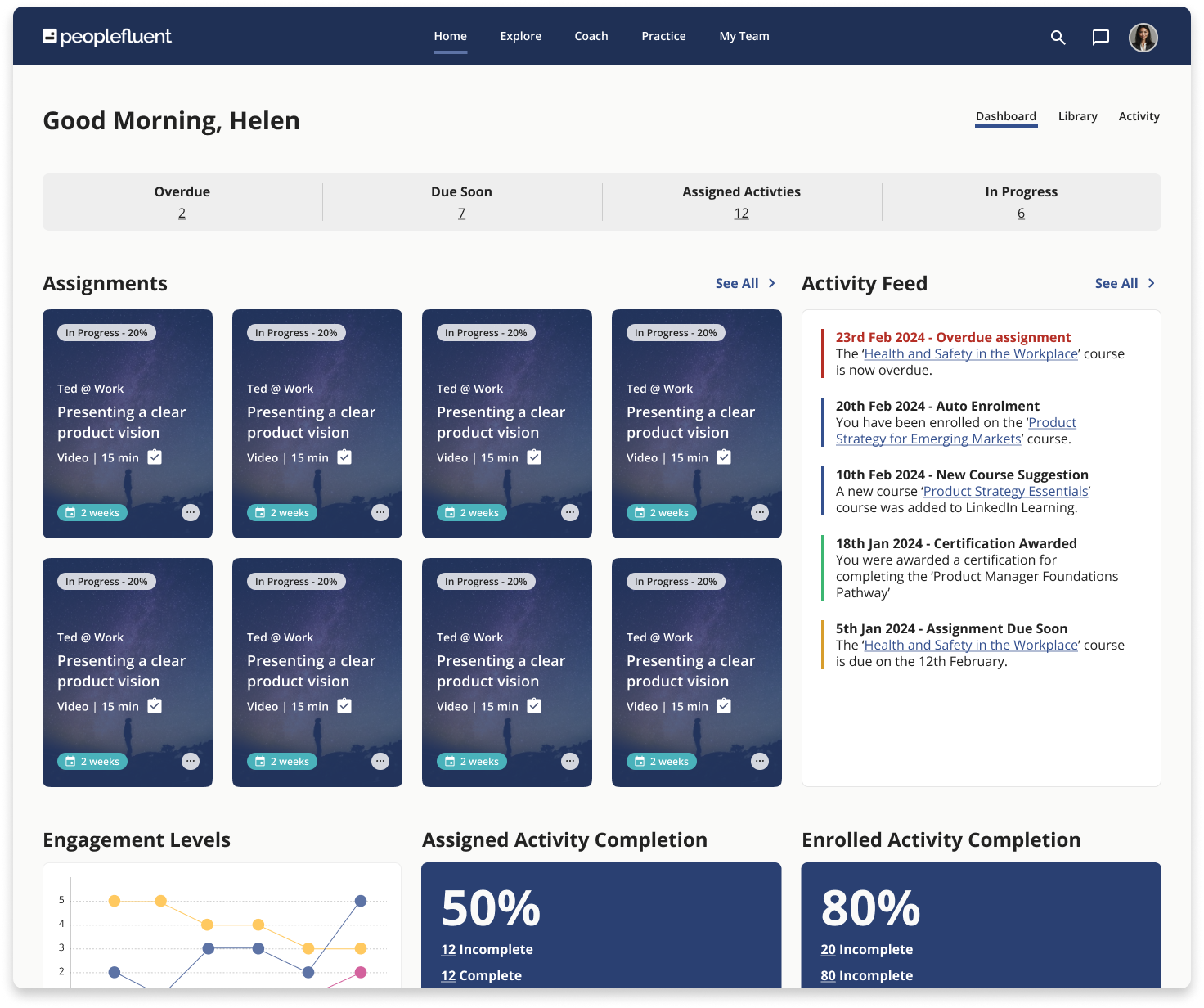
PeopleFluent Learning supplies the course delivery and records behind training programs, including certification and competency tracking. It offers cloud and on-premise options, granular permissions and support for more than 40 languages. The learning audience can extend beyond employees to partners and customers. That breadth makes sense for organizations whose obligations do not stop at their payroll.
Reflektive adds another route into performance management, with goals, reviews, recognition and ongoing feedback. Its integrations include Slack, Microsoft Teams and email tools. Putting feedback into an existing work environment follows the same adoption logic as the bank’s familiar pay process: reduce the distance between an intention and the place someone must act on it.
AI arrives with a pencil and an eraser
The recent releases are revealingly specific. Version 25.04, announced in April 2025, introduced generative assistance for performance comments and job descriptions, alongside documented one-to-one conversations. Administrators can control the prompt fields. These features sit next to ordinary workflow changes, including ways to distribute compensation statements.
Version 25.07 followed in July, with AI assistance to validate and correct formulas and AWS Bedrock as the default AI service. It also changed feedback access, delegation administration and interface details. Formula checking is a fitting use case for this company: it addresses the small, consequential errors that can make an administrative process expensive.
In February 2026, Learning 26.02 added clearer competency and certification history dates and more granular auditing controls. Acquisition dates, expiration dates, who changed what: these are unglamorous details, but a training record’s usefulness depends on them. PeopleFluent also announced a 2025 WorkTech Award. For a buyer, the release details are more revealing than the trophy.
Buy the exception, budget for the setup
The market contains broad alternatives: Workday offers compensation management inside its larger platform; Cornerstone serves enterprise learning. My reading of PeopleFluent’s position is a specialist argument for configurable depth, whether bought separately or together. Its own implementation guidance emphasizes connecting compensation to existing HR information systems and handling arrangements such as multiple pay rates.
The commercial model is enterprise software with implementation and support, led by sales conversations and demos. Comparing quotes should include configuration, integration, data preparation and the people who will administer the system. The familiar spreadsheet has costs too, especially when a pay cycle requires repeated reconciliation. Buyers should measure those hours before assuming that either approach is cheaper.
PeopleFluent’s learning guidance says a deployment can take four to six weeks when administrators have capacity and necessary data; sophisticated configurations and limited resources can add time. That qualification is part of the product’s real-world meaning. A small employer with a simple training list may have little reason to purchase this depth. An organization without clear owners for its rules will have difficulty configuring them.
The lesson a reader can copy is pleasantly concrete. Pick one troublesome process. Write down its handoffs, exceptions and repeated checks. Preserve the steps people trust, give the rules an owner, and measure the chasing before and after. PeopleFluent’s customer stories make the case for a quieter kind of software ambition: the ordinary work should demand less extraordinary effort.