Somewhere in a training department, a perfectly serviceable presentation is waiting to become something more useful. It contains the procedure, the product explanation, the knowledge an experienced colleague has spent years acquiring. It also contains thirty slides and the optimistic assumption that reading them is the same as learning them. iSpring MEA has built its pitch around that very ordinary predicament.
- Start with familiar files. Suite turns PowerPoint material into interactive, trackable courses.
- Separate making from managing. The authoring tool can work with an existing LMS; iSpring also sells its own.
- Let experts contribute. A simpler production workflow can move some work out of the course designer’s queue.
- Budget for judgment. Reviewing content and checking whether people learned remain human jobs.
The software begins where the files already live
iSpring MEA is the regional presence associated with iSpring’s Arabic-facing website and Middle East and Africa outreach. The site offers courses, demonstrations and training resources in Arabic. Its regional LinkedIn account has promoted an Arabic webinar on adaptive learning; public professional posts also place the team at the 2024 HR Summit and Expo in Riyadh. The regional conversation concerns the same software sold by the global business.
That business began in 2001. Founder Yury Uskov and his colleagues started with software development; a PowerPoint-to-Flash converter followed in 2005. The commercial insight was pleasantly unromantic. People had presentations. They needed those presentations to travel. Rather than demand that everyone acquire a new creative identity, iSpring gave an existing habit another destination.
Flash is a historical footnote now. The habit survives. Suite works inside PowerPoint, adding the machinery for quizzes, video, interactions and simulated conversations. The regional offer makes particular sense to a buyer who already has knowledgeable trainers and a cupboard full of presentations. Familiarity reduces one part of the work. It leaves the more interesting part: deciding what the employee should actually be able to do.
Two tools, two jobs
A course-authoring tool is a workshop. A learning management system is the place that sends people to the workshop’s finished products and keeps the attendance book. Confusing the two is an excellent way to buy an expensive answer to the wrong question.
iSpring Suite handles creation. An author can take slides, add a knowledge check, record an explanation, or build a branching conversation in which a learner chooses a response and sees what follows. Its publishing options include SCORM, xAPI, AICC and cmi5: formats used to move training content between compatible systems. A team can improve its authoring without committing to replace its existing LMS.
iSpring LMS handles delivery and administration. Its features include learning tracks, assignments, reporting, development plans and mobile apps with offline learning support. Integrations connect it with business software and external course libraries. The service formerly called iSpring Learn became iSpring LMS in October 2025, with existing accounts and content preserved. The new name is a fair description of the larger administrative job.
The customers are typically the people responsible for making workplace knowledge repeatable: HR teams, learning departments, trainers, educational institutions and subject experts. The global vendor reports more than 61,000 clients in 172 countries. That is a measure of the parent business’s reach. MEA’s distinctive contribution is a regional point of entry, including Arabic product information and learning outreach.
The bottleneck has a name and a diary
Consider a global customer example, Tapas Advisory. In a September 2026 account published by iSpring, talent management lead Ram Narayanan described course production that depended too heavily on him. Medical training also required doctors’ direct expertise. He added iSpring alongside his existing Articulate toolkit so specialists could record themselves with their slides while he handled finishing and publishing.
“The main thing is ease of use.”
Ram Narayanan, Tapas Advisory
The team reported roughly 175 modules and estimated $175,000 in avoided outsourcing charges, using about $1,000 per module. That calculation excludes the internal production costs needed to establish net savings. The transferable idea is delegating part of production to experts while retaining editorial control. It is a workflow choice, rather than proof that one tool must replace every other.
$175,000 in reported avoided outsourcing charges
Tapas Advisory’s estimate. Before software, internal labour and review costs.The first thing to fix was the course
Zoltek’s Hungarian operation offers another global example. Its problem was weak existing eLearning, compounded by shift-based scheduling. Pál Tamás Fábián evaluated authoring tools, completed iSpring certification and presented the case to management. Approval followed; he reported 33 courses in less than a year. Zoltek retained its existing delivery platforms.
There is a useful restraint in that sequence. A disappointing training programme does not automatically require a new platform. The next purchase should follow the diagnosis. If a course explains a process badly, a more elaborate attendance report will merely tell you, with greater precision, how many people encountered the bad explanation.
The approval story also exposes a less glamorous part of adoption: the person recommending the software needs to know what they are recommending. A credible demonstration with the team’s own material gives managers something concrete to judge. An attractive feature list is harder to connect to Tuesday’s work.

The price of making it yourself
The global USD pricing page lists Suite at $970 per author per year, Suite AI at $1,290, and browser-based Cloud AI at $720. The LMS Business page lists $8,286 annually for 100 active users. These are public prices checked on September 30, 2026; a regional quote determines the applicable currency and terms. The LMS page also lists Suite AI among included features, so check the author-seat allowance before buying separately.
Active-user billing deserves attention. For the LMS, a registered user becomes active by logging in at least once during a month. That can matter when training is seasonal or different groups attend in rotation. The procurement question is how the actual learning calendar fits the contract, rather than how many names appear in the employee directory.
A licence is only one budget line. Someone still gathers material, obtains expert approval, checks translations and administers the programme. iSpring’s Academy, certification and custom course services acknowledge that software and expertise are separate purchases. Faster authoring creates room to spend more care on the parts that learners notice.
Teach the task, then test the task
The competitive set includes Articulate Storyline and Adobe Captivate for authoring, and numerous corporate LMS platforms for delivery. iSpring’s clearest argument is the short distance between a familiar presentation workflow and a publishable course. That is particularly attractive when subject experts need to contribute. Whether it suits a particular team depends on the content and the working environment.
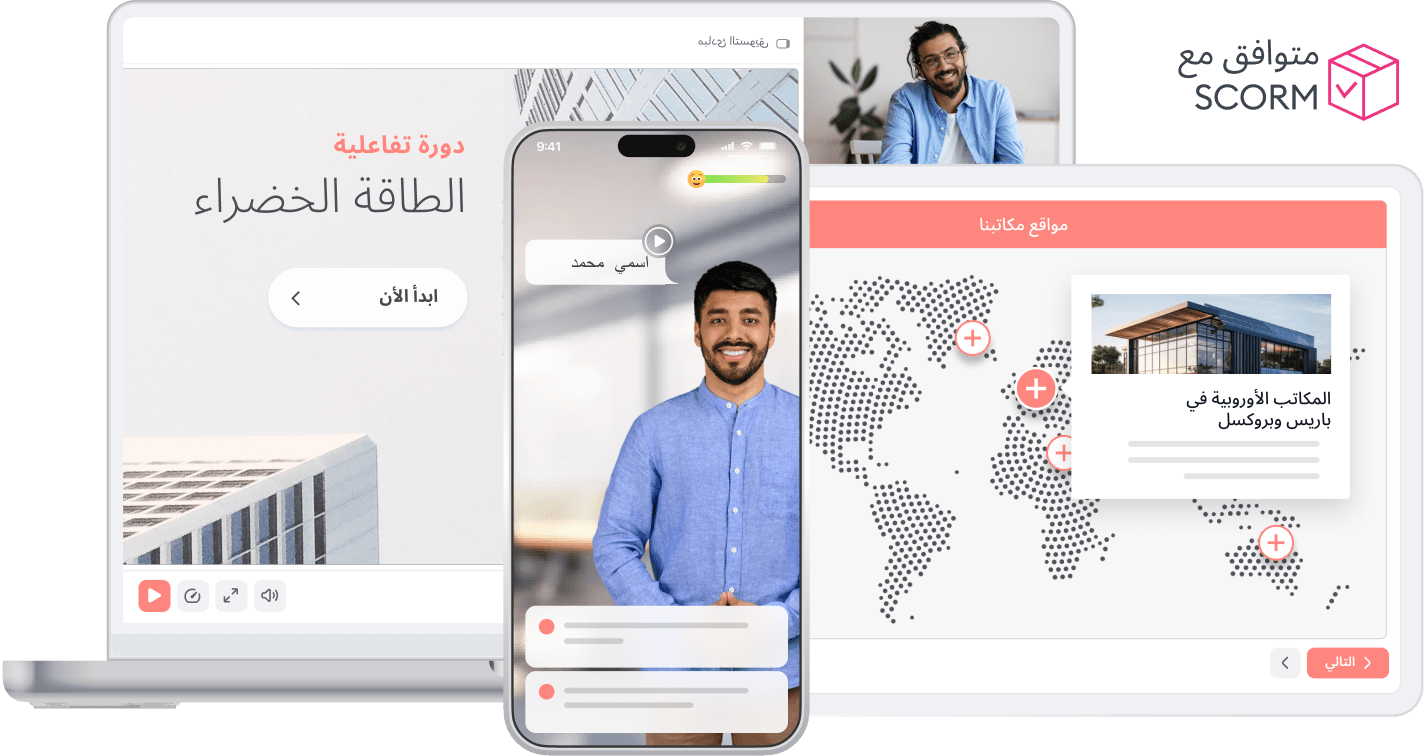
Desktop Suite requires Windows and a supported desktop version of PowerPoint. Browser-based Cloud AI provides another authoring route; viewing a finished course on a Mac or phone is a different matter from creating it. Buyers should test their own requirements rather than infer compatibility from a screenshot of a tablet.
A useful pilot is small enough to finish. Choose one recurring training problem. Use the real slides, the real reviewer and the device employees will use. Add a decision the learner must make. Check the completion record, then ask the learner to perform the relevant task. For Arabic content, inspect the actual wording and display on those devices. A beautiful demonstration says little about a course nobody has yet tried.
Hands-on work still needs hands-on assessment. Completion records show that someone finished a course; they cannot, by themselves, establish competent performance. Zoltek’s account makes that boundary explicit where manual practice and tool use are involved. For those tasks, online instruction belongs beside supervised practice.
iSpring MEA’s proposition becomes persuasive at this modest scale: an expert contributes more easily, a course becomes easier to update, a manager can see who needs another attempt. The neglected slide deck finally earns its keep. The people making it have a better question to answer than whether every slide has been viewed: what should happen differently when the learner returns to work?
Open the toolbox
Explore the products, regional learning resources and customer accounts discussed here.