The modern restaurant employee may learn a new menu between orders. A hotel supervisor might approve a skills check while crossing the lobby. A franchise operator has to know that 300 locations received the same safety update without pretending all 300 locations work the same way. This is the unglamorous, unforgiving corner of corporate software where Schoox built its business: training people who do not spend their day parked in front of corporate email.
Founded in 2012 by Lefteris Ntouanoglou, Costas Vasiliou and Bill Lolos, the Austin-based company sells a cloud learning platform for onboarding, compliance, course creation, skills development and performance reporting. The company says more than 4,500 organizations now use it, reaching 20 million learners in 180 countries. Its customer list includes Sonesta Hotels, The Fresh Market, Subway, KIOTI Tractor, Biscuitville and Sport Clips - businesses whose org charts tend to look less like trees and more like subway maps.
The first thing that failed was the old system
Schoox's origin story is refreshingly ordinary. The founders had experienced an older learning and talent system that was difficult to implement, cumbersome to administer and even harder to persuade employees to use. The failure was not a moonshot exploding on a launchpad. It was software behaving exactly like software nobody wanted to open.
That frustration changed the brief. Instead of optimizing a system around administrators and compliance records, Schoox built around the learner, with mobile access and a configurable model of the organization underneath. A course could be assigned by brand, job, region, department or location. A franchise group could preserve local structure without losing corporate oversight. A manager could combine a short video with an in-person observation and keep both in one record.
This is the useful idea to steal: choose a customer whose operating reality makes the generic product visibly break. Schoox did not initially need to win every knowledge worker. It needed to make training survive a shift change, a shared device, a franchise boundary and a new employee's first week.
One product, several jobs
At its center, Schoox is an enterprise LMS: companies create or upload courses, assign them, test knowledge and report completion. It supports self-paced lessons, instructor-led sessions, virtual classrooms, on-the-job checks, SCORM and xAPI content, social features and gamification. Its custom-branded mobile app comes without a separate app fee. A content marketplace offers more than 100,000 courses from 13 providers, ranging from general business skills to safety and hospitality instruction.
Then comes the development layer: skills maps, career paths, coaching, goals and personalized recommendations. For the buyer, the promise is consolidation. Onboarding, mandatory training, manager development and external partner education can live inside one configurable system rather than a thicket of portals.
The business model is familiar enterprise SaaS. Schoox sells annual subscriptions through custom quotes based on active learners and the chosen tier. Marketplace libraries may be licensed separately. There is no public price card, and the 2021 strategic growth investment from Vista Equity Partners' Endeavor Fund came with no disclosed dollar figure. In other words, the honest answer to “what did it cost?” is: outsiders cannot know from public terms. Buyers have to price the software against rollout labor, content licenses and the cost of the problem it replaces.
“The skills gap isn't widening - it's exploding.”Lefteris Ntouanoglou, founder and CEO
The bet changed from learning activity to business impact
Schoox was initially skeptical of the first rush of generative AI. Its leaders could see that models made course creation faster, but another machine that produced more content did not solve the executive's real complaint: nobody could show whether training changed revenue, retention, safety or speed to proficiency. That realization changed the company's pitch.
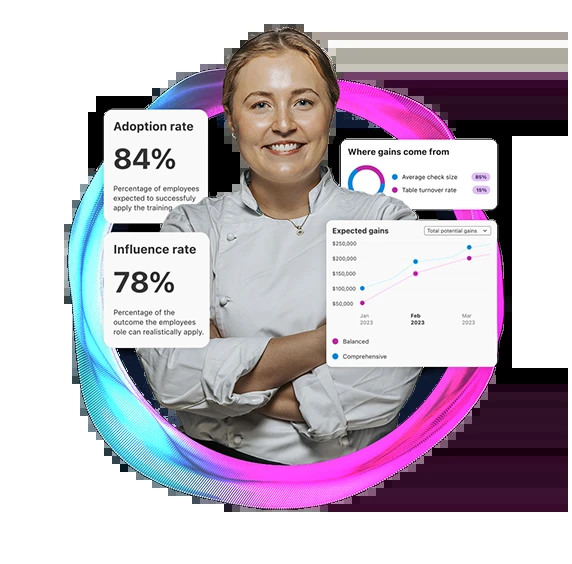
The Learning Impact Suite, launched in November 2025, starts with a desired business result. Software helps map that goal to role-specific skills, identifies gaps in the existing library, generates or arranges a training plan, delivers it to the relevant employees and then monitors the associated metric. Schoox calls the stages Model, Develop, Deliver and Optimize. The sequence matters more than the acronym soup. It forces the learning team to name a result before commissioning another course.
There is a practical restraint in the AI design: administrators choose whether to enable the features, and Schoox says tenant data is not used to train external models or shared among customers. Several AI features, including micro-course creation and skills mapping, are included in the platform subscription. The larger value proposition is not “press button, receive curriculum.” It is using AI to narrow the distance between an operational objective and the specific practice an employee needs next.
Where the ROI story gets concrete
Schoox's strongest proof does not come from feature counts. It comes from customer operations. In its 2024 Impact Awards, Sonesta Hotels reported saving $600,000 on new-hire training and cutting onboarding time by 10 percent. Altitude Trampoline Park reported an 80 percent reduction in the time required to open new locations and a 36 percent increase in employee retention associated with high training engagement. KIOTI Tractor reported doubling reporting and compliance performance while cutting course-creation time by 20 percent.
Those figures should be read as case results, not universal guarantees. Still, they reveal the market Schoox occupies. Docebo, Cornerstone, Absorb, SAP SuccessFactors Learning, Adobe Learning Manager and HCM-suite learning modules can all cover pieces of the same job. Schoox's differentiation is the combination of mobile-first delivery, complicated organizational structure, frontline use cases and a newly explicit attempt to measure business impact.
Its partnership with UKG is strategically useful here. UKG offers a learning solution powered by Schoox, giving the specialist platform distribution inside a much broader workforce-management relationship. Other partners extend content, training operations, rewards, scheduling and hands-on instruction. Schoox is not trying to author every safety lesson or replace every HR system. It wants to be the learning layer that connects them.
That puts the company in a useful middle position. A bare-bones LMS can distribute files and record attendance cheaply. A giant human-capital suite can fold learning into payroll, recruiting and performance management, giving procurement one vendor to manage. Schoox has to earn its place between them by making frontline complexity worth a specialist contract. Its argument gets stronger as the number of locations, roles, languages and franchise relationships rises. It gets weaker when a buyer mainly needs a tidy course portal for 80 people. The market fit is therefore not “any company that trains.” It is an enterprise where inconsistent execution across locations creates a visible bill - slow openings, repeated safety work, uneven service or new hires who take too long to become useful.
What a buyer can copy - and where it breaks
A learning leader can borrow the method without buying the software. Pick one operating metric. Identify the roles that influence it. Describe the observable skills those roles require. Audit existing material against those skills. Deliver the smallest useful intervention, then compare performance before and after. This is less theatrical than announcing an “academy,” but more likely to survive the next budget meeting.
The approach also asks for discipline. A correlation between training and retention is not automatically causation. Store managers, wages, staffing levels and local demand can all move the same number. Good implementation needs baseline data, a comparison group where possible, patient measurement and somebody with authority over both learning and operations.
There is another frontline reality software cannot tidy away. A mobile lesson can make training available, but not necessarily paid, protected or useful. If employees are expected to complete mandatory learning off the clock, or managers treat the app as a box-checking exercise, better personalization will not repair the labor practice. The tool works under conditions the customer must create: time to learn, relevant content, in-person practice where safety demands it and accountability beyond the completion screen.
That makes Schoox's latest promise both appealing and dangerous. The closer learning software gets to the business result, the easier it is to expose weak training - and the harder it becomes to hide weak management behind a dashboard. For a company born from a system nobody wanted to use, that is a fitting next test. The course is no longer finished when the employee clicks “complete.” It is finished when something at work gets better.
Continue exploring