A lawsuit does not arrive as a tidy stack of exhibits. It arrives as email threads, Teams chats, spreadsheets, phone extractions, PDFs, duplicates, attachments and a few messages that somebody wishes had disappeared. Relativity is the machinery lawyers use to turn that digital landslide into a reviewable record. The Chicago company’s flagship, RelativityOne, collects and processes data, lets teams search and classify it, protects privileged material, redacts sensitive information and prepares productions. Increasingly, it also asks artificial intelligence to point at what matters and explain why.
That last phrase - explain why - is the crux. A general chatbot can draft a plausible answer. In discovery, plausible is a dangerous standard. A missed document can alter settlement strategy; an exposed privileged email can trigger a clawback; a shaky breach list can notify the wrong people. Relativity’s wager is that AI earns a seat in legal work when it lives inside the governed matter, uses the actual evidence, exposes a rationale and leaves the final call to a human.
The product nobody bought
Relativity began in 2001 as kCura, Andrew Sieja’s boutique software consultancy. The name was a mash-up of “k” for knowledge and a Latin root for management. The domain was available. An early customer asked the team to build document-search software, then declined to buy it. kCura kept the rights. That rejection was the first thing to fail - and, usefully, it left the company holding a product.
The timing did the rest. By 2007, legal discovery was turning electronic and the volume of corporate data was climbing. The company stopped consulting and concentrated on the system that became Relativity. This was less a lightning-bolt pivot than a pattern noticed early: law firms had a recurring, expensive information problem, and each matter improved the tool for the next one. “Customer by customer, case by case, gigabyte by gigabyte,” Sieja later wrote, users helped shape the platform.
In 2017, kCura took the name of its flagship product. By then Relativity was no longer a quirky project born beside a second-hand green couch - the company’s fact sheet lovingly records its $25 price - but a common layer across law firms, government agencies, corporations and the service providers that run discovery on their behalf.
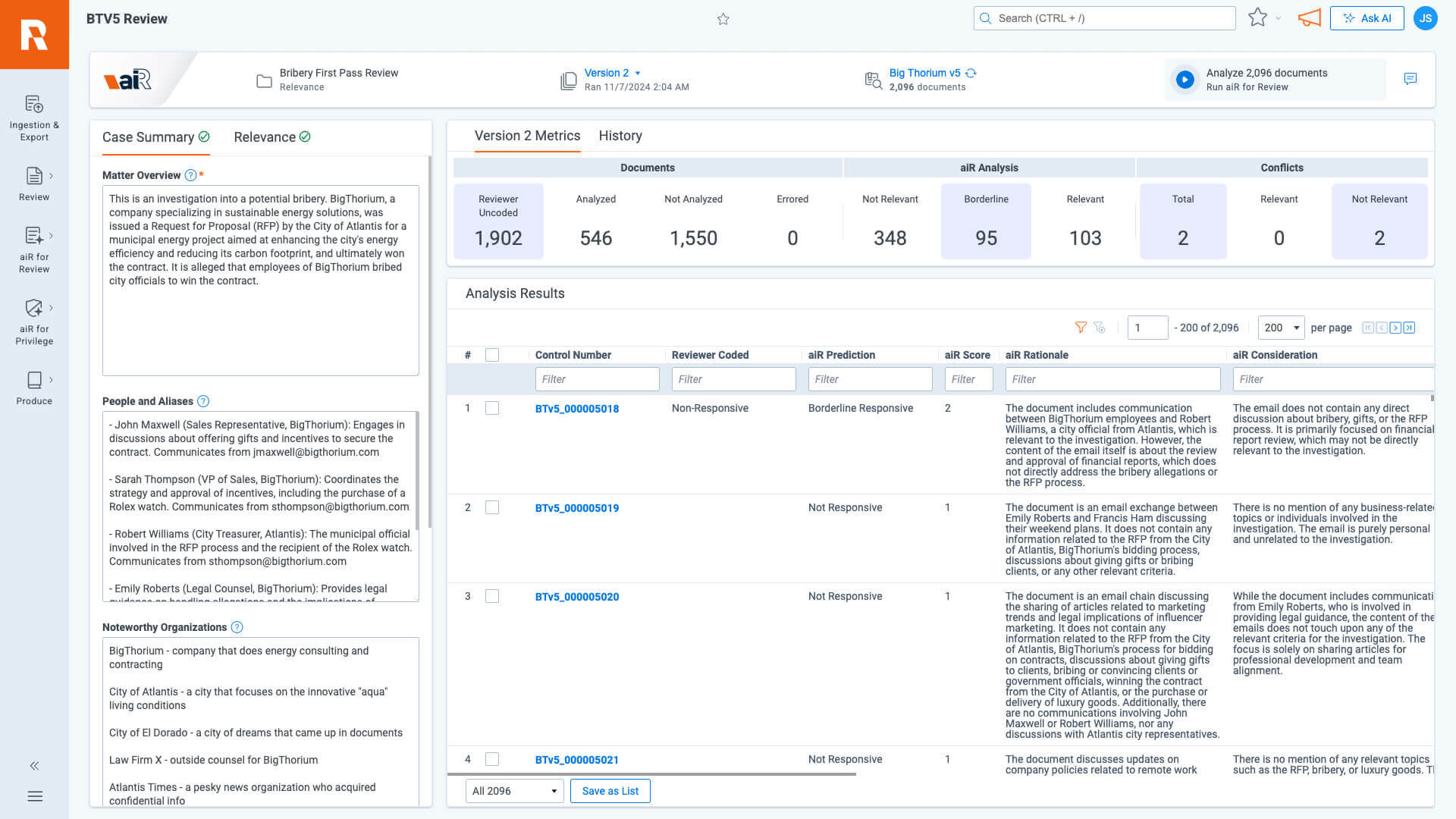
One matter, five jobs, fewer handoffs
RelativityOne is the base layer: preservation, collection, processing, early case assessment, review, analytics, redaction, translation and production in an Azure-hosted workspace. Relativity Legal Hold handles custodian notices and preservation. Contracts applies review workflows to agreements. An app ecosystem and service-provider network extend the platform for specialized work.
The aiR family sits on top. aiR for Review classifies documents for relevance and issues. aiR for Privilege looks for protected communications and drafts descriptions for a privilege log. aiR for Case Strategy extracts facts, people and dates into a developing narrative. aiR for Data Breach Response identifies personal or health information, links it to affected people and produces notification-ready outputs. aiR Assist offers conversational access to matter data, while claiR - introduced in advanced access in August 2026 - is designed to answer plain-language questions across the full record with citations.
The practical difference is fewer exports between point tools. Evidence, metadata, permissions and audit history stay in one place while the team changes tasks. That does not make every tool elegant, nor every result correct. It does make the chain of custody and the reasoning easier to inspect.
“Organize data. Discover the truth. Act on it.”Relativity’s mission - terse enough to fit on a legal pad
What did the speed buy?
Relativity’s best evidence comes from customer case studies, so the numbers deserve the proper label: reported outcomes, not controlled guarantees. IntrepidX says it used aiR to cut a 500,000-document post-search set to 67,000 responsive documents, generate 10,000 privilege descriptions overnight and complete the workflow in under two weeks with a lean team. It estimated $46,800 in avoided privilege-review cost. Baker McKenzie describes a 100,000-document matter where a traditional privilege review was expected to cost $300,000. In another published case, Law In Order calculated that assisted review reduced a 157,000-document job from an estimated AUD 314,000 in manual review to AUD 29,000 in review plus analytics - a reported AUD 285,000 saving.
The economic mechanism is not mysterious. Human review is expensive, and most collected documents are not useful. Software pays when it safely reduces the population that senior people must inspect. It fails economically when the matter is too small, the data is unusually cheap to review, criteria keep changing, or the team runs an AI pass without using the result to shrink downstream work.
What does Relativity itself cost? There is no clean sticker price. Enterprise contracts are negotiated around committed capacity, review and repository storage, workspaces, users, support, and AI units or thresholds. Cost Explorer tracks billable peak data and product consumption. Service-provider fees add another layer. The honest buying question is not “What is the per-GB rate?” but “What will we ingest, retain, promote to review, analyze and keep hot each month?” A low hosting quote can still produce a high bill if teams preserve everything forever.
The cloud deadline is the strategy
Relativity’s biggest product decision is also its most uncomfortable. The company spent its first era becoming configurable server software embedded in partner businesses and law-firm routines. Now it wants one cloud platform with a faster release cadence, common security controls and integrated AI. In January 2025, CEO Phil Saunders said that new matters created from January 1, 2028 must generally be hosted in RelativityOne. Existing Server matters remain supported, and limited geographic or regulatory exceptions apply.
Relativity’s early-2026 update; the figure describes company business, not a universal customer migration rate.
What changed the company’s mind was not one outage or one competitor. Scale, security and AI all reward a shared cloud architecture. Relativity said more than 75 percent of its business was already in RelativityOne by early 2025; an early-2026 update put it near 79 percent and said more than 600 terabytes moved during the second half of 2025. The company offers migration tools, test environments, incentives and technical help because this is not a browser refresh. Customers must map workspaces, integrations, custom applications, permissions, security approvals and client economics.
The migration will not fit everyone. A disconnected environment, strict data-sovereignty rule, unsupported geography or bespoke server integration can make cloud deployment impractical. A service provider whose margin depends on on-premise hosting may see the economics differently from a corporate legal department that wants less infrastructure. Relativity has left room for narrow exceptions, but its direction is unambiguous.
A moat made of habits
Everlaw, Reveal, DISCO, Nuix and OpenText offer platform alternatives; Consilio, Epiq and other service firms combine people, process and technology. New AI-native legal companies attack drafting, research and workflow from another direction. Relativity’s advantage is not that competitors lack search or models. It is an installed network: trained reviewers, certified administrators, custom apps, service partners, security approvals and matter templates accumulated over years.
| Choice | Why it wins | Where it strains |
|---|---|---|
| RelativityOne | Depth, configurability, partner network, governed AI and large-matter scale | Negotiated pricing, learning curve and migration work |
| Cloud challengers | Often simpler interfaces, faster onboarding or a cleaner all-in-one experience | Smaller installed ecosystems or less workflow customization |
| Server / point tools | Local control, known workflows and specific regulatory fit | Slower updates, fragmented handoffs and limited access to new AI |
That moat can become a trap if familiarity turns into friction. Relativity is responding by moving closer to the lawyer. It acquired Gavel in June 2026 to connect matter intelligence with drafting and redlining in Microsoft Word. It has linked mobile collection through Cellebrite, deepened its Azure and Microsoft 365 relationship, and announced a Gemini Enterprise for Legal connection through Model Context Protocol. The ambition is wider than e-discovery: keep context attached from raw evidence through strategy and finished work product.
The part worth copying
A legal team does not need Relativity’s scale to borrow its useful idea. Put AI where the work and the evidence already live. Define the question before paying to analyze the whole corpus. Make the system show a rationale. Sample the easy calls, inspect the borderline calls, investigate disagreements and preserve an audit trail. Then measure avoided human review rather than celebrating how many documents the model touched.
Five moves to steal - no 93-petabyte estate required
- Choose a representative closed matter with a known outcome.
- Write relevance and privilege criteria as if briefing a new reviewer.
- Run a small sample first; revise ambiguous criteria before scaling.
- Review conflicts, low-confidence calls and a random slice of the rest.
- Compare total cost, recall, precision and attorney hours with the old workflow.
Conditions matter. The playbook breaks when source data is incomplete, the legal question is unstable, nobody owns quality control, or a team treats generated reasoning as evidence rather than a lead. It also breaks when savings from fewer reviewers are swallowed by hosting, migration and consulting costs. Human judgment remains in the loop not as a ceremonial disclaimer but because courts, regulators and clients ultimately ask people to defend the process.
Relativity’s history gives it a peculiar advantage in the AI moment. It started with a product a customer would not buy, learned from thousands of matters and became infrastructure before trying to become an assistant. The next phase will be judged less by whether aiR can read quickly than by whether lawyers can disagree with it intelligently - and still find the email that changes the case.
Go inside the matter
Explore the platform, product education and public channels, including two short demonstrations of how aiR works.