In 1999, the browser was where you read the news, checked an unruly Hotmail inbox, and waited for images to arrive one horizontal stripe at a time. NetDocuments asked law firms to put their working memory there. Contracts, briefs, emails, client confidences - the material that makes lawyers useful and keeps risk officers awake - would live outside the office server and arrive as a service. The name for this delivery model, software as a service, had barely entered the business vocabulary. The bet sounded less like product strategy than an argument with the IT department.
Ken Duncan, Lee Duncan, and Alvin Tedjamulia had earned the right to make it. Their earlier document-management company, SoftSolutions, was bought by WordPerfect in 1993. NetDocuments took the lesson and removed the machinery: no local server fleet, no upgrade weekend, no different version in every office. A lawyer could open the same matter from another floor, another city, or a client's conference room. The product was the filing cabinet; the commercial model was a subscription; the real promise was continuity.
The filing cabinet became a platform
The modern NetDocuments is easiest to understand from the center out. At the center is a matter-centric document and email system: search, metadata, version history, access controls, audit trails, records policy, and Microsoft 365 integration. Around it sit ndMail for putting email in the right matter, CollabSpaces for sharing controlled files with clients, SetBuilder for compiling transaction binders, and PatternBuilder for turning questionnaires and rules into finished documents and workflows.
That adjacency is the business model. NetDocuments and its partners sell per-user monthly subscriptions, then charge for the implementation, migration, integrations, and optional modules a firm chooses. There is no public menu with a neat dollar figure. The expensive part is often not the license anyway. It is cleaning decades of folders, translating taxonomies, testing ethical walls, moving versions, retraining impatient professionals, and keeping the old system alive while the new one earns trust.
The customer range is broad but not mysterious: small practices, global law firms, in-house legal departments, compliance teams, and public agencies. More than 7,000 organizations now use the portfolio. A 2024 presentation with Amazon Web Services put daily global users above 185,000 and stored documents above eight billion. Those numbers explain why NetDocuments matters to the AI race. Everyone can rent a capable model. Very few vendors already sit on a governed, permissioned archive of what a firm has done, for whom, and with which outcome.
AI with a keycard, not a visitor badge
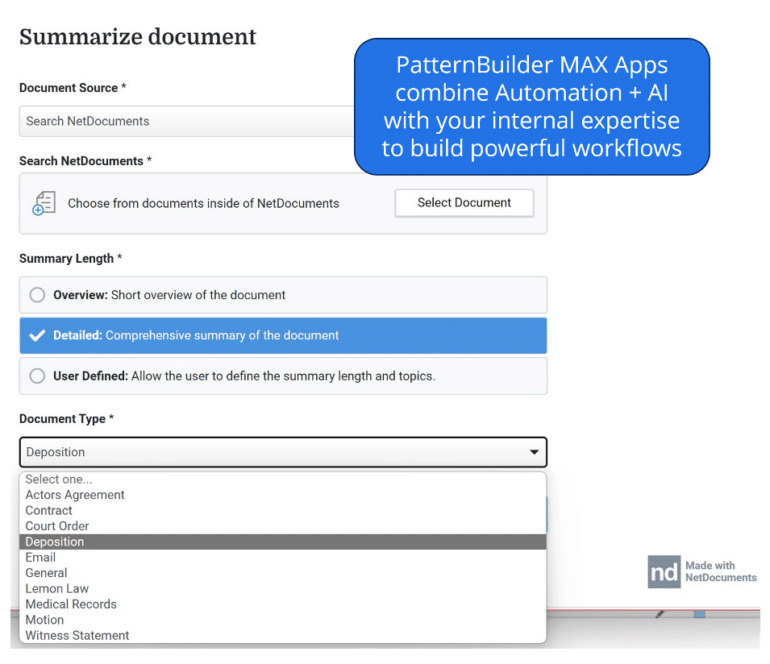
NetDocuments' first useful AI move was not a universal chat box. PatternBuilder MAX, introduced in 2023, added generative calls to a no-code automation engine. A legal team could chain prompts, extraction, human inputs, and document generation into a repeatable app. By March 2024, the company said roughly 13,000 users had access, customers had built more than 500 apps, and the system had handled more than 18,000 prompts. One firm's ten-prompt workflow processed or drafted the equivalent of 30,000 pages in a week.
In 2026, the pitch moved from apps to context. Smart Answers lets a user ask natural-language questions of the firm's own repository and receive answers with citations. The reimagined platform, announced in May and opened first as a private preview, adds a Legal Context Graph: a continuously updated map connecting matters, documents, communications, parties, precedent, and people. Existing permissions and ethical walls are supposed to travel with every connection.
The context loop
The company also decided the winning AI model might belong to somebody else. Its ndConnect program gives tools from Harvey, Legora, Thomson Reuters, and others a governed route into NetDocuments content. Direct connections include Claude, Microsoft Copilot, and additional model providers through MCP. That is a pragmatic position: own the context and control plane, let customers choose the intelligence they prefer.
NetDocuments' August benchmark makes the economic claim explicit. Holding the model, questions, agent, and documents constant, it reported that structured legal context reduced the cost of a correct answer by 48 percent while keeping answer quality essentially steady. The study is a company benchmark, not a universal law of AI. Still, the mechanism is plausible: when a system already knows which matter, version, party, and precedent matter, the model spends fewer tokens rediscovering the filing cabinet.
What they bought, and what it bought them
The expansion was financed and occasionally acquired. Frontier Capital invested $25 million in 2014. Clearlake Capital bought its position in 2017 and pushed a wider small-firm, corporate, and government go-to-market motion. During Clearlake's four-year period, annual recurring revenue grew 250 percent. Cove Hill invested in 2019; Warburg Pincus replaced Clearlake in 2021. Later deal terms were not disclosed, though the 2021 transaction was reported at a $1.4 billion valuation that NetDocuments did not confirm.
The acquisitions filled recognizable gaps. Afterpattern supplied no-code document automation and became the foundation for PatternBuilder. Worldox brought a large community from a veteran on-premises DMS. The eDOCS purchase from OpenText, completed in January 2026, added a product, a specialist team, and reach into more than 90 countries. NetDocuments says eDOCS has no planned end of life. That is an unusually patient migration funnel: keep the legacy system working, then offer the cloud platform when the customer is ready.
A six-hour chore meets a half-hour tool
The cleanest product proof is delightfully mundane. A pensions lawyer at Walker Morris described a small document bible taking roughly six hours on a previous platform, with crashes capable of erasing the work. In SetBuilder, the job took about half an hour. NetDocuments materials also claim average hard-cost savings of nearly $1,500 per transaction for organizations using the bundling tool. The lawyer did not get a futuristic oracle. She got five and a half hours back and could promise delivery today instead of next week.
That pattern tells other software builders what to copy. Begin with the system of record, where permissions and user habits already live. Watch for adjacent work that leaves the system - the email dragged to a folder, the closing binder assembled by hand, the intake question copied into six documents. Automate one loop completely. Preserve an escape hatch for specialists. Then measure the returned time rather than the number of buttons shipped.
- Own a trusted system of record before adding an intelligence layer.
- Automate a whole workflow, not one sparkling prompt in the middle.
- Carry permissions and citations into every AI answer.
- Let customers connect outside tools instead of demanding a closed stack.
The first thing to fail is adoption
Document systems are closer to office plumbing than ordinary apps. If a migration mislabels matters, if deep folders become hard to search, or if Outlook slows down, a lawyer does not admire the roadmap. They route around the system. A public case study from rival iManage describes an anonymous global corporate legal team abandoning NetDocuments after two and a half years, citing difficult administration, search, reliability, support, and weak adoption. It is one customer's account in a competitor's marketing, but the failure mode is credible because every DMS depends on disciplined configuration and daily use.
Successful customers describe the inverse. Ellisons Solicitors made its own short training videos and guides, calculated time lost to repetitive filing and photocopying, and framed remote access in terms of client service. The technology changed their minds only after the work changed: a managing partner could see a current matter without tracking down the absent partner; staff could drag email into the client file; version-controlled documents could reach clients without paper copies.
Where it fits
Legal organizations with sensitive matter content, formal governance, Microsoft workflows, multiple offices, external collaborators, and enough repetitive work to justify automation.
Where it strains
Tiny teams needing simple storage, buyers unwilling to fund migration and training, or organizations whose essential bespoke workflow cannot survive a realistic pilot.
The closest alternative is iManage, particularly in larger firms. Microsoft SharePoint and OneDrive can satisfy organizations willing to assemble more of the legal layer themselves. Clio may cover the smaller practice that values practice management over enterprise content governance. Box and Dropbox solve simpler collaboration needs. The NetDocuments difference is the combination of cloud-native legal architecture, matter controls, document automation, and an integration network that now stretches from Microsoft and DocuSign to specialist legal AI.
It will not work merely because the buyer likes the demo. A firm needs an accountable migration owner, a tested taxonomy, real ethical-wall scenarios, integration checks, a trained help desk, and lawyers in the pilot who are willing to complain specifically. AI adds one more condition: the documents and permissions must already be reliable. A context graph built over disorder can make disorder easier to retrieve.
The next cabinet is a map
NetDocuments has made the Inc. 5000 five years in a row and ranked No. 3,265 in 2026. That achievement matters less as a trophy than as evidence that a 27-year-old vertical software company can keep finding a larger job. It began by moving the cabinet. Then it organized the mail around it, invited the client in, automated the paperwork, and connected outside AI.
The 2026 question is whether the cabinet can understand its contents well enough to become a map. If the Legal Context Graph works at full firm scale, a new lawyer could open a matter and see the parties, timeline, relevant work product, and colleagues with useful experience without reconstructing everything from scratch. An agent could draft against the firm's actual precedent while seeing only what its user is permitted to see. That is more demanding than chat. It is also much closer to the way professional memory creates value.
There is nothing inevitable about success. Private preview claims must survive broad deployment; integrations must remain governable; firms must decide how much institutional inference clients will permit. But NetDocuments has one advantage its younger AI competitors cannot speed-run: years spent learning how lawyers file, resist, search, share, and worry. The old cloud bet looked like infrastructure. It may turn out to have been the patient acquisition of context.
Reported efficiency figures reflect customer examples or NetDocuments' own materials and will vary by workflow, data quality, implementation, and model usage.