The litigation platform that treats a case file like an intelligent database instead of a shared drive - built by a lawyer who got tired of hunting through folders.
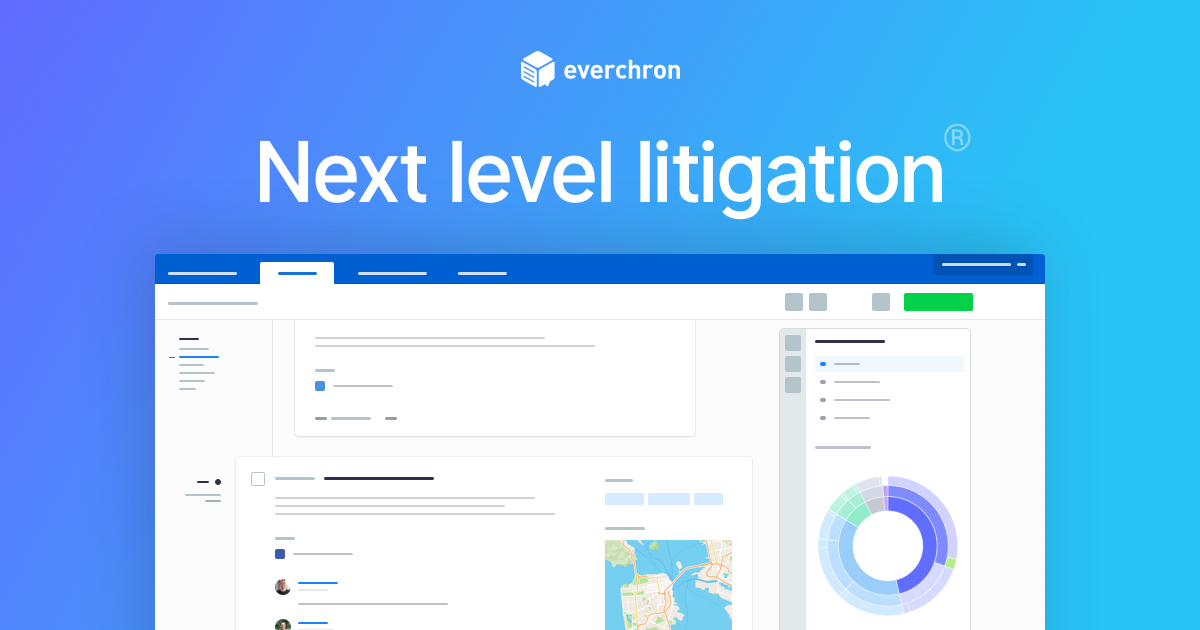
The pitch, unadorned. Everchron's own share card reads simply "Next level litigation." Behind the wordmark: a case chronology, a document panel, a witness list, and a data wheel - the daily furniture of complex litigation, all on one screen.
Here is a fact about litigation that nobody puts on a billboard: a great deal of it is not arguing. It is filing. A complex case can involve thousands of documents, dozens of parties, hundreds of deposition pages, and one very anxious associate at 11 p.m. trying to find the email that proves the thing. The lawyering happens in the gaps between all that retrieval.
Ofer Bleiweiss knew those gaps well. Before Everchron, he practiced litigation at Irell & Manella - one of the more formidable names in the business - and then ran his own law office. He has a J.D. from USC Gould and, tellingly, a UC Berkeley degree in psychology and mathematics, which is roughly the right toolkit for someone who wants to understand both how humans organize information and how they fail to.
The premise of Everchron, founded in 2012, is that the tooling most litigators use to manage a case is a spreadsheet, a shared drive, and heroic memory. Those work until the case gets big, at which point they quietly stop working and nobody notices until a document is misfiled or two associates are maintaining two conflicting timelines of the same events.
Everchron's answer is a single, cloud-based place where the whole team keeps the case's structured knowledge: the chronology, the documents, the witnesses, the transcripts. The company describes itself, without much flourish, as "the first collaborative case management platform for litigators." The operative word is collaborative. Being on the same page, in litigation, is not a nice-to-have. It is the job.
The company stayed small and stayed focused. It is a roughly 19-person operation, remote-first, competing in a market where the other logos are considerably larger. Its market position is less "disrupt everything" and more "do the litigator's core workflow carefully, and earn trust one AmLaw firm at a time."
Built by lawyers, for lawyers.- Everchron's founding principle, and the whole thesis in four words
* Everchron states it is relied on by AmLaw 100 firms, litigation boutiques, and corporate counsel; exact customer counts are not publicly disclosed.
The product is organized around the artifacts a litigator lives inside. Nothing here is exotic. The value is that these things finally sit together, updated by the whole team, instead of scattered across a drive.
Build a living case timeline that links facts, events, documents, issues, and people. Entries can be tagged and filtered to develop the narrative you'll eventually argue.
An intelligent filing system for case documents, built to survive large, messy matters - including multi-district litigation with a crowd of parties.
Auto-generated profiles that connect the key people in a matter to their documents, exportable into a ready-to-use witness kit. Prep that used to eat a weekend.
Deposition and testimony management, with transcript syncing so the record is searchable and organized rather than a stack of PDFs.
Mark, categorize, and manage deposition designations - the unglamorous but decisive work of deciding what testimony goes in front of the court.
Generative AI that interrogates the documents already in your matter - summaries and insights grounded in the case record, not the open internet.
Every legal-tech company now has an AI story, and most of them are betting the same chip. Everchron's version, EC:AI, has a useful constraint baked in: it answers from the documents already inside your matter. In a profession where a fabricated citation can end a career, "the AI reads your evidence" is a more sellable promise than "the AI knows things."
That constraint is also a product strategy. The company that owns the structured case file - the chronology, the master file, the transcripts - is the company best positioned to put grounded AI on top of it. Everchron spent a decade assembling that file. The AI is the payoff, not the pivot.
Litigator-turned-founder. Bleiweiss practiced at Irell & Manella (2006-2012) and ran the Law Offices of Ofer Bleiweiss before starting Everchron. He holds a J.D. from USC Gould School of Law and a B.A. in Psychology and Mathematics from UC Berkeley.
The relevant credential isn't the degree list - it's that he billed the hours. Everchron is the tool he wanted and never had, which is the oldest and most reliable origin story in vertical software: the best product is often the one the founder personally needed.
A leading litigation management software solution that provides legal teams with a secure and collaborative solution in the cloud.- How Everchron describes itself
Ofer Bleiweiss leaves private practice to build a collaborative case-management platform for litigators in Los Angeles.
Everchron's case-management technology becomes available in the Relativity ecosystem, connecting ediscovery review with case management.
Everchron closes an early-stage round associated with MDR Lab, the London legal-tech accelerator.
The company earns attention as part of a wave of legal-tech built outside Silicon Valley.
Everchron achieves SOC 2 Type II compliance and rolls out EC:AI generative-AI features grounded in the case record.
The Everchron Public Interest Community offers the platform free to pro bono and public-interest lawyers.
Everchron's customers span the litigation food chain: AmLaw 100 firms, top litigation boutiques, corporate legal departments, and general counsel. The common thread is complexity - the matters big enough that a spreadsheet stops being a system and starts being a liability.
The business runs on the familiar B2B SaaS logic: subscriptions, sold to firms and legal departments, with trust earned through security certifications and integrations rather than flash. SOC 2 Type II isn't a growth-hack; in a profession this cautious, the audit report is a feature that closes deals.
Then there's EPIC - the Everchron Public Interest Community - which gives the software away free to organizations and lawyers doing pro bono and public-interest work. It's the kind of program that's easy to read cynically and probably shouldn't be: the same tools that help a mega-firm manage a multi-district case help an under-resourced public-interest lawyer do more with less.
Competition comes from every direction - Everlaw, Relativity, CaseFleet, Opus 2, the old CaseMap/TextMap workflow, and the eternal default: a shared drive and a spreadsheet. Everchron's wager is that focus and lawyer-built design beat breadth.
How years at Irell & Manella shaped Everchron's product philosophy.
Managing litigation with dozens of parties on one intelligent filing system.
Keeping generative AI tethered to the case record instead of hallucinating.
Building enterprise software outside Silicon Valley.
How EPIC puts serious litigation tools in pro bono hands.
From weekend binders to one-click witness kits.
Sources include everchron.com, Stanford CodeX Techindex, Crunchbase, PitchBook, Tracxn, LawNext, Above the Law, and Jameson Legal. Funding, revenue, and customer figures marked approximate are third-party estimates and unverified. Facts stated as certain are drawn from Everchron's own materials and public reporting.