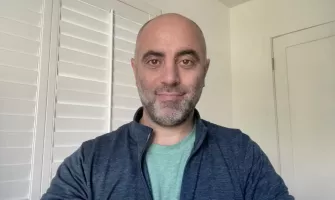
A litigator who got tired of the binder
Most legal software is sold by people who have never pulled an all-nighter before a deposition. Ofer Bleiweiss has. That difference is the whole company.
Ofer Bleiweiss runs Everchron, a cloud-based platform that does something deceptively simple: it puts every fact, document, and witness in a lawsuit within a few clicks of the lawyer who needs them. The pitch on the company's own door is unfussy - "built by lawyers, for lawyers." He means it almost literally. The team he assembled is stocked with senior litigation attorneys who have lived through large-scale document review on high-stakes cases, the kind where a single misfiled exhibit can cost a client dearly.
Before any of that, he was the person doing the filing. Bleiweiss joined the Los Angeles firm Irell & Manella as an associate in 2006, working the sort of complex, document-heavy litigation that makes or breaks careers. The work was intellectually serious. The tooling was not. Lawyers were stitching cases together out of spreadsheets, shared drives, and software that had quietly refused to follow the rest of the world into the cloud. The dominant incumbent, CaseMap, was a desktop relic that never made the jump online. That gap - obvious to anyone living in it, invisible to almost everyone outside - became the opening.
Everchron puts case-critical information and analysis at a lawyer's fingertips.
Around 2012 he hung his own shingle - the Law Offices of Ofer Bleiweiss - and started building the alternative on the side. By 2014 the software had eaten the law practice. He went all-in as founder and CEO of Everchron, betting that the best tools for litigators would come from people who had actually been litigators. It is a bet that runs against the grain of most software companies, where domain experts are consultants brought in late, not the founders.
The shape of the thing he built
The company stays deliberately lean and deliberately scattered - engineers, designers, and ex-litigators working across Los Angeles, Houston, Boston, Washington DC, and abroad. It was distributed before distributed was a buzzword, which tells you something about a founder more interested in hiring the right practitioner than the nearest one.
Witness files that build themselves
Here is the trick that makes litigators lean in. As documents and testimony pour into a matter, Everchron quietly assembles a profile for every witness on its own - linked exhibits, declarations, testimony, and analytics, each tagged with importance and favorability. A partner can land on a name and, in a few clicks, see every scrap of evidence connected to that person. No paralegal army required.
Around that core sit the unglamorous-but-essential parts: dynamic chronologies of key facts, nondestructive highlighting and issue tagging, deposition transcript syncing, and a master file that pulls federal dockets straight from PACER. It imports load files from Relativity, DISCO, Logikcull, Concordance, and Summation without dropping metadata or tags. And it is SOC 2 compliant, because the people using it are handling other people's most sensitive secrets.
The Everchron Philosophy
Three principles the company repeats: streamline the path from information to action, support both collaborative and private work, and design from how lawyers actually practice.
In 2025 the platform leaned hard into generative AI - letting a lawyer ask a question across an entire matter and get an answer, summarize documents, and surface connections between witnesses. Bleiweiss's wager remains consistent: the most useful legal AI will be built by people who understand what a litigator is actually trying to find, not just by people who understand the model.
From associate to operator
Math, psychology, and the law walk into a courtroom
The degree stack is a tell. At UC Berkeley he double-majored in psychology and mathematics - one discipline about how people make sense of chaos, the other about structure underneath it. Then USC's Gould School of Law put both to work. It is hard to imagine a cleaner intellectual blueprint for a product whose entire job is to impose structure on the chaos of a thousand-document case and present it in a way a human brain can actually hold.
The goal is simple: help you win cases.
- Quantitative litigator. A psychology-and-math double major is not the usual on-ramp to courtroom work - or to running a software company. He did both.
- Practitioner-first hiring. The people designing the software are ex-litigators, so the late nights they are fixing are nights they personally remember.
- Filled a gap, not chased a trend. Everchron exists because CaseMap never moved to the cloud and someone living in the gap decided to do something about it.
- Distributed by conviction. A team spread from LA to Houston to DC to overseas, built that way on purpose.