AJ Shankar did not set out to modernize litigation. During his computer science PhD at the University of California, Berkeley, he took a technical-expert assignment for a law firm. The case concerned how the internet worked. The surprise was not the legal argument; it was the software surrounding it. Smart people doing high-stakes work were wrestling with systems that looked inherited from another age. The data was multiplying, the tools were clumsy, and finding one decisive email could mean digging through an electronic landfill.
That accidental encounter became Everlaw, founded in 2010 with practicing lawyer Jeff Friedman. The company built in the cloud before that was an obvious choice for cautious legal departments. It added machine learning before every enterprise pitch acquired an AI slide. Its core proposition was sober: take evidence from collection through processing, search, review, redaction, production, and case preparation in one place. Make the machinery fast enough that lawyers can think about the case instead of waiting for the database.
The bet produced a private company valued above $2 billion after a $202 million Series D in 2021. Everlaw now says more than 1,000 customers use the platform, including Fortune 100 legal departments, 93 of the Am Law 200, leading federal agencies, and every state attorney general. The company sits in a crowded market beside Relativity, DISCO, Reveal, Exterro, Logikcull, Casepoint, and Nuix. Its distinction is less a single trick than the distance it tries to cover: from the first preserved message to the timeline, deposition outline, or brief built from it.
01 / The unglamorous advantageThe AI answer is only as good as its receipts
Generative AI made fluent output cheap. Legal work makes unsupported output expensive. A plausible sentence can still be a professional disaster if nobody can prove which document supports it, who had permission to see that document, or how the answer was produced. Everlaw's current strategy follows from that mismatch. It calls itself the “evidence layer” for legal AI - the governed system of record underneath whichever assistant a lawyer prefers.
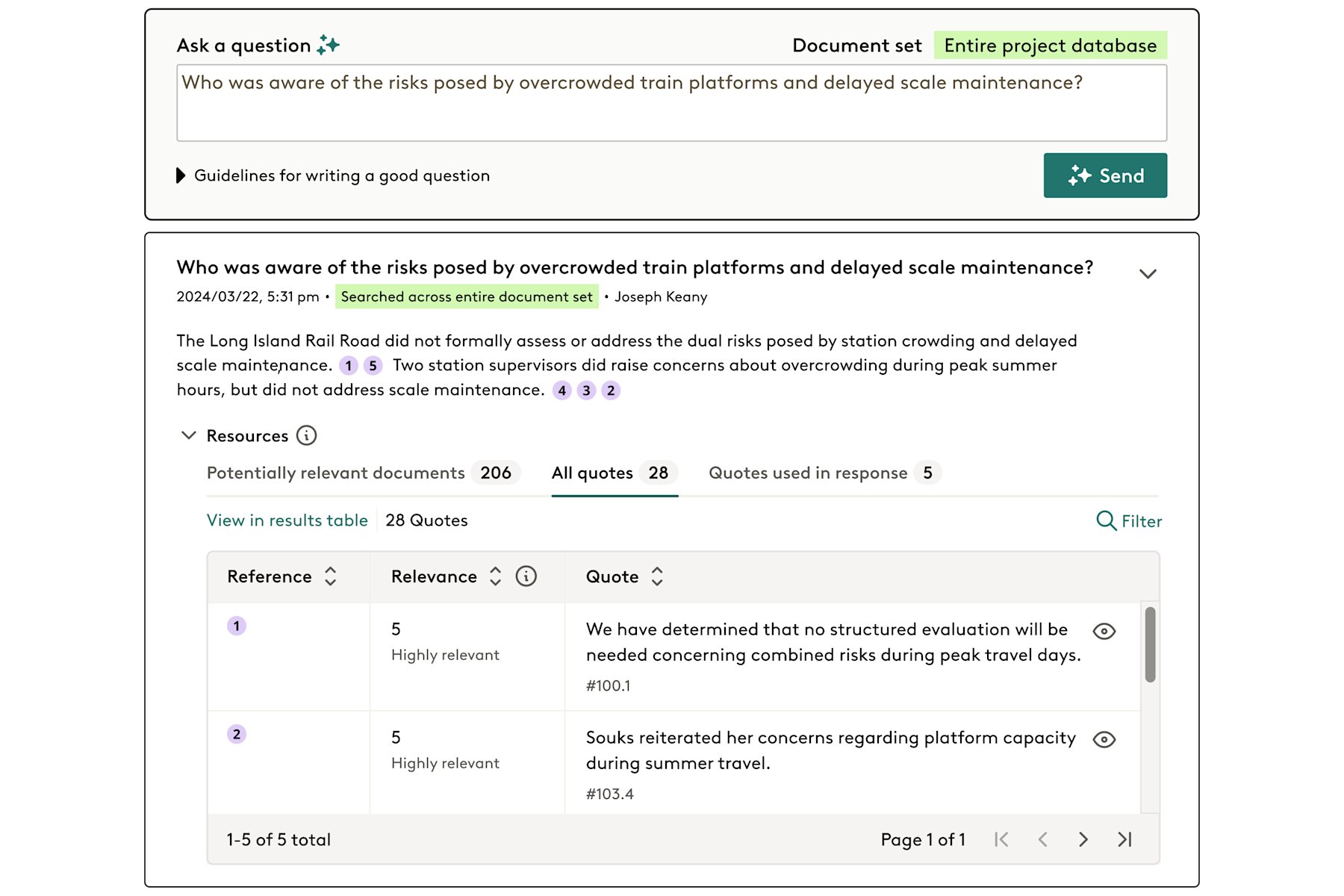
Inside Everlaw, Deep Dive accepts natural-language questions across large collections and returns synthesized answers with citations. Coding Suggestions applies a lawyer's criteria to individual documents and recommends classifications. Writing Assistant turns selected evidence into drafts, outlines, and chronologies. Storybuilder holds facts, testimony, deposition material, timelines, and arguments after review. None of those features removes the lawyer from the loop. Their point is to shrink the distance between “there are three million files” and “here is the claim, with the five records behind it.”
“Litigation data is too complex for a single silver bullet.”AJ Shankar, founder and CEO
The more revealing move is outside the product. In 2026, Everlaw connected or announced connections to Anthropic's Claude, Microsoft 365 Copilot, Google Gemini Enterprise for Legal, Harvey, Legora, and Thomson Reuters CoCounsel Legal. That is a bet against one-model loyalty. Lawyers may research in CoCounsel, draft in Microsoft, and run an agent in Claude or Harvey. Everlaw would rather make the evidence portable to those interfaces than force every task into its own chat window. The prize is becoming infrastructure: less visible than the answer, harder to remove than the assistant that wrote it.
02 / The proof is in the workflowWhat customers actually changed
The clearest customer stories are not about asking an AI to “review everything.” They are about redesigning the funnel. A Fortune 500 construction company had historically sent discovery work to outside providers. On one matter, the old route would have sent 400,000 documents out for review at an estimated $260,000, excluding hosting. Using Everlaw to cull the collection early, the in-house team identified 2,500 records for immediate review and estimated the bill at $75,000 - about 70 percent less.
Another energy-company legal team used early case assessment to reduce 300,000 emails, texts, and documents to 2,000 relevant records in roughly eight hours. Its compliance director estimated that a manual six-week review would have consumed 240 hours and about $140,000 in outside legal fees at a $600 hourly rate. The company could now answer follow-up inquiries in as little as 30 to 60 minutes. Those are customer estimates, not universal guarantees, but they expose the economics: expensive judgment should arrive after cheap filtering, not before it.
The Dinsmore & Shohl example is more instructive because it includes the failure. After a cyber incident, the firm needed to find notice obligations in more than 26,000 contracts. Search alone reached 92 percent recall. That sounds good until the missed eight percent could create another breach. The team layered in AI Coding Suggestions and predictive coding, tested each stage, revised its approach, and sampled the results. Recall rose to 98.2 percent. A manual review was estimated at 260 attorney hours.
What changed the team's mind was not a polished demo. It was measured performance on a live matter. At Orrick, a similar trial on about 10,000 documents in an intellectual-property case moved attorney Cal Yeaman from skepticism to deployment; he estimated that Coding Suggestions cut review cost by more than half. His practical advice was to begin with a small sample, inspect actual documents, and iterate on the prompt. The first thing to fail is often not the model but the instruction - vague criteria produce confidently inconsistent classifications.
03 / The business underneathPay for the data, invite the whole room
Everlaw sells enterprise SaaS, but its unit economics reflect discovery. Commercial prices are quoted rather than posted as a simple sticker. The primary meter is hosted data volume. Standard plans bundle unlimited users, processing, productions, onboarding, training, and support; compute-heavy batch AI actions use credits. The design removes the tax on collaboration. A firm can invite partners, associates, reviewers, a client, and outside experts without counting seats, while Everlaw earns more as the corpus grows.
For buyers, the real cost is larger than the subscription. Migration, collection design, review staffing, data retention, AI credits, and organizational change all matter. The platform works best when a legal team owns the workflow, trains people on consistent coding criteria, and reuses what it learns across matters. It is a weaker fit for a tiny, one-off dispute with little data, a team unwilling to change its process, or a matter whose sources are so poor that no search or model can reliably interpret them. Strict residency, procurement, or integration demands can also erase the speed advantage.
Security is part of the product, not an appendix, because the corpus may contain trade secrets, medical records, executive messages, and material under protective order. Everlaw lists SOC 2 Type 2, FedRAMP Moderate, GovRAMP Moderate, ISO 27001, 27017 and 27018, HIPAA, GDPR, CCPA, and Cyber Essentials Plus among its programs and authorizations. Its AI positioning depends on preserving permissions and auditability when evidence travels into partner tools. If that chain breaks, the “evidence layer” becomes a slogan.

04 / A peculiar operating choiceThe software company that refuses to sprint
Everlaw's product philosophy has an internal counterpart. Shankar has argued publicly that fixed software sprints reward hurried local decisions, create bugs, and slow total output as technical debt compounds. Everlaw instead assigns features to small teams - sometimes one engineer - with ownership across the stack. Engineers decide when a feature is ready, and the company avoids promising customers hard delivery dates.
It is an unfashionable bargain: less calendar certainty in exchange for fewer handoffs and more coherent code. It will not work everywhere. A regulated deadline, contractual launch, or tightly coupled hardware program cannot simply wait for engineering elegance. It also requires senior people who understand customer priorities without a daily ceremony forcing the conversation. But the principle travels well beyond software: shrink the team, widen ownership, and measure completed useful work rather than motion inside a two-week box.
That patience also describes Everlaw's company strategy. The market once doubted that a new entrant could crack discovery software, where incumbents, security requirements, and switching costs were formidable. The cloud changed the opening; pandemic lockdowns accelerated adoption. Generative AI changed it again. Now the platform built to organize the dullest layer of legal work may own the thing every glamorous AI application needs - controlled access to the facts.
Everlaw still has to prove that its many partnerships create daily workflows rather than a crowded logo wall. It must keep AI outputs accurate enough for adversarial scrutiny, maintain trust across corporate and government customers, and justify enterprise spending when rivals bundle similar features. But its core idea is sturdy. In litigation, eloquence is optional. Evidence is not.