EXHIBIT A: The logo of a company whose whole job is making the clock disappear.
Legal Tech / New York / Est. 2023
PointOne
The AI that writes your timesheet while you work - so the most hated chore in law quietly does itself.
The AI that writes your timesheet while you work - so the most hated chore in law quietly does itself.
Somewhere in a Manhattan office tower, a litigation associate closes her laptop and goes home. She does not open a spreadsheet. She does not squint at her calendar trying to remember whether that call ran twelve minutes or eighteen. She does not perform the nightly ritual that lawyers have endured for half a century: turning a day of work into a column of six-minute boxes. PointOne already did it.
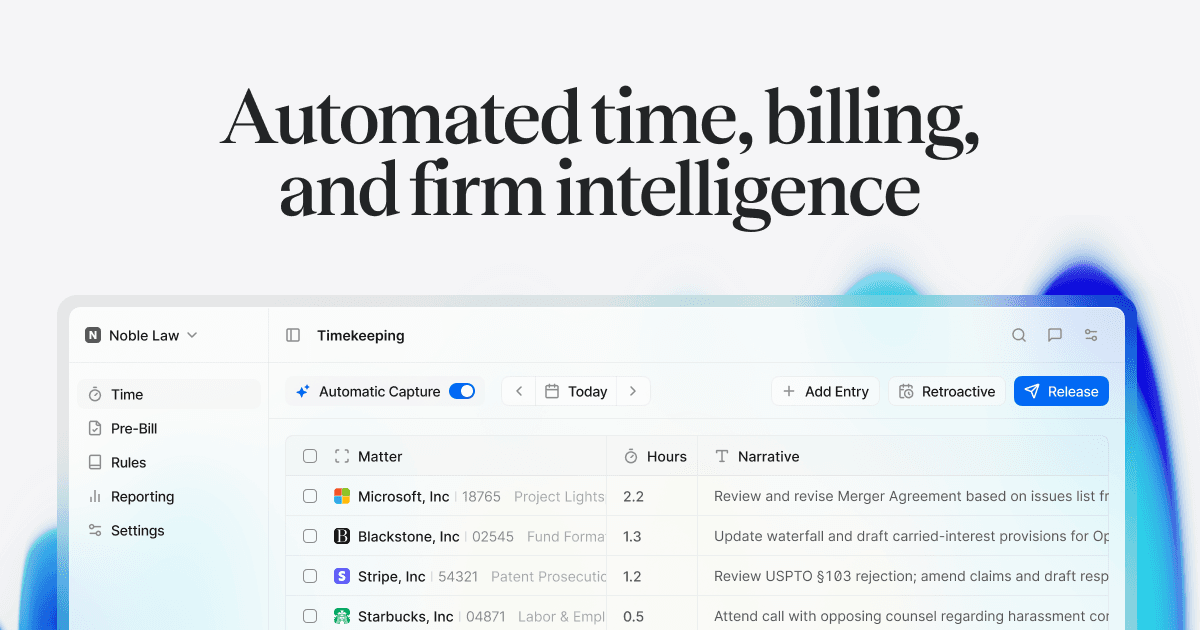
That quiet is the product. PointOne is a New York company that uses AI to capture an attorney's billable day passively - across documents, email, calendar, the web, and phone calls - and turn it into complete, compliant, written time entries. The lawyer reviews. The lawyer does not author from memory. The difference sounds small. The money says otherwise.
"When we looked at the tools law firms were using to manage their most valuable asset, we couldn't believe what we saw."
- Jeremy Ben-Meir, Co-Founder & CTOHere is the awkward arithmetic of legal work. An attorney sits down for roughly eight hours. By the time the day is reconstructed - often days later, often from a foggy memory - only about 2.6 of those hours make it onto a bill. That is roughly a third. The rest evaporates: undocumented, under-described, or simply forgotten. The industry has a polite name for this. It calls it "revenue leakage," as though the money merely wandered off.
The existing tools didn't fix the problem; they digitized it. Timers you forget to start. Entry screens that demand prose at the end of an exhausting day. Pre-bill review that eats ten-plus partner hours a month before a single invoice goes out. Every product in the category had quietly agreed that the lawyer's job included being a part-time data clerk.
"Law firms can deploy the most sophisticated AI research tools, but if they can't accurately capture time, price work, and collect revenue, none of it compounds."
- 8VC, on why it led the Series AIn 2023, Katon Luaces and Jeremy Ben-Meir made a bet that sounds almost contrarian in an era of flashy legal copilots: the highest-leverage problem in law wasn't drafting the brief, it was getting paid for it. Both had built at Google. Luaces had also worked at Applied Intuition on the validation of autonomous vehicles - a discipline obsessed with capturing what a system actually did, accurately, without asking the human to remember. That instinct ported neatly to billing.
The wager: if you could observe the work as it happened and let AI write the record, you wouldn't just save lawyers a chore. You'd build the data layer everything else depends on - pricing, staffing, profitability, compliance. Y Combinator backed them in the Winter 2024 batch. A $3.5M seed followed. The skeptics' question was fair: passive tracking and "AI for billing" have been promised before. The answer would have to be in the numbers.
PointOne's design choice is the whole story: stop asking the lawyer to report, and start observing what they actually do. PointOne Time monitors activity across the applications attorneys live in - documents, email, web, calendar, calls - and uses AI to generate detailed narrative entries that read like a human wrote them, because they describe what a human did.
From there the product climbs the value chain. PointOne Review runs an intelligent pre-bill workflow that flags issues, enforces firm and client rules, and supports collaborative editing with comments and tags. Underneath sits compliance with outside counsel guidelines - the dense rulebooks that govern what a client will and won't pay for - plus firm intelligence on pricing, staffing, and profitability.
Passive capture across docs, email, web, calendar and calls, turned into compliant narrative entries automatically.
AI pre-bill review that flags problems, suggests edits, and lets teams collaborate on the bill before it ships.
Extracts and enforces complex outside counsel guidelines so write-offs and disputes go down, not up.
Analytics for pricing, staffing and profitability - including fixed-fee and alternative billing models.
"PointOne provides the infrastructure to accurately capture and manage time data - the foundation for pricing, staffing, and profitability."
- PointOne, on the missionSkeptics deserve evidence, and this is where the category usually goes quiet. PointOne doesn't. Firms running the platform report capturing 6-11% more billable time per day - found money that used to leak. Some cut billing preparation time in half. And the business grew the way conviction looks on a chart: revenue up 10x in six months, headcount from four people a year ago to nearly twenty.
The proof isn't only customer logos. It's the company kept by the cap table - 8VC leading the Series A, with Bessemer, General Catalyst and Y Combinator returning. And it's the partnerships: SurePoint plugging PointOne into mid-market firms, and a statewide government rollout that survived a pilot built to stress-test multi-agency billing and tangled review flows.
PointOne's ambition runs past the timesheet. Accurate time data is the substrate for everything a firm decides: what to charge, who to staff, which matters actually make money. The legal industry is drifting toward fixed fees and price transparency, and that shift is impossible to navigate blind. PointOne wants to be the layer that turns captured work into decisions - and the playbook extends naturally to accounting and other professional services that bill by the hour and hate doing it.
The flashy legal AI gets the headlines: the model that drafts the motion, the bot that reads the contract. But none of it compounds if the firm can't capture its time, price its work, and collect its revenue. That's the unglamorous floor everything else stands on - and it's exactly the floor PointOne is rebuilding.
So return to 6:47 p.m. The associate is already home. The day she worked is already written, already compliant, already reviewable in the morning. The firm she works for now knows, in something close to real time, what it earned and what it's worth. The clock didn't get faster. It got quiet. And in a business that has always sold time, finally getting an honest account of it may be the most valuable thing of all.
"Lawyers hate timesheets. This startup wants to do them for you - and turn the leftovers into a smarter firm."
- The short version