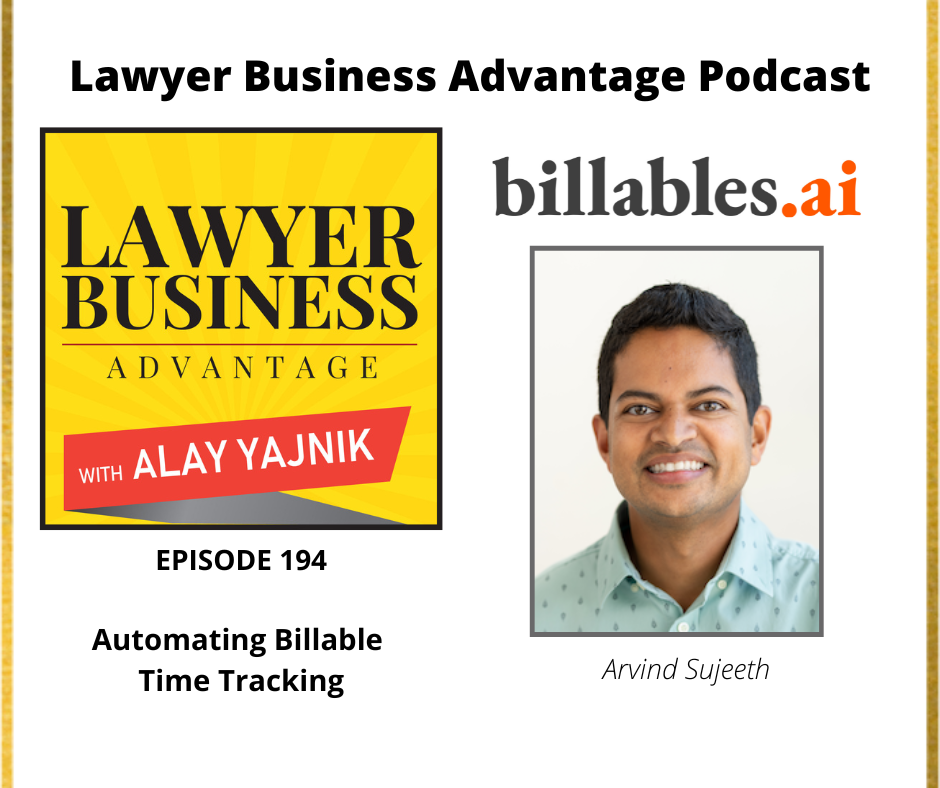
The Profile / Vertical AI
Arvind
Sujeeth
He built machines that scream through generative AI. Then he pointed them at the most hated five minutes in any lawyer's day.
He built machines that scream through generative AI. Then he pointed them at the most hated five minutes in any lawyer's day.
Arvind Sujeeth runs Billables AI from San Francisco, and the company's entire pitch fits on a sticky note: stop making lawyers fill out timesheets. The software watches the work that already happens - the email in Outlook, the call on Zoom, the redline in Word, the thread in Teams - and quietly assembles the billable entry. It groups the activity, assigns it to the right client and matter, and writes the narrative description in something close to the attorney's own voice.
That last part is the trick. Anyone can timestamp a calendar. The hard problem is the sentence - the line item a partner would have written at 11pm, in their own shorthand, that a client will actually pay. Billables learns the habits, the styles, the preferences, and drafts it for you. Early firms tell the company they capture 15 to 30 percent more billable time and spend 90 percent less time writing those narratives.
It is, on its surface, an unglamorous thing to spend your forties on. Sujeeth has spent a career around exotic compilers and AI supercomputers. The timesheet is the opposite of exotic. That is exactly why he likes it.
"It's one of the most impactful problems I think I've worked on," he says, "because of how painful it is for individual attorneys and how much is being left on the table." Read that twice. He is not selling magic. He is selling the recovery of money that already belongs to you and the elimination of a chore you already hate. The market for hating timesheets is, conservatively, everyone who has ever filled one out.
We want to get as close to what you as an attorney would have written yourself. That means learning your own habits, your own styles, your own preferences.- Arvind Sujeeth, on how Billables drafts a time entry
The company's own founding blog does the math, and it is gloriously petty. Arvind's wife complained about reconciling her monthly bills about five times a week. Over an eight-year relationship, that lands somewhere near 2,080 individual gripes. Most spouses would learn to nod. Sujeeth heard a market.
What he recognized was that the complaint wasn't personal - it was structural. Lawyers feel it. Accountants feel it. Consultants and agencies feel it. The billable hour is the engine of an entire economy, and the people inside it lose pieces of every day to the friction of writing down what they did. He had spent years building systems that find inefficiency and crush it. Here was inefficiency hiding in plain sight, in a spreadsheet, on a Friday afternoon.
He did not start the company alone. Nancy Jeng, who led global product marketing at Pinterest and cut her teeth at the ad agency Edelman, knew the billable-hour grind from the agency side. Laura Maddox, a veteran AI engineer from a family of lawyers, came on as founding VP of Engineering. The team adopted a borrowed line as a kind of operating principle: pain is inevitable, suffering is optional.
Two things had to be true for this to work, and both finally were. Covid pushed nearly all of this work into digital tools that leave a trail. And AI got good enough to read that trail with something approaching human judgment. Strip away one of those and Billables is a decade too early. Together, they make it look almost obvious - which is the highest compliment a hard idea can earn.
Look closely and every chapter is the same move - find the work people dread, and teach a machine to do it.
There is a clean line from the dissertation to the startup, and it is worth tracing. Sujeeth's academic work, OptiML and the Delite framework, was about a single frustration: experts shouldn't have to hand-tune low-level code to get high performance. Describe what you want at a high level, and let the system generate the efficient, parallel version underneath. The human states intent; the machine handles the tedium.
Swap "researcher" for "attorney" and you have Billables AI. The lawyer states intent simply by doing their job. The machine handles the tedium of turning that into a clean, billable, defensible record. Same instinct, new audience. Between the two sat his years at SambaNova, where he helped ship one of the most aggressive hardware-plus-software stacks in generative AI - the deep end of the field, where models meet silicon.
And before all of it, there was Migo, lending to people the formal banking system had ignored. Microloans, AI supercomputers, legal billing: three industries that could not look more different, joined by one engineer who keeps asking the same question. Where is the painful, repetitive work - and can a model carry it instead?
"It's one of the most impactful problems I've worked on - because of how painful it is for individual attorneys and how much is being left on the table."
"That means learning your own habits, learning your own styles, and your own preferences."
"By eliminating burdensome administrative overhead, legal teams are capturing more billable hours and spending less time on non-billable tasks."
"Pain is inevitable. Suffering is optional."
He co-authored a programming language for machine learning more than a decade before founding an AI company. The taste for automating the dull part runs deep.
Before law firms, his AI underwrote microloans for people in emerging markets with no credit history. Same engine, very different borrowers.
One co-founder comes from a family of lawyers; another spent a decade inside advertising agencies. The team didn't have to imagine the pain - they lived it.
His Stanford lineage - the Delite framework - is still cited in compiler and ML-systems coursework years after he left the lab.
The goal isn't a better timesheet. It's no timesheet at all - an AI layer underneath every lawyer, accountant and consultant that captures the work and gets them paid for it, automatically.
Vertical AI · Legal Tech · San Francisco · Profile compiled from public sources