Profile / Founder & Engineer
Srinath Sridhar
The engineer who decided the future of sales was hiding in the emails nobody wanted to write.
The engineer who decided the future of sales was hiding in the emails nobody wanted to write.
There is a certain kind of founder who studies the machine so closely that he ends up defending the human. Srinath Sridhar is that kind. He holds a PhD in algorithms and machine learning from Carnegie Mellon, an MBA from Harvard, and a resume that reads like a tour of Silicon Valley's formative years. And yet the thing he keeps coming back to, in interview after interview, is people.
His technical education began at the University of Texas at Austin, where he earned a Bachelor of Science in Computer Science with Honors. It continued at Carnegie Mellon, where he specialized in the parts of computer science that most people find least romantic - algorithms - and along the way co-authored Zinc, described as the first open-source version control system for data. It was a quietly prophetic project. Years before anyone was arguing about training sets, Sridhar was already worried about how to keep track of data over time.
Then came the part of the story that startup mythology loves. He joined Facebook when its engineering team was roughly 100 people, a number that today would barely staff a single product org. He was a founding engineer at BloomReach. He picked up an MBA at Harvard for good measure, which is the sort of thing you do when you want to understand not just how to build the thing, but why anyone would pay for it. In 2013 he co-founded a supply-chain company called Onera and served as its CTO for close to a decade.
So by the time he co-founded Regie.ai in 2020, Sridhar had already been an engineer, a scientist, and an operator. What he had not done was pick the flashiest possible problem. Regie.ai automates prospecting - the outbound emails, the follow-ups, the endless first-contact drudgery that every salesperson dreads and every buyer deletes. It is unglamorous work. It also turned out to be extremely valuable work.
The insight is deceptively simple. For decades, the rule of sales was that personalization did not scale. "You're never going to personalize each one of those emails," as Sridhar puts it, describing the old limitation. A human being can write a thoughtful note to ten prospects, maybe fifty on a caffeinated afternoon. Regie.ai was built to write a hundred thousand, each one shaped to its recipient. The economics that made mass personalization impossible simply stopped applying.
What makes Sridhar interesting is not that he built an AI company. Everyone built an AI company. It is that he refuses to talk about it the way everyone else does. Ask him whether the machines are coming for our jobs and he reaches for ornithology. "Even though we may continue to make progress in flight technology," he says, "we are still nowhere close to replicating flights of birds." Airplanes fly. They do not flap. Progress, in his telling, is not imitation - it is a different sort of power. The point is not to build a synthetic human but to build something that is superhuman in narrow ways and hopeless in others.
From that follows his whole philosophy of deployment. He does not believe in flipping a switch and handing the enterprise over to the robots. "We can think of deploying agents in steps," he says. "The first can be humans first, then humans in the loop and successively iterate." It is a patient, almost old-fashioned idea in a field addicted to the word "disruption." Trust is earned in stages, even by software.
He is equally particular about transparency. In an era of black-box models that even their creators struggle to explain, Sridhar insists on a second requirement beyond intelligence. "It's not enough for our AI systems to be smart; they also need to be clear," he says. "Our users deserve to know how these systems work." Coming from someone whose entire competitive advantage is a sophisticated model, that is a slightly inconvenient thing to believe. He believes it anyway.
None of this is soft. Sridhar is clear-eyed about where machines beat us. "AI is always going to be more consistent in its decision making," he notes, a polite way of pointing out that humans have good days and bad days, moods and blind spots and Monday mornings. His argument is not that AI is gentle. It is that AI is steady, and steadiness, applied to the right tasks, frees people up for the parts of work that actually require a pulse. "AI is taking a huge chunk of routine and repetitive tasks off our plates," he says. "This frees up employees to focus on more meaningful and creative work."
The market has agreed, at least so far. By late 2022 Regie.ai had raised $10 million and signed up more than 75 organizations, including AT&T and Crunchbase. In February 2025 the company closed a $30 million Series B, pushing its total funding to $54.8 million, and rolled out RegieOne, which it bills as the first AI-native sales engagement platform. The word "native" is doing a lot of work there. Plenty of companies bolted AI onto existing sales software; Sridhar's bet is that the whole category needs to be rebuilt with AI at the center rather than the edge.
Watch him talk about what comes next and the engineer's excitement leaks through the CEO's composure. "Everybody's talking about agents these days," he says. "An agent has the ability to make all of those calls to APIs. What can it do with those calls? I think there's going to be a lot of magic." It is a revealing choice of word. A man with a doctorate in algorithms, who has written patents and textbooks and helped invent version control for data, still reaches for "magic" when he describes the frontier. The rigor never quite kills the wonder.
He points to the wider world for proof of how fast things are moving - a political campaign run largely on synthetic voice and video, medical tests that were once too expensive to bother with becoming feasible because AI can do the analysis. His recurring theme is that AI does not only automate the work we already do; it makes possible the work we never attempted because it cost too much. That is the optimist's case, and Sridhar makes it without the usual hand-waving, because he has spent twenty years learning exactly where the technology breaks.
Which brings the story back to where it started. The most technical person in the room turns out to be the one arguing hardest for the humans. "The human-computer partnership is here to stay," he says, "because they will continue to add value differently." It is not a slogan. It is a thesis, backed by a PhD, an MBA, a Facebook badge from the early days, and a company built on the unfashionable belief that the point of a very smart machine is to give people back their time.
"The human-computer partnership is here to stay because they will continue to add value differently."- Srinath Sridhar
A human can hand-write a personalized outreach note to only so many prospects before the day runs out. Regie.ai's premise is that AI changes that ceiling entirely.
Illustrative comparison based on Sridhar's public descriptions of the platform's scale.
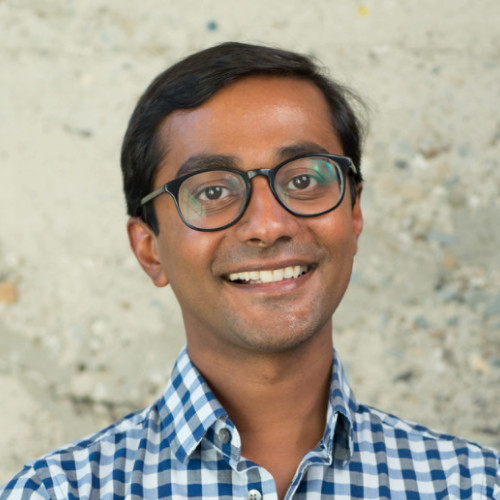
Srinath Sridhar, co-founder and CEO of Regie.ai, on building a company at the frontier of generative AI.
▶ Watch on YouTube