BREAKING • BriefCatch closes $6M Series A led by Full In (Dec 2025)
• Acquires editing-software maker WordRake, Feb 2026
• 126% net enterprise revenue retention
• Trusted by 45+ Am Law 200 firms & 80+ courts
• 3.6M suggestions accepted by users
• 11,000+ expert edits, live inside Microsoft Word
Who They Are Now
Somewhere right now, a lawyer is staring at a sentence at 11 p.m. that almost works. The argument is there. The prose is not.
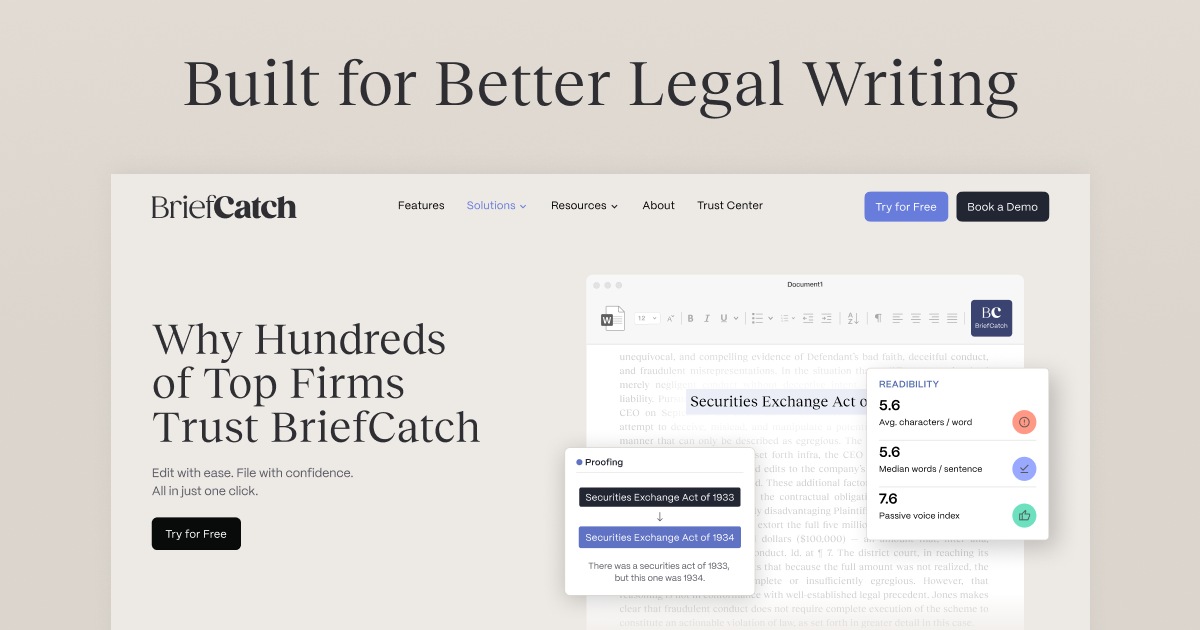
That lawyer is BriefCatch's whole reason for existing. The company makes an editing tool that sits inside Microsoft Word and reads legal drafts the way a brilliant, slightly obsessive mentor would - flagging the bloated clause, the buried verb, the citation that breaks Bluebook rules. It does not write the brief for you. It makes the brief you wrote sharper. Eleven thousand expert-informed suggestions, delivered in real time, with examples pulled from the best legal writers alive.
In December 2025 it closed a $6 million Series A. In February 2026 it bought a competitor. Its law-firm customers don't churn - 99% stick around, and the large ones spend 26% more each year than the year before. For a product whose core promise is "we'll fix your commas," that is an unusually loyal crowd.
BriefCatch is spell-check for persuasion - and it turns out persuasion is the part lawyers most need help with.
The pitch, in one line
The Problem They Saw
Even the best lawyers write badly under pressure.
This is the uncomfortable truth at the center of the company. Law school teaches you to think like a lawyer. It does not, reliably, teach you to write like one. Then deadlines arrive, judges get impatient, and the prose that sounded fine in your head lands on the page as a 58-word sentence with three nested qualifiers.
The old fixes don't scale. A senior partner can mark up an associate's draft, but partners are expensive and asleep by midnight. A grammar checker can catch a typo, but it has no idea whether your topic sentence actually carries the paragraph. And the new wave of generic AI will happily rewrite your brief - confidently, and sometimes catastrophically wrong, which is a problem when the document is going to a federal judge.
You can teach judgment, or you can automate spelling. BriefCatch's bet was that the valuable, unscalable thing in between could be packaged.
The gap in the market
That gap - between the dumb checker and the reckless robot - is where BriefCatch decided to live. The space reserved for the kind of feedback you'd get from someone who has read ten thousand briefs and remembers exactly why each one worked.
The Founder's Bet
One man had read ten thousand briefs.
His name is Ross Guberman. Before BriefCatch, he spent two decades as the legal world's writing teacher - training lawyers at Am Law 200 firms, coaching federal judges on their opinions, and writing the bestselling books Point Made, Point Taken, and Point Well Made. He is, in the narrow and competitive field of "people lawyers trust to fix their prose," roughly the most famous person there is.
His bet, in 2017, was deceptively simple: the advice he gave in seminars - the patterns, the rules, the before-and-after examples - could be encoded into software. Not as a chatbot guessing at sentences, but as a structured library of edits a machine could spot and a lawyer could click. Turn the expert into the product.
We're marrying my passion for first-rate legal writing with custom AI.
- Ross Guberman, Founder & CEO
It is a harder bet than it sounds. Anyone can build a writing tool; building one that lawyers respect requires knowing the difference between a sentence that's grammatically fine and one that will lose a motion. Guberman's pedigree was the moat. The software just had to be good enough to deserve it.
The Product
It does not replace you. It catches what you missed.
BriefCatch's design philosophy is restraint - which, in the age of AI that wants to write your whole document, is itself a position. It lives where lawyers already work, suggests rather than overwrites, and shows you why, with examples from writers you'd want to copy.
Core
The Word add-in
11,000+ real-time suggestions for clarity, concision, flow, and punch - plus draft analytics that score your writing and rescan as you edit.
2025
Bluebook & the advisor
BriefCatch 4 adds AI-driven Bluebook citation correction and a context-aware writing advisor that reads the room, not just the rule.
Beyond briefs
BriefCatch for Outlook
The same editorial eye, now on your email - because the badly-worded client note travels just as far as the badly-worded brief.
Proof
Examples & analytics
Side-by-side examples from respected legal writers, plus detailed reports that benchmark a document against what good actually looks like.
Generic AI will rewrite your brief. BriefCatch assumes you'd rather it didn't - and that you'd like to know why a sentence is weak before you trust the fix.
Why security and control are features, not footnotes
The Proof
Skadden uses it. Judges use it. The numbers explain why.
The customer list reads like a who's-who of American law: Wilson Sonsini, Skadden, Bartlit Beck, Kellogg Hansen, Nixon Peabody, plus 80+ courts and a stack of government agencies. The retention numbers are what investors actually fell for.
126%
Net enterprise revenue retention
Translation: lawyers try it, keep it, and then buy more of it. The rarest trick in software.
The retention story, in three bars
Reported figures around the Dec 2025 Series A
Gross retention (firms/courts)
100%
Net revenue retention
126%
Net revenue retention exceeds 100% because existing customers expand their spend - the orange bar is capped at full width for scale; the figure is 126%.
The market is undergoing a lot of change - law firms are digitizing at a rate they hadn't before.
- Elodie Dupuy, Founder & Managing Partner, Full In
The Mission
Build the Word-native platform for elite legal writing.
The $6 million didn't arrive to keep the lights on - it arrived to fund a roll-up. Guberman has been blunt about the plan: disciplined acquisitions and deeper product development, at the same time. The February 2026 purchase of WordRake, a patented editing tool of its own, was the first move.
The destination is a single, integrated, Word-native system for legal writing, editing, and research - one that, in Guberman's words, leaps past both legacy editing tools and generic genAI. The wager is that lawyers don't want ten clever apps. They want one that lives where they already are and never makes them paste a confidential brief into a chatbot.
This investment lets us accelerate two things at once: disciplined acquisitions and deeper product development.
- Ross Guberman
Why It Matters Tomorrow
Back to that lawyer, at 11 p.m.
The sentence still almost works. But now there's a quiet underline beneath it, and a suggestion in the margin that knows exactly what's wrong - and shows a cleaner version, with a reason. The lawyer clicks. The argument that was always there finally reads like it.
That is the small, repeated thing BriefCatch sells, three-point-six million times and counting. Not a robot that writes the law. A better version of the editor most lawyers never had time to become. In a profession where a single muddy sentence can cost a case, that turns out to be worth a great deal - and worth coming back to, year after year, which is the only metric that ever really mattered.
The brief gets filed. It's sharper than the one that would have been. Nobody in the courtroom will ever know why.