The filing cabinets were disappearing. At Gould & Ratner, the Chicago law firm, a wall of them had given way to something considerably less imposing. Ken Koehn, its chief operating officer, described most of the team working with a single drawer. For a profession so fond of a paper trail, this was a small domestic revolution.
- The customer: mid-sized law firms trying to keep legal work, money and growth in view.
- The foundation: specialized accounting software, with roots in a Cincinnati accounting firm.
- The turn: acquisitions brought attorney workflows and legal market data into the portfolio.
- The test: can information travel from a lawyer’s work to a financial decision without being entered twice?
The drawer that explains the company
In SurePoint’s account of Gould & Ratner’s experience, the earlier problems were stubbornly practical: manual financial processes, slow profitability analysis and information that was difficult to retrieve. Koehn reported that staff overtime of 10 to 15 hours a week disappeared as the firm became comfortable with the software. He also described a month-end close taking half an hour. These are customer-reported outcomes, not a stopwatch held over every SurePoint installation.
“We went from having a wall of filing cabinets to most of our team operating with one drawer.”
Ken Koehn · Gould & Ratner
The appeal is easy to understand. A lawyer’s work produces records of time, expenses, tasks and client obligations. An accounting team needs those records in a form it can bill, reconcile and analyze. The more laborious the exchange, the more people spend their days translating information for one another. A filing cabinet can be remarkably good at storing an answer and remarkably bad at delivering it.
SurePoint sells software for this business behind the legal work. Its center of gravity is the mid-sized law firm, where a managing partner, finance director and legal administrator may all need different answers from the same matter. The company reports more than 100,000 legal professionals using its solutions. That figure describes its broader customer community, rather than adoption of one newly launched product.
The accountants go shopping
SurePoint’s origins help explain its preoccupations. Joseph Rippe and George Kingston founded the predecessor accounting firm in Cincinnati in 1976. The specialized legal software business followed in 1982. The distinction matters: the company’s long history begins before the software operation itself. Its own timeline places the Legal Management System, or LMS, in 1990 and its cloud launch in 2000.
An accountant’s starting question is likely to be where the money went. An attorney’s may be where the document went. SurePoint eventually needed to serve both conversations. ParkerGale acquired the software business in 2018; the SurePoint name arrived in 2020. In June 2021, Aquiline agreed to take majority ownership, while ParkerGale retained a minority interest. The announcement did not attach a purchase price to the transaction.
- 2022ContactEase + Coyote AnalyticsClient relationships and financial management
- 2024Leopard SolutionsLegal market and talent intelligence
- 2025ZenCaseAttorney-facing practice workflows
- 2026SurePoint ProPractice, finance and embedded intelligence
The ZenCase acquisition is particularly revealing. In a published interview with Bob Ambrogi, then-CEO Eric Thurston explained that customers wanted a more intuitive front-office experience. SurePoint had been improving its existing products and collaborating with ZenCase. Buying the attorney-focused platform, he argued, would accelerate innovation by roughly three years. That was management’s estimate of time saved, not an independently measured result.
The change in direction came from a recognizable constraint: accounting depth alone could not settle the question of how lawyers preferred to work. Acquiring a usable front end was a way to shorten the route. It also created an integration job. At the acquisition announcement in January 2025, the combined platform remained a plan, although selected Leopard reports were already available inside ZenCase.
Three jobs, one business
On February 2, 2026, SurePoint introduced SurePoint Pro. Its proposition connects practice management, financial operations and embedded legal intelligence. Practice Pro handles attorney-facing work such as matters, time entry and collaboration. Finance Pro connects that activity to billing, reconciliation and reporting. Legal Insights supplies information about the surrounding market. Each addresses a different part of a firm’s working day.
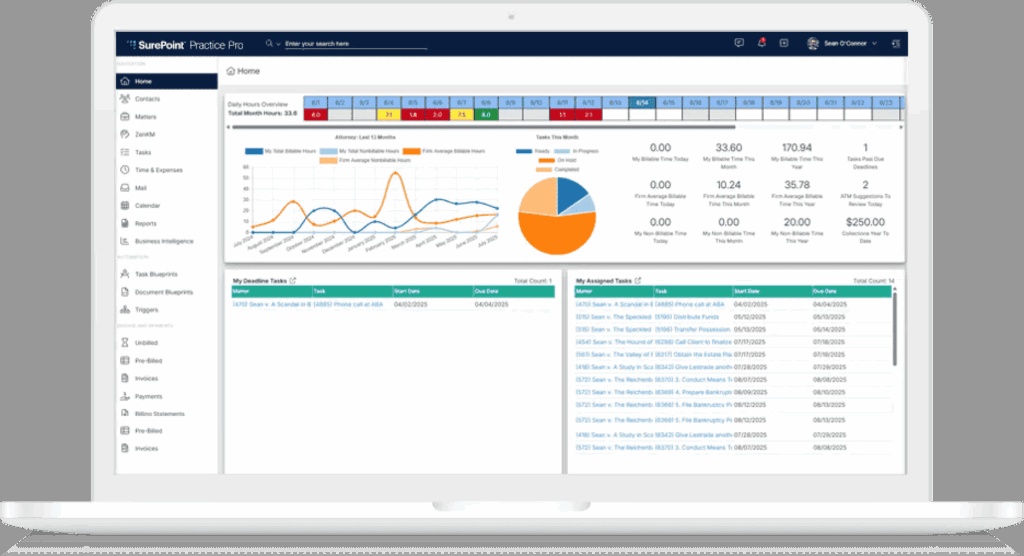
The wider portfolio still matters. Finance Core is the former Coyote product, positioned for smaller accounting teams. Finance Enterprise is the former LMS, aimed at distributed accounting operations. Finance Pro is available exclusively within SurePoint Pro. Those names should prompt a buyer to ask which product, workflow and integration is actually being demonstrated. A shared brand does not make every configuration identical.
Payment Services adds cards, electronic checks and digital wallet options, with payment information connected to invoices and reconciliation. SurePoint CRM, formerly ContactEase, handles relationships and marketing. These are useful extensions of the same problem: a prospect, a matter and a paid invoice should not require three incompatible versions of the client.
Partners extend the reach. The April 2026 Lawmatics integration links intake to matter and billing workflows. LawToolBox brings rules-based deadline calculations into SurePoint Pro. January’s Laurel partnership feeds automated time entries back into the SurePoint ecosystem. The sensible demonstration is a complete exchange between systems, including the review of a proposed time entry, rather than a parade of logos.
Hiring with the books open
Leopard Solutions, acquired in 2024 and now called Legal Insights, takes the company beyond internal administration. It tracks law firms, attorney movement and professional connections. Users include recruiters, law schools and in-house counsel as well as firms. Market intelligence can help a leader ask where a practice is growing, which attorneys have relevant experience and which relationships might support an introduction.
A newer Gould & Ratner case study connects those questions to money. The firm reports a 68% reduction in third-party recruiting fees after building an internal recruiting capability supported by Legal Insights. Its finance team uses SurePoint Finance Enterprise to model compensation and profitability. The useful detail is the combination of internal recruiting and better information; software was part of an operating change.
In March 2026, SurePoint won the Legalweek award for innovation in hiring, staffing and recruiting. The recognized Connection Report Suite includes an Attorney Connection Map, drawing on employment and education records to surface professional links. A relationship map cannot make someone take your call. It can give the person making it a more informed opening.
The price of a cleaner handoff
SurePoint’s business is subscription software and legal data, sold through a consultative process. One public price anchor exists in iManage’s partner directory: a legacy ZenCase listing quotes $1,068 per user annually. That works out to $89 a month. Treat it as a price for the named legacy offering, not a quote for the current SurePoint Pro bundle.
Annual licenses for 50 users at the legacy directory rate. This is an illustration, not a SurePoint Pro offer or total project budget.
A buyer can copy the arithmetic, then make it useful by obtaining a written scope: software, data migration, training, integrations, support and payment processing. Time spent changing habits belongs in the decision too. A firm should ask whether its savings come from fewer manual steps, faster collections or a better use of staff, and measure the relevant baseline before making the switch.
Begin with one real matter. Have an attorney record work, a biller prepare the invoice, finance reconcile the payment and a partner inspect profitability. Include the awkward client rule and the adjustment that usually needs a spreadsheet. If staff continue keeping separate records, or nobody owns the quality of the underlying data, a connected platform will struggle to produce a trustworthy answer. This is a buying test, not a claim that every implementation succeeds.
A crowded room, a particular bet
SurePoint has substantial company. Clio offers practice management, accounting and payments; Aderant Expert Sierra combines financial and practice operations; Elite’s platform serves law-firm financial workflows. The existence of those alternatives makes “all in one” an insufficient explanation of SurePoint’s position. The more specific argument is its accounting heritage, midmarket focus and acquired legal intelligence alongside attorney workflows.
In July 2026, Jeff Steinberg became CEO and Thurston moved to Executive Chairman. Steinberg previously founded Redwood Analytics, a legal business-intelligence company. He inherits a portfolio whose names record a series of purchases and whose value depends on how well those pieces work together. Buyers should judge the journey of their own information through it.
The filing drawer remains a useful standard. It is tangible. Someone can count the steps removed, the repeated entries avoided and the hours no longer spent asking accounting for a report. A law firm has plenty of occasions for persuasive language. Its software purchase is a fine occasion to demand a demonstration.
Visit the working parts
Explore SurePoint’s website, the Pro platform, Legal Insights, company news and the blog. Follow the company on LinkedIn, X and Facebook.
WATCH + LISTENFinance Pro product video ↗YouTube interviews with the SurePoint community ↗LawNext: Eric Thurston on the ZenCase acquisition ↗