A funeral folder has an unusually unforgiving deadline. It must contain the right name, the right photograph, the right dates. It must be ready when people arrive. Nobody wishes to discover, beside the chapel door, that the printer has developed an interest in abstract expressionism. Start with that modest object and Messenger’s sprawling business becomes easier to understand.
- Messenger supplies funeral professionals with stationery, keepsakes, and services.
- Its free personalization software works alongside paper that customers purchase.
- Acquisitions added insurance funding, fingerprint jewelry, and UK printing.
- The useful business lesson: look closely at the next task your customer must finish.
Frank Messenger began selling religious calendars in Chicago in 1913. Today the company’s family includes a stationery business, Thumbies keepsakes, Express Funeral Funding, CemSites software, and the British printer Just Digital. These businesses make rather different things. Their customers, however, inhabit the same working world: funeral homes, cemeteries, and the families depending on them.
Here is the editorial argument: Messenger’s expansion makes sense when you follow the work rather than the materials. Paper leads to personalization. Personalization leads to keepsakes. Arrangements bring invoices, insurance claims, and records. Each is a possible place for an established supplier to become useful again.
The paper knows its audience
The original stationery business remains concrete. Messenger sells register books, memorial service folders, prayer cards, acknowledgements, and bookmarks. Its broader catalog includes urns and everyday service items. Funeral professionals buy the products; families choose, use, or receive them. The distinction matters. The buyer needs a dependable order. The recipient may keep the result for years.
Consider its Family Tree deluxe service folder. The product page specifies artwork by Bonnie Mohr, metallic ink accents, embossed details, and a short fold. It also says the sheet is suitable for printers and copy machines. Sentiment and machine compatibility share a product description. They have to: the paper must be attractive enough to keep and practical enough to finish.
Messenger fits into the supply layer of deathcare. It equips the organizations conducting services and handling arrangements. Riverarch’s March 2022 investment announcement reported more than 10,000 customers across the United States. That is a dated customer figure, rather than a count of families or a measure of market share, but it helps explain the appeal of adding products to an established sales channel.
U.S. customers reported in the March 2022 investment announcement.
Free software, paid paper
Make It! Personal is Messenger’s free web application for customizing stationery. A funeral home buys preprinted themed stock, then adds personal information and photographs using its own printer. The software offers templates and custom layouts. Supported management systems can import case information, reducing the need to type it again.
There is an appealing division of labor here. Messenger produces the visual foundation; the funeral home finishes the particular story. The company says printing only personalization and images saves ink expense. The commercial logic is straightforward: a useful free tool supports purchases of physical stock. “Free” describes the application. Paper, equipment, ink, and the employee operating the printer still belong in the calculation.
Customers can also move work upstream. Design Service supplies personalized PDFs for local printing, with same-day delivery available. Signature Service takes on design, printing, and shipping, with same-day shipping available. Its succinct declaration is “WE DESIGN, PRINT, AND SHIP.” For a manager short of staff, those six words describe a consequential transfer of responsibility.
Choose by available staff, equipment, and delivery time.
A local production route makes sense when a funeral home has suitable equipment and someone available to use it. Outsourcing may suit a team with less capacity, provided delivery meets the service schedule. A decision about stationery is therefore also a decision about staffing. The prettiest template cannot allocate an afternoon.
A template can have too many owners
One revealing piece of Messenger’s history sits in its Make It! Personal 2.0 documentation, created in September 2016 and revised in August 2017. The release introduced permissions intended to prevent employees from accidentally changing or overwriting perfected custom templates. Administrators could control shared layouts while staff created their own variations.
The same document describes a rewrite in HTML5 that removed the requirement for Microsoft Silverlight. It also explains an editor that could change layouts without attaching a case. These are wonderfully ordinary improvements: fewer hurdles to opening the software, less confusion while editing, better protection for work already finished.
The lesson a reader can reasonably draw is that customization requires boundaries. Let people personalize an individual memorial while protecting the reusable structure. This is useful far beyond funeral printing. Any business with shared documents and hurried employees has reason to distinguish editing today’s work from changing tomorrow’s starting point.
The prettiest template cannot allocate an afternoon.
The insurance clock runs differently
In 2019, Messenger acquired Express Funeral Funding. The new business addressed a different document problem: life insurance proceeds can be available to pay for a funeral, yet payment and claims administration have their own timetable. EFF provides insurance assignment funding to funeral homes and cemeteries.
Its published process begins with a request and assignment form submitted for verification of proceeds. Payment, EFF says, is typically received within 24 to 72 hours. Necessary documents then help families obtain any remaining proceeds they are not advancing. “Typically” deserves to stay attached to that timetable; it is a service description, not a promise for every case.
A June 2024 association-partnership announcement describes a processing fee commonly passed to the family’s policy. The economics therefore require attention to who bears the fee. Assignment funding also depends on a suitable policy and verification. It cannot be treated as a universal way to pay for any funeral.
For Messenger, the acquisition put another service in front of a familiar buyer. An adviser’s account of the transaction explicitly connected it to serving more of funeral-home customers’ needs. The inference is commercial, not psychological: a company already supplying those customers had a route to offer them help with another recurring task.
A fingerprint, then a wider footprint
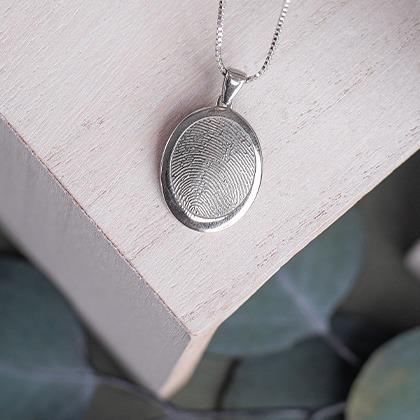
Messenger announced its Thumbies acquisition in September 2022. Thumbies makes personalized fingerprint keepsakes; Buddies extends the idea to pets. The acquisition announcement explained that Messenger’s sales representatives could offer the jewelry through their existing portfolios. A pendant and a service folder can travel through the same professional relationship.
As checked in October 2026, Thumbies lists several classic pendants from $195, with final choices affecting the purchase. Unlike trade stationery that requires an account or pricing inquiry, this consumer storefront gives a family a visible starting point. It also illustrates the company’s mixture of channels: professional distribution alongside direct shopping.
The portfolio widened elsewhere. In February 2022, Messenger announced its acquisition of Bass-Mollett Publishers, another funeral-stationery business. PNC Riverarch announced its investment the following month. Kevin Tkacz said the company wanted a collaborative partner “while also providing the capital and resources to accelerate our growth.” The deal terms were undisclosed.
Insurance assignments
Stationery + fingerprint keepsakes
Personalized printing in the UK
Lincoln International records the 2024 sale of UK-based Just Digital to Messenger Holdings, describing rapid-response personalized printing principally for funeral services. CemSites, also in the current family, supplies cloud software for cemeteries, crematories, and funeral homes. In April 2026, Messenger promoted Andy Buckman to Chief Sales Officer across the five-brand portfolio while he retained his presidency of EFF.

The next problem beside the old one
Partnerships extend the offer. Tukios integrates tribute videos into Make It! Personal. Send With Love adds a sympathy gift store to a funeral home’s website: Messenger sources and fulfills the products, while the partner earns cashback. Messenger advertises no startup costs, partner fees, or inventory requirement for that store. The shop’s merchandise, of course, still has a price.
Competitors complicate any easy claim of uniqueness. Hilton Funeral Supply also sells stationery and offers free customization through Shared Memories. Kelco supplies funeral professionals through its own catalog. Messenger’s distinctive proposition is the breadth assembled around the same professional customer. A buyer can still prefer individual specialists, particularly when existing tools work well or only one product is needed.
What can another business copy? Study the tasks immediately before and after the product you sell. Offer customers a choice about how much work they keep. Protect the reusable parts. Then check whether your existing reputation earns permission to tackle the next problem. Messenger’s history supplies examples of that approach; it does not guarantee that every adjacency will pay.
The register book is a useful place to finish. Its pages are ordinary until someone writes a name in them. Messenger’s business occupies the space between an ordinary object and a particular life: stock, software, hands, payment, and the care required to deliver it on time.
Explore the work
Products, company updates, and demonstrations.