The awkward moment in digital marketing comes after success. Someone buys the thing. The advertisement follows them home anyway. A system has recorded the transaction; another system continues bidding for the buyer’s attention. Somewhere between those two pieces of software, a perfectly useful fact has lost its influence.
Lytics built its business in that gap. Its customer data platform gathers first-party information from connected systems, assembles customer profiles, and helps marketers decide what to show, send, recommend or suppress. Suppression is the deliciously unglamorous part: sometimes the cleverest advertisement is the one you stop paying for.
- Lytics turns customer behavior into audiences and personalized experiences.
- Its three core products handle profiles, warehouse activation and marketing decisions.
- Contentstack bought it in December 2024; the announcement followed in January 2025.
Founded in Portland by James McDermott and Aaron Raddon, Lytics emerged in the early 2010s as marketing departments accumulated tools faster than those tools learned to communicate. The company’s proposition was connective: preserve the applications marketers used, while making their customer information useful across them. A tidy database was a beginning. The interesting question was what happened next.
A concert promoter’s untidy address book
Consider AEG Presents. Its business spans small clubs and large arenas, with venue arrangements that make a shared customer view difficult. Musical taste adds another complication. A fan record has to help a promoter suggest a show someone might actually want to attend. An unreliable profile is a poor substitute for knowing your audience.
AEG’s Lytics case study describes fragmented, unstructured information across tools and channels, alongside unreliable fan profiles. Here, the first obstacle was ordinary organizational plumbing. Campaigns had to cross those gaps before a recommendation could reach a music fan. The case study reports an 80% reduction in campaign execution time after adopting Lytics.
Reported in the AEG Presents customer case study. A workflow result from one deployment, with no promise that another team will repeat it.
That distinction matters. Faster campaign execution gives a team more room to work; it does not automatically prove a lift in ticket sales. The lesson worth borrowing is the choice of problem. Find the specific delay between an available customer signal and an action. Measure whether that delay shrinks.
Three products between a click and a decision
Lytics eventually described its platform through three products. Conductor handles the infrastructure: collecting information, managing schemas, resolving identities and building unified profiles. Its tools serve engineers and data teams who need to understand where a field came from and how separate interactions belong together.
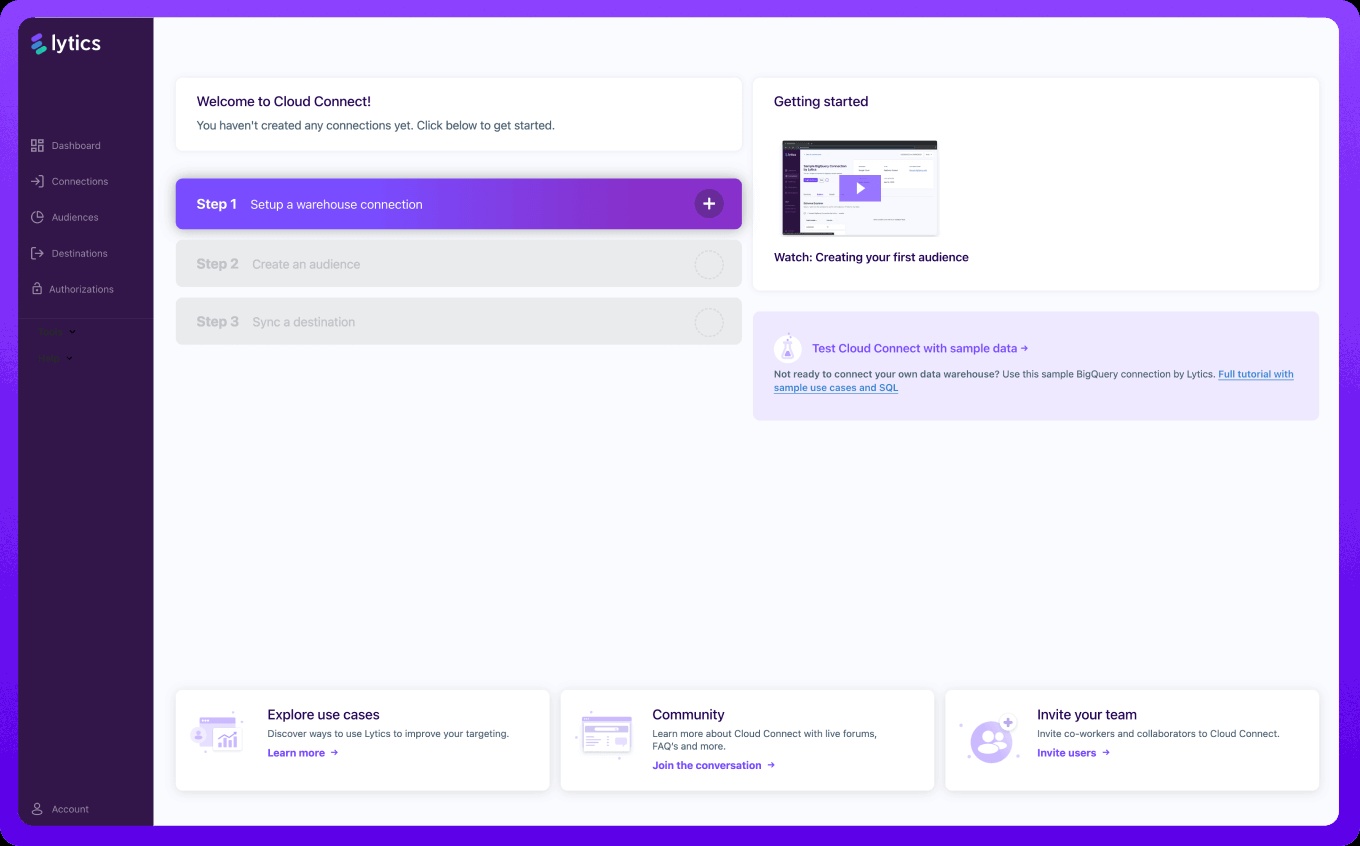
Cloud Connect makes warehouse information available for activation. A team can query customers who have not logged in recently, or accounts missing a particular product feature, and translate the results into audiences or profile attributes. Those are useful questions because they already suggest an action.
Decision Engine serves marketers. Behavioral scoring, content affinities and predictive insights help form segments and personalize experiences. Someone’s reading or browsing interests can influence a recommendation. Engagement changes can move that person between audiences. A purchase can remove them from a paid campaign. The output is a decision expressed through connected channels.
Identity + profiles
Warehouse audiences
Content + channels
The Economist supplied another concrete use case. In 2019, McDermott described targeting visitors who were not subscribers but appeared likely to subscribe, using relevant subscription calls to action and display advertising. The attraction was a more selective invitation. An existing subscriber and a promising prospect should not receive identical treatment.
The warehouse gets a vote
A customer data platform enters a crowded room. There may already be a warehouse, a CRM, an email service and an advertising stack. Requiring a wholesale replacement makes every existing investment an objection. Lytics’s Cloud Connect launch in January 2022 explicitly acknowledged customers’ warehouse-based customer-360 strategies, including their governance, security systems and IT teams.
The product worked with that architecture. SQL models could expose relevant audience information while the warehouse remained the source of truth. Lytics’s documentation describes authorization controls that can restrict access to particular tables. Flexibility here has a practical meaning: give marketers usable segments without treating the company’s data arrangements as an inconvenience.
That puts Lytics between CDP alternatives such as Amperity or mParticle and the warehouse activation work a company might build itself. Broader experience suites, including Sitecore and Optimizely, address a larger purchasing decision. Buyers should compare the job they need done: identity, audience syncing, decisioning or an entire digital experience platform.
The bill, and the bottleneck
Lytics sells business software through subscriptions and offers assistance with implementation and ongoing use. A 2014 report put its starting price at $1,500 a month. That is a historical price tag. It gives the origin story scale, but belongs well outside anyone’s current procurement spreadsheet.
There is a second bill in this story: infrastructure. A Google Cloud customer account reports that moving Lytics’s existing software to Google Cloud cut monthly infrastructure spending by 70%, while increasing streaming performance and stability. The initial aim was lower cost. The tests revealed reasons to rethink the underlying infrastructure as well.
“without a corresponding increase in support and operations engineers”Aaron Raddon, on scaling with Google Cloud
By February 2019, Lytics reported more than 175 enterprise brands and announced a $35 million Series C led by JMI Equity. Those figures establish historical traction. For a prospective customer, the more useful discipline is narrower: choose one campaign, specify the identifiers and permissions it needs, and test the result against a baseline.
Data finds somewhere to go
Contentstack’s acquisition joined this customer context to content management. Its April 2026 architecture describes Lytics as the Data Cloud layer supplying identity resolution and behavioral scoring within the Agentic Experience Platform. The logic is straightforward: knowing a visitor’s interests has greater value when the publishing system can respond.
A team still needs usable signals, sound identity rules and content worth selecting. Sparse behavior or weak permissions can leave a sophisticated system with little to act upon. Lytics’s appeal rests on making that action possible. The buyer who has already bought the thing is a fine place to begin.