The restroom sign is an unusually honest object. It has to work for someone who is distracted, in a hurry, or standing in bad light. Put it inside a historic theater and it acquires another obligation: it should look as though it belongs there. A beautiful sign pointing nowhere useful is a failure. An obvious sign that jars with the room is a different kind of failure.
For Riverside’s Fox Performing Arts Center, PrintMyStuff combined African mahogany with printed, frosted acrylic. A decorative pattern came from the building’s original 1929 tiles. The signs were prepared for lighting. This was work involving wood, legibility and the character of a room, undertaken by a business many customers might first encounter while ordering copies.

A shopping cart has its limits
PrintMyStuff.com is the public-facing name of PIP Printing Riverside/Corona. The business traces its local history to 1968. Its company description puts printing beside design, direct marketing, mailing and promotional products. The revealing word is “beside.” These activities share a customer, even when they require different equipment.
Consider a hypothetical restaurant opening. Someone needs menus, a window graphic, a promotional postcard and perhaps labels. Each can be purchased separately. But somebody still has to reconcile the colors, measurements, materials and delivery dates. That somebody is usually a person with several other jobs to do. A supplier able to discuss the whole collection can be useful before the first sheet is printed.
The company’s printing menu includes digital work for short runs, offset work for larger quantities, personalized pieces, books and engineering drawings. It sells through online orders and custom quotes. Its position in the market becomes clearest on the unusual jobs: somewhere between a conventional commercial printer, a sign shop and a small fabrication workshop.
“So, when do you need it?”
The first question, according to PrintMyStuff’s homepage
The bill that made a machine make sense
A printer can offer a wide range of work by sending some of it elsewhere. That arrangement has an economic limit. In July 2023, trade coverage of PrintMyStuff’s new Insignia6H die-cutter described growing demand for packaging and rising outsourcing costs. Sam Tracy, identified as owner and president of operations, brought the cutting stage into the company’s own production.
The machine’s attraction was specific: thicker materials for cartons and boxes, and a 20-by-20-inch sheet format offering more layout room. Those capabilities suited the work the company wanted to do. The purchasing logic started with a recurring expense and an identifiable demand.
For another business considering a similar move, the copyable habit is to examine the handoff. How much money repeatedly leaves the building at one stage? What work does that stage prevent you from accepting? Ownership only makes sense if enough suitable work exists to justify equipment, operators, maintenance and space. A machine can remove an outsourcing bill and create several new bills of its own.
2023: die-cutting brought in-house. A shorter supplier chain, not a claimed turnaround measurement.
Fifty is enough to require engineering
One Claybourne countertop-display project involved 50 units. PrintMyStuff used printed aluminum DIBOND for the structure and back-printed clear acrylic for visual depth. The aluminum base folded together with tabs. Producing a modest batch still required decisions about assembly, strength and how the object would look on a counter.
The shop reports that the display won its category in the 2021 Application Innovation Awards. More instructive than the trophy is the combination of tasks: engineering, printing and fabrication in one project. The useful question for a buyer is whether a supplier can explain how the object goes together, as readily as how the image goes on it.
Small batches can still ask big questions about materials and assembly.
This is also a way to compare competitors without getting hypnotized by a unit price. A standardized online product may be perfectly suitable when the specification is settled. A custom construction asks for a different conversation. Compare the delivered object and the work required to get there, including the buyer’s own time.
Paper has a sense of touch
The Riverside Transit Agency’s report covering 2020 presented another sort of problem. The agency wanted to recognize essential workers. After consultation, its design gained satin lamination, raised spot UV on selected cover elements, and gloss inside. A herringbone texture made part of the cover tactile.
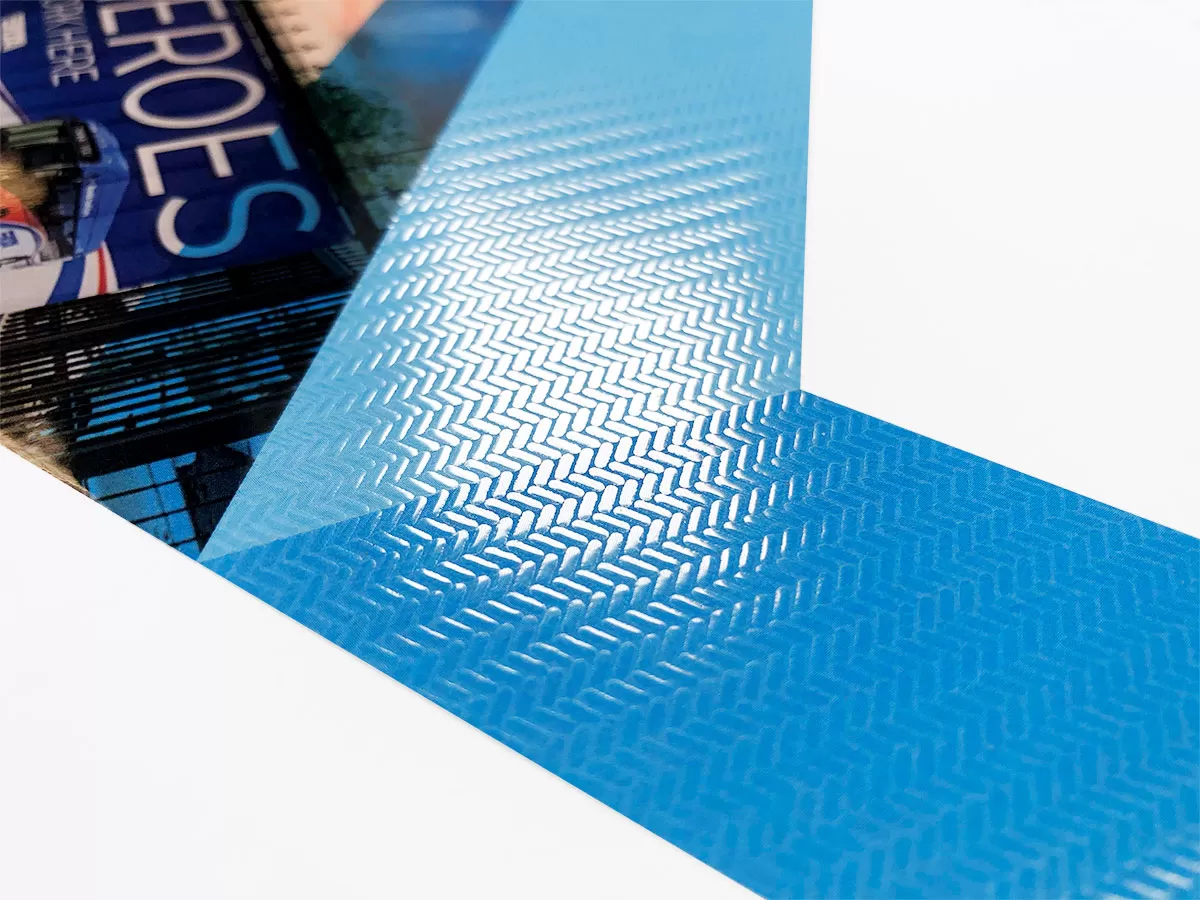
Finishing is easy to treat as decoration added at the end. In a physical document, it helps decide what a reader notices. A smooth field beside a raised pattern creates a change in texture; selective gloss changes what catches the light. The paper becomes part of the reading experience.
PrintMyStuff’s finishing choices also include foil, embossing, folding, lamination and several kinds of binding. The useful buying exercise is to ask which treatment serves the document. A manual that needs convenient handling and a presentation piece intended to attract attention can demand different answers. Specifying every available embellishment is not a design strategy.
The second order should be less work
Behind the unusual objects sits a less photogenic service: repeat purchasing. PrintMyStuff offers private B2B storefronts for organizations that regularly order branded materials. These portals can centralize ordering, support personalization, manage brand standards and connect production with fulfillment.
The appeal is administrative. Once an organization has settled a design, its next buyer should not have to reconstruct every decision. A controlled catalog can preserve the approved choices while allowing an employee to order what is needed. This matters most when the same materials recur; for an occasional one-off, a conversation and a quote may be sufficient.
Mailing extends the same idea beyond the print room. The company offers list management, addressing, inserting, presorting and fulfillment. A stack of printed postcards is an intermediate product. Somebody still needs to organize its journey to the intended recipients. Combining those stages gives the customer a larger piece of the job to hand over.
Buy the batch you can use
For a buyer, cost begins with the specification. PrintMyStuff’s packaging service includes mockups, short runs and larger production orders. That range permits a practical distinction between testing an idea and supplying an established need. A promotional box for a limited event has a different inventory problem from packaging used every week.
The sensible comparison is total useful output. A lower unit price offers little comfort if a large share of the order becomes obsolete. Conversely, repeated small orders may be inconvenient when demand is predictable. Ask for quantities that reflect both scenarios, then compare the complete quotes. That is a buying method, not a promise that short runs always cost less.
Start with dimensions, quantity, intended use and the date the finished work must be in hand. Discuss the proof before treating the schedule as fixed. The online shop’s terms tie production timing to print-ready files, approval and payment. They also distinguish a screen proof’s layout information from reliable color matching. The clock on a print job does not necessarily begin when someone first clicks “order.”
An old file can be a useful asset
In February 2025, PrintMyStuff published a notice for customers of PrintProPlus, which had ceased operations. Artwork and order histories had been preserved to help customers move their printing work. The notice explicitly said this was not an acquisition and that PrintMyStuff had not assumed the former business’s obligations.
That episode reveals a quieter form of service. A returning customer wants continuity: the correct artwork, the familiar job, a person who can help make sense of what was ordered before. The previous order is a record of decisions that would otherwise need to be made again.
It brings us back to the theater sign. Useful printing begins with understanding what an object must do, then remembering enough to do it again. A clear arrow, a box that fits, a report someone wants to pick up: these are modest outcomes. Making them reliably is a substantial business.
See the objects, start a job
Visit PrintMyStuff · Request a quote · Recent projects · YouTube production videos