At Tuna Paradise, a seafood processor in Thailand, a mistake in a spreadsheet could travel a surprisingly long way. Workers counted boxes in cold storage by hand. When those counts were wrong, shipping containers sometimes left partly filled. The company paid to move empty space. The fish had a destination; the information about them had fallen behind.
ThisFish Inc., the Vancouver company behind its replacement software, sells a remedy for that lag. Its central product, Tally, records what happens as seafood moves through a factory. The interesting part is how the company arrived there. It started with a question a shopper might ask and ended up beside the weighing scales.
- The work: turn seafood production, inventory and traceability into live records.
- The buyer: processors, canneries, distributors and cooperatives.
- The bet: make good records useful enough that factories want to keep them.
The clipboard was the clue
In 2010, Ecotrust launched an online platform that let consumers trace seafood back to its harvester. It expanded beyond British Columbia, into other fisheries and countries. But the same obstacle kept appearing: much of the information needed to tell that story remained on paper inside processing plants. A compelling consumer experience depended on some decidedly unglamorous factory administration.
The team followed the obstruction upstream. Ecotrust Canada, Indonesian nonprofit MDPI and Wageningen University developed a prototype in 2015, testing it in two plants in Indonesia’s Maluku Islands. Its nickname was Tally-O. The beta followed in 2017, when ThisFish launched as a social enterprise. The company’s account of its origins describes a change in focus driven by that bottleneck.
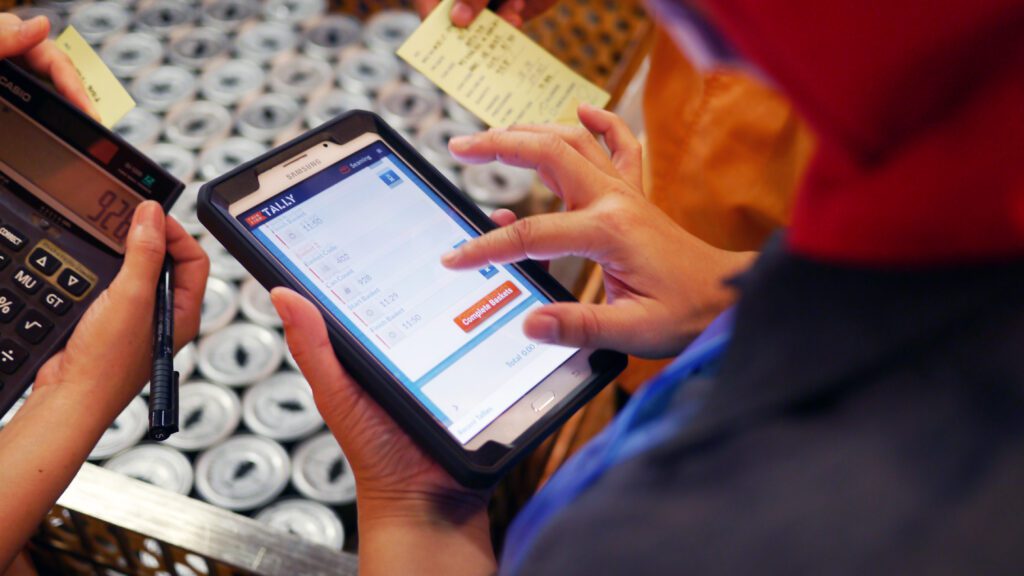
Co-founder and CEO Eric Enno Tamm grew up in a commercial fishing family. His company now pairs that industry knowledge with software engineers, data scientists and customer-support specialists spread across several countries. Its stated values include curiosity and ownership. In this business, those ideas have a practical test: can someone understand a particular plant well enough to translate its daily routines into software?

Thirty tablets, fewer hiding places
Consider MMP International, a Thai tuna cannery working with UK supplier World Wise Foods. Workers recorded production on clipboards. Some information was retyped into Excel; documents eventually went into warehouse storage. A traceability request meant retrieving, scanning and tabulating records, a process that took four to six hours.
According to ThisFish’s customer case study, the plant replaced its clipboards with 30 tablets. Installation and training took just over a week. Workers used buttons and menus; calculations happened automatically. Managers gained more than 20 customized reports and live views of temperatures, production lots and processing times.
Reported in the MMP International case study.
The important change was timing. A report arriving a day or two later could explain a problem. A dashboard could expose it while someone still had time to intervene.
The price of an almost-full container
At Tuna Paradise, Tally connected to electronic scales, printed QR labels and tracked trays as workers scanned them through production. Finished boxes were scanned into shipping containers, producing packing lists. More than 40 customized reports covered matters including yields, mass balance and traceability.
That makes the commercial argument easier to understand. The same record that helps answer a customer’s question about origin also helps a manager establish what is available to ship. Traceability becomes part of doing the work, with an immediate operational use.
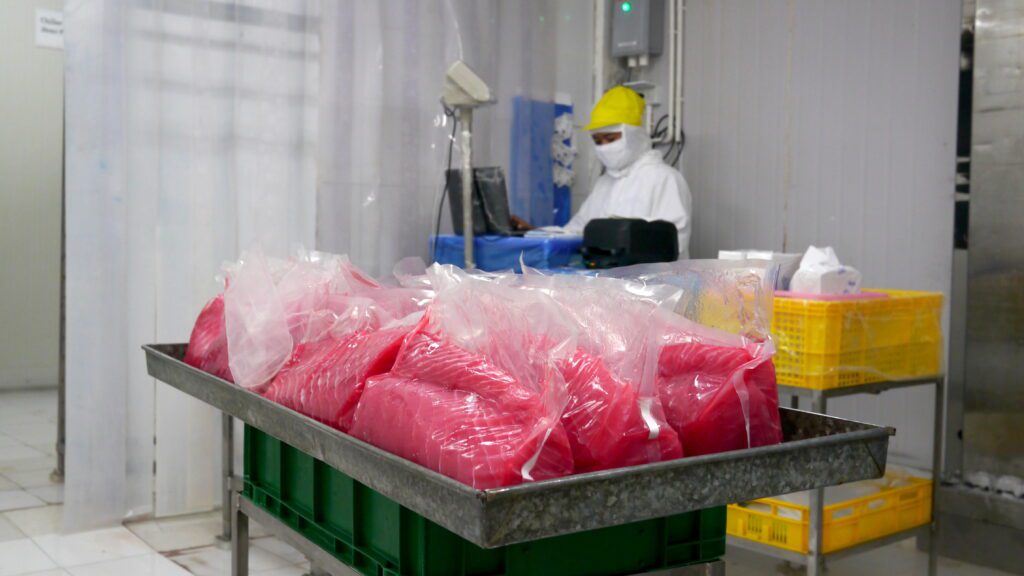
“I can now monitor hourly output and yields in real-time.”
Raju Kalai / President, Tuna Paradise
A fish refuses to have a standard cost
There is another complication: seafood changes value as it changes shape. At Canadian processor Orca Specialty Foods, purchase prices and processing yields made costing difficult. Inventory included raw materials and finished goods, with some held in third-party cold storage.
Orca introduced Tally to track inventory, production and costs as events occurred. ThisFish configured an algorithm that calculates a quantity-weighted average price for each raw-material type, updating it as stock enters or leaves. The system also exchanges purchase orders and master data with Orca’s accounting software. The Orca case explains why seafood expertise matters: a generic record of purchases leaves considerable work unfinished.
ThisFish calls Tally a manufacturing execution system. It occupies the factory floor, alongside accounting and enterprise systems. Paper, Excel and legacy software are practical alternatives; specialist traceability platforms occupy adjacent territory. Tally’s pitch combines production detail with product history.
First the record. Then the robot.
The product family follows that logic. TallyHub connects equipment; TallyBI provides dashboards and reports. TallyTrace shares selected histories with customers, TallyTag monitors temperatures, and TallyPlan maps warehouse inventory. TallyBot handles calculations, checks and automation.
- 01 / CAPTUREWeights + scans
- 02 / CONNECTLots + inventory
- 03 / ACTReports + checks
TallyVision adds cameras and computer vision to inspect fillet size, colour and defects. In May 2026, PacifiCan announced C$665,000 to help scale ThisFish’s camera system. That announcement funds development and commercialization; it does not establish that every proposed inspection application already works everywhere.
A factory needs a reason to change
Buying the system involves annual software fees based on configured forms and features, plus compatible hardware. Full implementation generally takes three to nine months. A short on-site installation is one stage of that process. Unreliable internet may require an on-premise deployment; workflow changes and staff training still need attention. The sensible starting point is one troublesome process, with a clear owner and a measurable reason to improve it. ThisFish recommends phased rollouts for larger installations. Buying more modules cannot substitute for deciding who records each event and what should happen when a number looks wrong.
The reach keeps widening. In February 2026, ThisFish announced deployments with Japanese tuna wholesaler Yamayuki and cooperative Mie Gyoren. Its Japanese partner later produced a manga-style video about paperwork and digitization. Even factory software needs a story.
The useful lesson is small enough to copy: find where information first becomes inconvenient to record, then give the person recording it something useful back. A scanner cannot make a false declaration true. But a system that helps fill a container, price a shipment or catch a production problem gives a factory a reason to keep the record moving.
Keep following the fish
Explore the company website, Catch-Up blog and customer stories.