The truck is on time. The cartons are intact. The paperwork looks reassuring. Yet none of these things answers the question a pharmaceutical quality manager needs answered: what happened to the medicine while nobody was watching? A punctual delivery can still contain a temperature problem. Sensitech has built its business around making that invisible journey legible.
- The job: follow shipment conditions, then help people act on the evidence.
- The kit: sensors, cloud software and cold-chain specialists.
- The stakes: usable food, usable medicine and fewer expensive guesses.
The distinction is easy to miss. A location marker tells you where a shipment is. A condition record helps explain what it has experienced. Combine those records with product rules and operational expertise, and a shipper can decide whether to intervene, investigate or change the next journey. That is the territory Sensitech occupies between the cargo and the people responsible for its quality.
A thermometer with a memory
Sandy Santin founded Sensitech in 1990, when falling electronic component costs made digital temperature monitoring a more practical proposition. TempTale 1 followed in 1992. A temperature record could now become data that customers could compare across journeys. The company’s account of its early years describes customers pushing for analytics and real-time information. Their questions widened the assignment beyond building a better recorder.
Today, Sensitech says it monitors more than 16 million shipments annually. That is a measure of traffic through its monitoring business, rather than a customer count. Its market includes food producers, pharmaceutical businesses and industrial shippers. The recurring problem is shared: valuable goods pass through several organizations, while responsibility for understanding their condition can fall into the spaces between them.
The sensor rides with the cargo
Consider the placement of the device. Sensitech describes a logistics customer whose shipments included overseas parts moving through ports and onto railways. Monitoring attached to the cargo reduced dependence on a driver’s phone. That matters when the pallet and the vehicle part company. Following the goods gives the logistics team a record that can travel across those handoffs.
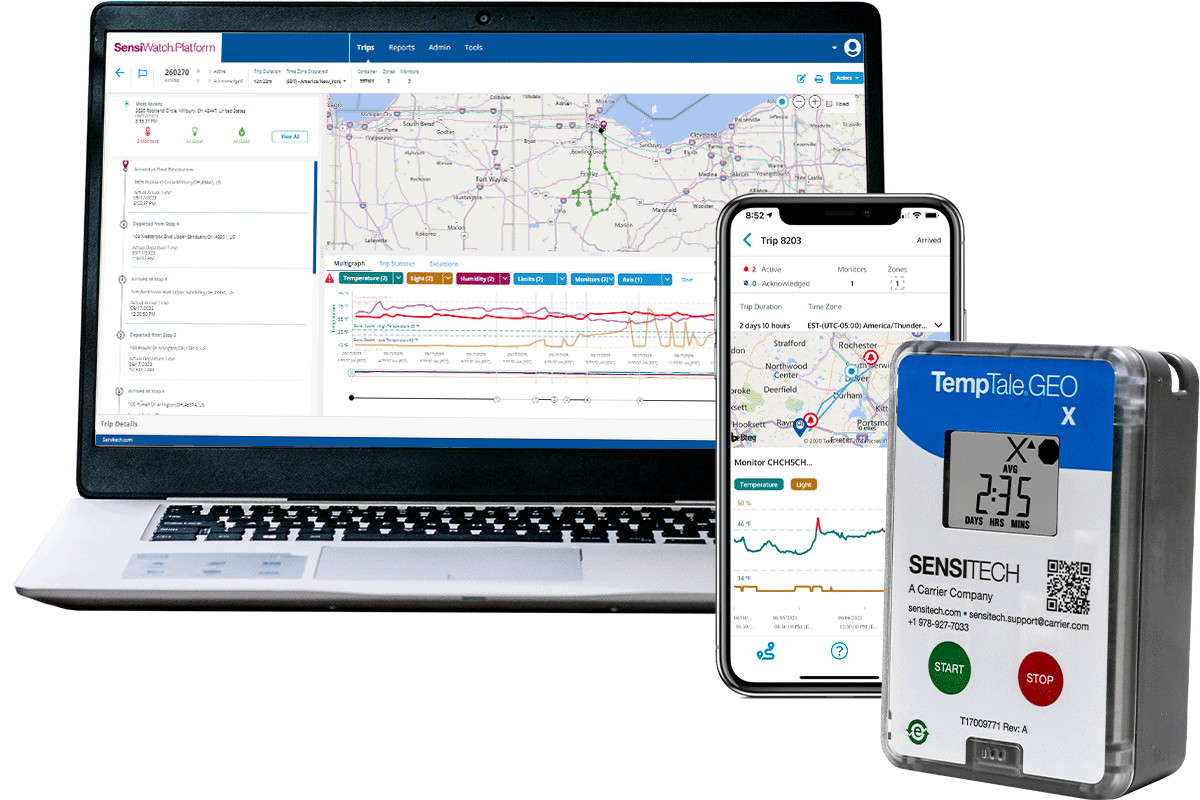
TempTale GEO X, introduced in 2024 for life-sciences logistics, brings condition monitoring together with cellular connectivity. SensiWatch supplies shipment maps, timelines, alerts and analysis. ColdStream Select handles validated data management and workflow automation. Sensitech also offers passive monitors and stationary monitoring, so a customer’s program need not depend on every shipment requiring the same device or reporting method.
The buyer is purchasing a business system: hardware to gather observations, software to organize them and services to make them useful. Food scientists, engineers and other specialists help establish monitoring programs and interpret results. Sensitech’s place in the market is therefore broader than the sale of a logger. Controlant and ELPRO offer overlapping combinations of devices and software; integration and operating fit deserve scrutiny.
Sometimes the answer is slower shipping
A useful test of any monitoring business is whether its data changes a decision. In a published brochure, Sensitech describes an unnamed US pharmaceutical company using approximately 200,000 temperature monitors a year. Packaging analysis indicated that packaging used for next-day delivery could support two- to three-day shipping without compromising the product. The company changed its shipping processes.
Sensitech reports annual savings in the low millions. The finding is specific to that customer’s packaging and analysis; it offers no general permission to downgrade pharmaceutical freight. But it makes the economic argument concrete. Monitoring can expose unnecessary spending as well as unacceptable risk. The price of the program belongs alongside freight costs, investigation time and the consequences of a rejected shipment.
“We always need more eyes on a product”Jenifer Smith, Senior Logistics Specialist, Direct Relief
Direct Relief offers a different reason to care. Sensitech’s humanitarian logistics case study describes inconsistent cold storage at certain airports and the difficulty of maintaining visibility in remote or war-affected locations. TempTale GEO Ultra and SensiWatch gave teams information for in-transit intervention and shipping-lane analysis. Here, the useful outcome is medicine reaching people in usable condition, with partners able to see the same journey.
The paperwork can become the bottleneck
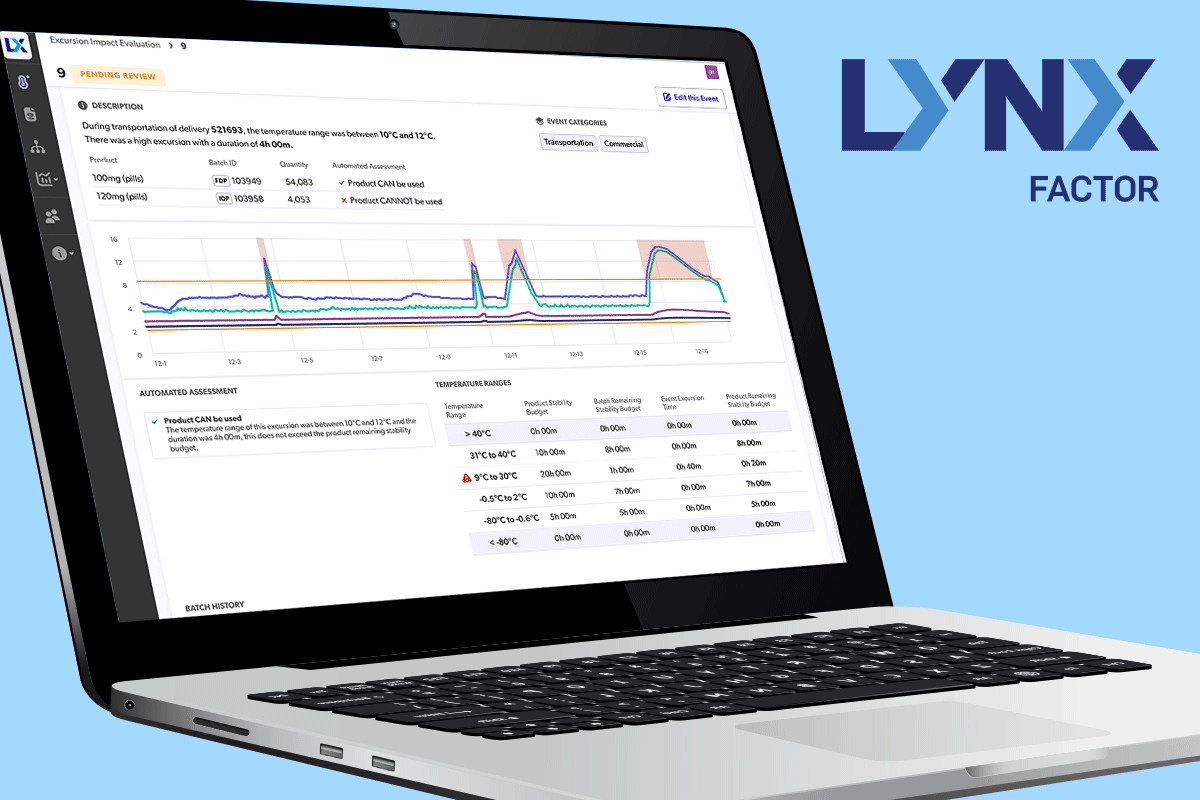
After a temperature excursion, the work continues. Someone must connect the event to the affected batch, examine its history and assess product stability. Carrier launched Lynx FacTOR in March 2025 to automate those evaluations. Its name points to time out of range: a reminder that the duration of exposure matters alongside the temperature itself.
Carrier says the device-agnostic SaaS can reduce assessments from days to minutes. It assembles data and applies rules to produce release recommendations; the customer retains the final decision. This is a significant boundary. Software can accelerate an assessment, but the product’s stability information and the quality team’s judgment still determine what an excursion means.
The gaps keep moving
Carrier has owned Sensitech since 2006. More recently, the August 2024 acquisition of Berlinger’s Monitoring Solutions business expanded its pharmaceutical, stationary-monitoring and global-health capabilities. An announced Qualcomm collaboration targeted location and connectivity improvements, although the October 2024 announcement specified a non-binding memorandum. These moves show where Sensitech sees work remaining: more settings to monitor and better connections between them.
In September 2026, it launched TempTale GEO APX Global for food moving by ocean, road and rail. Standard and extended versions support journeys up to 60 and 120 days respectively. LTE connectivity addresses another practical disruption: the retirement of older mobile networks. Eligible devices can enter Sensitech’s takeback program, adding a return journey to the monitoring lifecycle.
The lesson a reader can copy is procedural: define the decision before collecting the data. Choose appropriate monitoring, agree on product-specific limits and assign someone to respond. A cellular device has communication constraints; a sensor has operating limits; an alert needs an action. Sensitech makes the journey more observable. What saves the shipment is what people do with that observation.