A refrigerated container has two stories to tell. One is geographical: where it went, which port handled it, when it should arrive. The other is biological. Food warms. Pharmaceuticals have temperature limits. A power failure can turn an uneventful voyage into a cargo claim. A dot on a map tells only the first story.
ORBCOMM works on the second. Its devices collect signals from physical assets; its networks move those signals; its software helps operators decide what deserves attention. The customers are shipping lines, trucking fleets, equipment manufacturers and the companies that build monitoring services for them. The product is useful knowledge about expensive things that spend their lives somewhere else.
- Watch the condition. Track temperature, door events, movement and equipment status.
- Carry the message. Use cellular, satellite or hybrid connections to suit the job.
- Reach the right person. Turn a warning into a chance to protect cargo or service equipment.
The last person who can help
Consider the ship’s crew. An operator ashore may have a handsome dashboard, but a crew member is closer to the refrigerated box that needs checking. In June 2025, ORBCOMM introduced CrewView to bring monitoring aboard the vessel. It provides SMS alarms, container information and maps showing where boxes sit by bay, row and tier.
The revealing detail is that onboard visibility does not require satellite connectivity. Vessel-to-shore transmission handles the other part of the journey. The person who can inspect a problem does not have to wait for the entire communications chain to cooperate. In a business associated with satellites, one useful advance is knowing when the satellite can be left out.
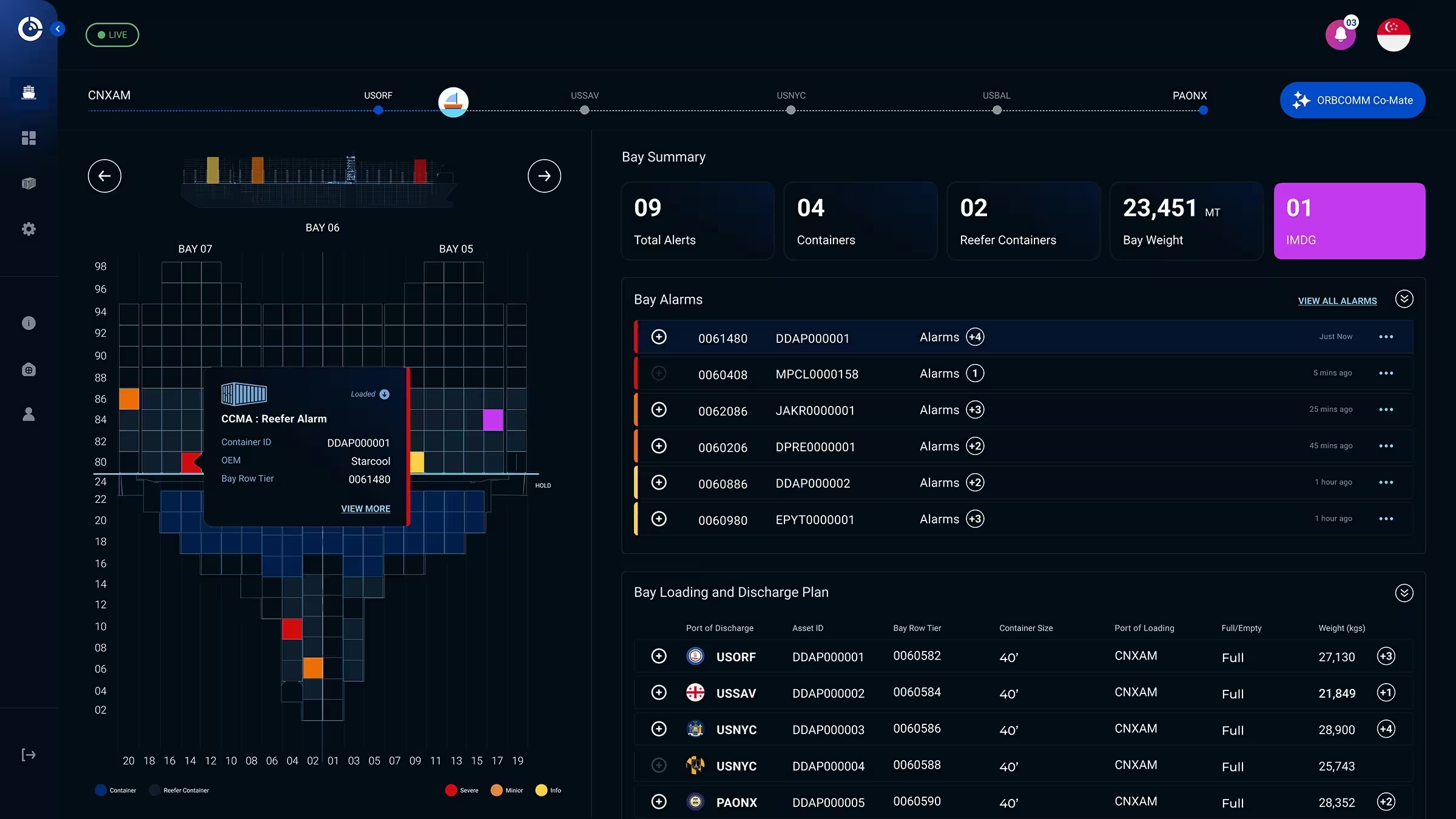
This was also a decision about ownership. CrewView builds on technology from Vobal, whose assets ORBCOMM acquired in May 2025 after a decade working together. CEO Sameer Agrawal explained the move: “With smart containers becoming the industry standard, we decided it was time to own the core technology and strengthen our maritime portfolio.”

The satellites survived. The business had to change.
The original ORBCOMM venture dates to 1993, within Orbital Sciences. Its promise was modest in bandwidth and ambitious in geography: let remote machines send messages. Yet an operating network could not guarantee a viable company. ORBCOMM Global filed for Chapter 11 in September 2000. The network continued operating during restructuring; a licensee-led investor group was subsequently approved to buy the assets.
That distinction matters. The early failure was corporate, while the communications infrastructure kept working. Treating the later company as an uninterrupted startup success would erase the uncomfortable part of its history. A machine can transmit perfectly and still belong to a business whose finances do not work.
Later expansion added more of what customers needed around the connection. In January 2015, ORBCOMM completed its $130 million SkyWave acquisition. Alongside satellite expertise came more than 250,000 subscribers and 400 channel partners. Buying that distribution mattered: local integrators could turn communications technology into an application a customer could actually install.
A machine can transmit perfectly and still belong to a business whose finances do not work.
The box learns to report trouble
In October 2025, Evergreen Line selected ORBCOMM technology for its dry-container fleet. The announced capabilities included door-opening alerts, temperature deviations, shock detection and location reporting. ORBCOMM said it had enabled more than one million smart containers by then. That is the company’s count, rather than an independent assessment of how much cargo was saved.

Refrigerated monitoring adds another layer: condition data and remote control, with optional live exception management. Fleet telematics tackles related questions on land, including trailer location, equipment diagnostics and asset use. Historical filings name customers such as Caterpillar, Komatsu and J.B. Hunt. These are different working environments, joined by the difficulty of supervising dispersed physical assets.
The current business separates those jobs into two brands. VIACHAIN addresses supply-chain asset intelligence. SKYWAVE supplies connectivity, devices and application enablement to solution providers and equipment manufacturers. ORBCOMM sells hardware alongside recurring connectivity, software and monitoring services. Installation and integration belong in the buying decision, too; the cost depends on what the deployment requires.
- 01SenseTemperature / door / shock
- 02SendCellular / satellite / onboard
- 03AssessSoftware + operating rules
- 04ActCrew / dispatcher / technician
Fewer decisions inside the device
SKYWAVE’s January 2026 ST 4000 announcement makes the engineering proposition explicit. The hybrid module combines satellite and cellular capabilities, reducing the need for separate device variants and custom failover logic. “In IoT, complexity adds unnecessary risk,” said SKYWAVE president Dave Roscoe. The announcement reported deployments by more than a dozen solution providers.
That puts ORBCOMM between communications operators and application specialists. Globalstar offers alternative satellite connectivity; fleet platforms compete for operators’ software budgets. The boundaries overlap. In July 2026, SKYWAVE and Iridium announced a partnership to embed Iridium Short Burst Data in SKYWAVE terminals for heavy-equipment customers. Integration was underway, so the announcement describes a direction, not universal availability.
Attention has a balance sheet
GI Partners took ORBCOMM private in September 2021 at approximately $1.1 billion including net debt. In April 2026, ORBCOMM announced a $460 million refinancing supported by Carlyle, Bain Credit and Morgan Stanley Private Credit. That package includes undrawn commitments and replaces existing facilities. It should not be read as $460 million of fresh equity.
The practical lesson for a buyer is smaller than those numbers. Start with a costly event, identify the signal that precedes it, and name the person who will respond. Then choose the hardware and connection. This is an inference from the product design, not a promised return: low-value cargo, reliable existing coverage or an unattended alarm queue can weaken the case for a more elaborate system.
ORBCOMM’s useful question is therefore very ordinary. When something starts going wrong, who finds out soon enough to do anything? The container has acquired a voice. The remaining work belongs to the people listening.