The ordinary shipping label has a very limited social life. It is scanned, ignored, scanned again, and blamed when a parcel goes missing somewhere between those two encounters. Trackonomy’s idea was to give the label a voice during the silence. Stick its battery-powered SmartTape on a box and the package can report location and conditions while it travels. That simple change - a label that speaks before someone asks it a question - has carried a San Jose company from package tracking into airport operations, healthcare logistics, chip design and label manufacturing.
The short version
- Trackonomy connects goods and equipment with smart labels, sensors and software.
- UPS Healthcare, Delta Cargo, Georgia-Pacific and Jettainer are publicly named users or partners.
- Its 2025 and 2026 acquisitions added BLE chips and industrial label production to the original tracking business.
- The point is to catch trouble between scan points, while an operator can still do something about it.
Erik Volkerink and Ajay Khoche founded Trackonomy in 2017. Volkerink had led technology work at Flex; Khoche brought experience in rapid prototyping and production. Their mission, in company language, was to connect “every last point in the supply chain.” In practice, that meant confronting an old bargain in logistics: a barcode is cheap and dependable, provided a person or reader happens to be there to scan it. The moments without a reader are where much of the useful story disappears.
The missing minutes
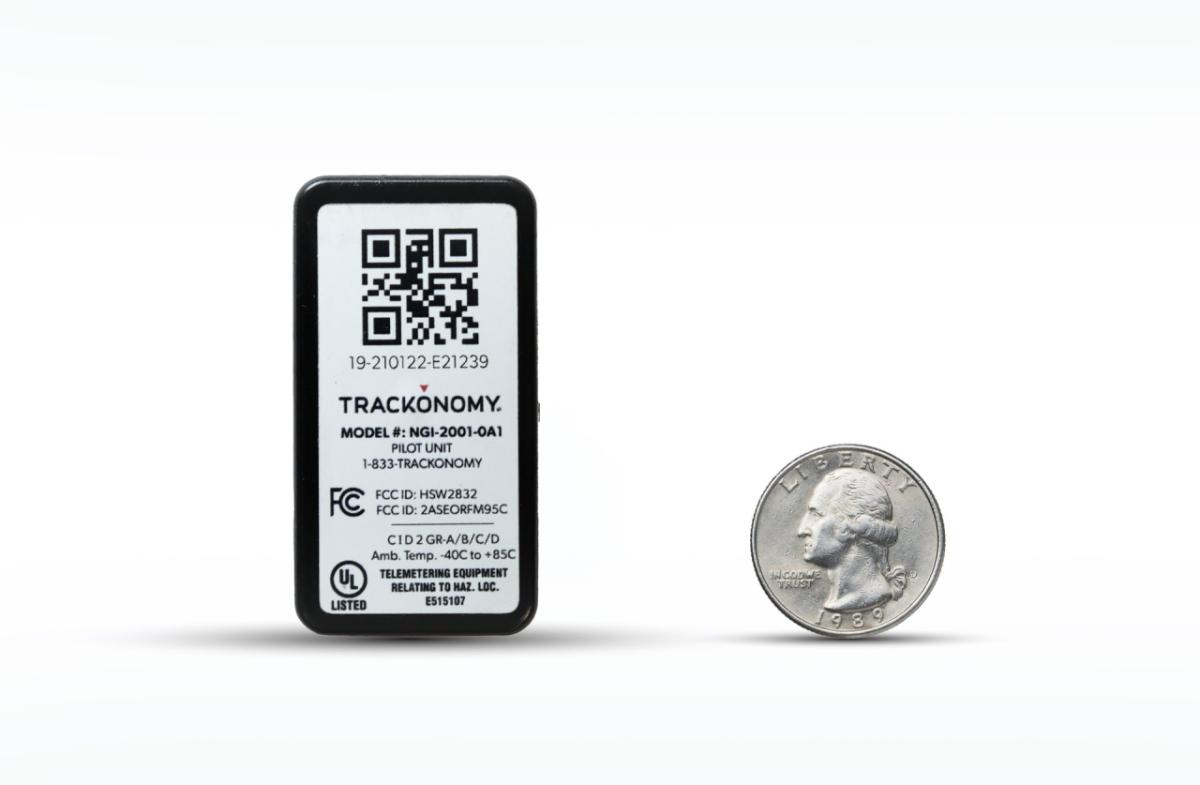
SmartTape is a tracking device in a tape-like form factor. A worker attaches it to a parcel, pallet or other asset and associates it with that item using a QR code. Depending on configuration, it can report location and conditions such as temperature or shock. The company markets it as a single-use purchase, without a monthly subscription fee for the device. Once the trip is over, there is no tracker to find, recharge and send home. That is a peculiar kind of elegance: the product is designed to be left behind.
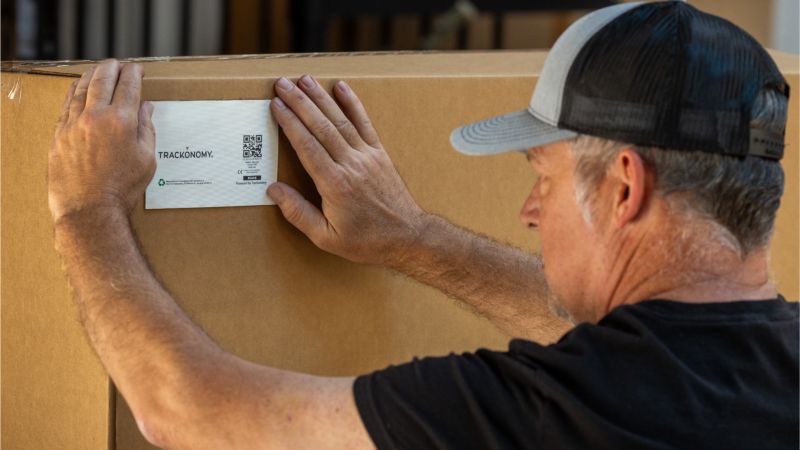
A low-cost label alone would make a better travel diary. Trackonomy also sells a software layer called Sentient, which combines sensor readings with other operational data and turns them into alerts and workflow decisions. In a cold-chain shipment, an unexpected temperature rise matters only if someone can locate the parcel and intervene. In an airport, the useful fact may be whether a container reached a gate in time for the next flight. This is where the company positions itself: where tracking data becomes a reason to act.
A vaccine is a demanding customer
Trackonomy’s public work with UPS gives the idea its clearest stakes. During COVID-19 vaccine distribution, UPS used Trackonomy technology to monitor sensitive shipments. The company says its system helped track millions of vaccine doses and supported 99.9% on-time delivery. The number is a company and partner account, but the use case is concrete: temperature, location and handling matter more when a shipment is both time critical and fragile. Trackonomy says UPS continued using its technology for a premier healthcare shipping service after the initial vaccine effort.
“Trackonomy allows us to resolve issues faster, better, and in a more economical way.”Daniel Gagnon · UPS Healthcare · LogiMed USA 2024
The same logic turns up in less obvious cargo. Georgia-Pacific worked with Trackonomy on plywood shipments ahead of hurricane season, when delays can keep building materials from retailers and communities that need them. Delta Cargo’s Pulse service uses Trackonomy technology to show shipment location from airport to airport and flag likely disruptions. Delta says SmartTape is applied to eligible DASH and DASH Critical packages at enabled U.S. stations, so customers receive the new visibility without a separate installation step. Jettainer, which manages aircraft cargo containers, selected Trackonomy devices for its global unit load device fleet. Its stated problem is familiar: fixed readers at airports leave blind spots between the places where they are installed.
The label gets a family
The most revealing move came after SmartTape was in the market. In 2025, Trackonomy bought InPlay, maker of ultra-low-power Bluetooth Low Energy chips. Its NanoBeacon chip is designed for small, inexpensive connected objects. Trackonomy and Tageos then announced battery-powered BLE inlays built around it. In September 2026, Trackonomy completed the acquisition of Identiv’s IoT label business, adding design and high-volume production of RFID, NFC and BLE labels. Trackonomy said demand had outstripped available manufacturing capacity. The combined company calls itself Trackonomy Group and describes three businesses: semiconductors, labels and end-to-end solutions.
The transaction terms are a story of their own. Identiv agreed to transfer its IoT operating assets, including a Thai subsidiary and German research center, and contribute $25 million in cash. In exchange, it received $50 million of Trackonomy preferred equity. That is not a simple cash purchase price: Identiv traded an operating business and cash for an ownership stake. The company said the cash would help integration and manufacturing scale. Trackonomy gained more control over the physical economics of a label that must be cheap enough to attach widely.
Identiv contributed its IoT business and cash for Trackonomy preferred shares. The acquisition closed in September 2026.
Volkerink says the three businesses will sell to the broader market on their own merits. That matters because the chip unit need not depend on Trackonomy’s own software customers, and a label maker need not become a captive factory. It is an ambitious structure, but it also exposes the test: each unit has to work as a business, while the pieces together make connected labels easier to deploy.
That arrangement also asks a great deal of the people making it work. Trackonomy describes its culture in terms of ownership and “radical accountability,” and said the combined group employed more than 500 people after the Identiv deal. A chip designer, a label factory and an airport software team do not naturally keep the same calendar. Their coordination may be as important to the product as any sensor.
What the tape cannot promise
There is a useful lesson here for anyone building technology for physical work. Start with a unit of work that people already touch - a parcel, a cargo container, a machine - and make the new step almost invisible. Then connect the resulting signal to a decision someone is already responsible for. A sensor that merely adds another dashboard may document failure beautifully while doing little to prevent it.
The conditions matter. A disposable, battery-powered tracker makes the most sense when the value of the shipment or the cost of a missed handoff justifies a device on each item. Cellular coverage, battery life, airline rules, sensor accuracy and integration with actual operations still set boundaries. A scan may be enough for a low-value parcel following a predictable route. The point of Trackonomy’s design is more specific: for shipments whose silent intervals are expensive, it gives the interval a voice.