Rosemary Johnston’s working life began with a small act of impatience. One semester at Cal Poly Pomona was enough to convince her that she wanted something different. She walked into a military recruiting station without a grand design. The first recruiter free to speak with her represented the Air Force. After a short spell of consideration and six months in delayed entry, the young woman from a small community outside Los Angeles was on her way to basic training at Lackland Air Force Base in Texas.
Chance opened the door. The next 23 years were anything but casual. Johnston trained in inventory management and graduated with honors. She learned a profession that is easily mistaken for shelves and spreadsheets, although its true subject is time. A missing part can keep an aircraft on the ground. An unseen container can trigger another order. Uncertainty breeds expensive habits: safety stock, duplicate purchases and urgent phone calls. Logistics is the craft of making sure need and arrival keep the same appointment.
She rose to Chief Master Sergeant and became the first female career field manager for her specialty. From 1995 through 1999, she helped shape training, staffing and recruitment for 35,000 Air Force and civilian personnel in supply logistics. The number is impressive. The more revealing detail is what it required: she had to understand a system at headquarters scale while remembering that it was carried by individuals at bases around the world.
The career field assignment was the culmination of years spent learning how policy behaves after it leaves the meeting room. Johnston worked on wartime planning concepts, forecasting and the rules that governed retail and wholesale supply. In 1991, while a senior master sergeant, she wrote an assessment of the Air Force stock fund and helped prepare an executive handbook for its managers. Paperwork is often the villain in stories about institutions. Here it was the instrument that translated billions of small decisions into a system people could actually operate.
She chaired the Supply Chiefs Advisory Board, the Supply Training Team and wartime-requirements workgroups. She also visited bases and mentored people she called the “Supply Blue Two.” The role required both abstraction and shoe leather. A staffing model could say how many specialists belonged in a unit. A visit could reveal whether the training, tools and processes made sense to the airmen doing the job.
The wall and the warehouse
In the mid-1980s, Johnston crossed through Checkpoint Charlie into East Germany. West Berlin had been noisy and bright, full of shoppers, workers and crowded cafés. Across the checkpoint, the streets fell quiet. Shop shelves were bare. Soldiers watched from posts along a wall crowned with barbed wire. The western face of that wall carried graffiti; the eastern face carried none.
She took away a conviction about freedom, expression and the danger of being constantly watched. It might seem remote from inventory management, yet the memory sits neatly beside the leadership philosophy she later described. People, in her view, deserve dignity and respect. They should be invited into open dialogue. Praise belongs in public; criticism belongs in private. Authority is not a license to diminish someone.
One superior provided the negative example. He embarrassed and belittled airmen, then wondered why the team underperformed. Johnston did not forget the equation. Respect is reciprocal; humiliation also compounds. Her preferred model was Glenn Milled, a retired chief who never directly supervised her. He understood fragile, elderly computer systems, argued plainly for what his team needed and knew the people on his base by name. Technical fluency made him credible. Attention made him approachable.
“Leaders inspire through their actions!”Rosemary Johnston
The sentence is brief enough for a poster, but Johnston attached it to a less glamorous scene. When resources were tight and an all-hands effort was needed to move product, she believed the leader should join the work. Titles could establish responsibility. They could not excuse anyone from it.
A second career in the same problem
After active duty, Johnston moved into commercial defense work. At Dynamics Research Corporation, she advanced from systems analysis through logistics leadership to management of a $10 million business supporting Defense Department and Pentagon customers. Her team worked across information systems, business transformation and mission-critical communications. She had changed uniforms, but not subjects. The central problem remained how to give people dependable information about the resources on which a mission depends.
The business results were concrete. Her unit grew new work by 25 percent, increased annual revenue by a third and retained every customer, according to her professional record. Teams supporting Pentagon and wider defense accounts expanded under her direction. The figures are useful because they locate her transition: Johnston was no longer only an expert in supply. She had learned capture strategy, pricing, contract negotiation and profit-and-loss responsibility. She could move between the language of the mission and the language of the balance sheet without pretending they were identical.
training
policy
systems
visibility
Johnston joined Savi Technology in 2006. The company’s work made a tidy bridge between her past and the emerging internet of things. During her time on the Air Staff, the military had tested automated identification technology. At Savi, she became responsible for programs that used active radio-frequency identification, cellular links, satellite communications and software to follow cargo across a global network.
By 2013, she had moved through services and support, process improvement, business integration and information systems into the management team. Savi named her vice president for federal sales and strategy. The promotion put a former Air Force supply chief in front of agencies wrestling with budget cuts and new technical standards. Her pitch was characteristically operational: constraints make accurate location and condition data more valuable, not less. A cheaper organization cannot afford to buy the same thing twice simply because it has misplaced the first one.
The old system could often report only the last place a tagged asset had passed a reader. That was better than darkness, but it was still a postcard from the past. A connected sensor could report location and condition while an item was moving. It could help a logistician see a delay before it ripened into a shortage. The gadget mattered less than the decision it allowed someone to make.
ASSET
SENSOR
+ CONDITION
THE DELAY
As a Savi vice president and later senior vice president of operations, Johnston became a public interpreter of that system. She explained why military units order “just in case” when they cannot see a shipment, how a lighter portable kit helps a team working in an austere location and why a global supply chain needs more than a pin on a map. Food, fuel, clothing, munitions and repair parts are not interchangeable dots. Their condition and expected arrival can matter as much as their coordinates.
Her career also followed the institutional history of the technology. She chaired the Supply Chain Council’s aerospace and defense working group, concentrating on the SCOR process model and RFID-supported visibility. She represented Savi during successive Defense Department contracts and partnerships. In 2020, when suppliers and the Army National Guard adjusted inspection and delivery routines to move 221 portable deployment kits, she called the result a model public-private effort.
The hard turn
Leadership acquired a harsher meaning in 2021. Savi closed its commercial software business, sought Chapter 11 protection and narrowed its focus to government contracts. Johnston, by then CEO, had to lead a smaller company through the change. Her public note thanked colleagues who would not continue into the next chapter. There was no jaunty management language to make the departures painless.
The moment illuminated an older belief. Honesty and integrity, she has said, are what permit a leader to make painful decisions and still look people in the eye. She had encountered that test in the Air Force when mandated personnel reductions forced changes to her career field. The setting changed. The obligation did not.
Public directories now list Johnston as Savi’s chief executive officer and president. Her unusual advantage is not simply that she knows the customer. She has been the customer, the person responsible for the career field, the contractor managing programs and the executive accountable for the company. She has waited on information and sold the means to produce it.
“Don’t dwell on your successes.”The counsel Johnston carried into every next assignment
Return to the workbench
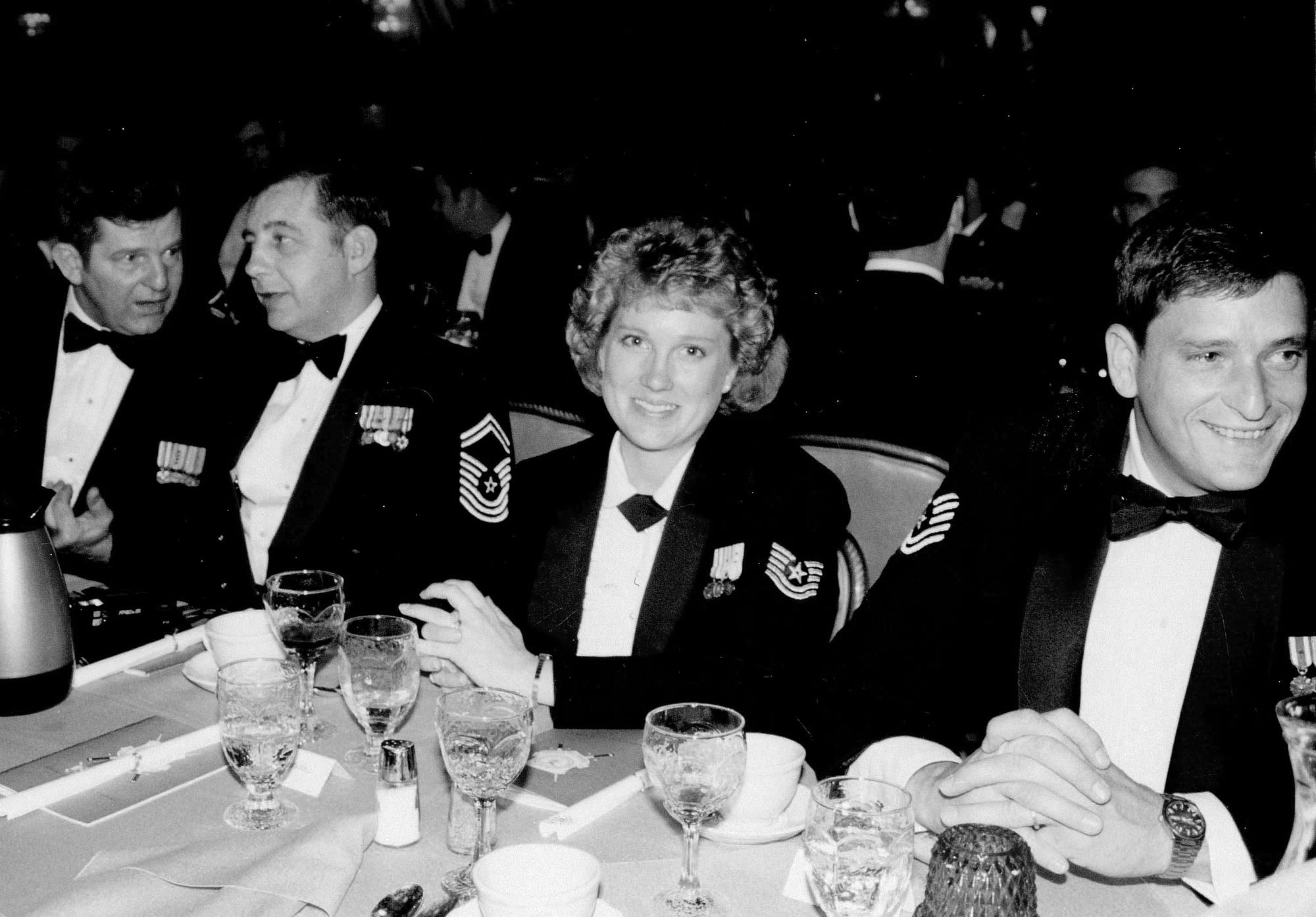
The warning came after Johnston was selected as one of the Air Force’s Twelve Outstanding Airmen of the Year. There were dinners, plaques and congratulations. Then a Chief Master Sergeant of the Air Force reminded the honorees what would happen when the ceremonies ended: they would return to their units. Promotion tests, professional education and the daily job would still be waiting. An award could acknowledge previous work. It could not complete the next assignment.
That may be the cleanest way to understand Johnston’s route from a recruiting-office whim to the executive suite. She kept returning to the workbench. Inventory training led to policy. Policy led to systems. Systems led to sensors. At each stage, the scale grew while the question remained almost comically plain: Where is the thing we need?
There is wit in the fact that an executive career can be built around refusing to lose the luggage. There is also gravity. Military logistics determines whether a unit can repair, move, eat and respond. The work rewards people who notice what has not arrived and what no one else can see. Rosemary Johnston has spent a career making the invisible report for duty.