A cargo ship can be 300 meters long and still manage to look suspiciously absent. It can switch off its Automatic Identification System, report a location that physics finds creative, change flags, pass cargo to another vessel at sea, or hide its owner behind a row of companies. To a conventional tracker, these are missing fields. To Windward, they are behavior.
That distinction is the company. Windward takes location broadcasts, satellite imagery, radio-frequency detections, ownership records, port calls, trade documents and open-source intelligence, then applies maritime-specific models to decide what deserves attention. A navy may be hunting a smuggling network. A bank may need to clear a trade-finance transaction. An insurer may be pricing exposure. A freight forwarder may simply want to know which container will be late. The interface changes; the wager does not: messy movement can become an accountable decision.
The software is sold to governments and large organizations through subscriptions, APIs and multi-year contracts, with services layered on for difficult missions. There is no public price card. Cost depends on modules, users, coverage, data, API consumption and deployment demands. That makes sense. A sanctions mistake for an energy trader and a missed vessel for a coast guard do not have a tidy per-seat value.
The first market failed before the machine did
Ami Daniel and Matan Peled, former Israeli naval officers, founded Windward in 2010 in a small apartment outside Tel Aviv. Their first ambition was to expose illegal fishing. It was a vivid problem with an awkward commercial fact: many organizations most motivated to stop it could not spend much on sophisticated technology. The market was too limited for the startup they wanted to build.
This is where the story becomes useful rather than merely nautical. They did not discard the expensive part. The vessel history, anomaly detection and domain knowledge could answer broader questions for buyers with urgent budgets. Government intelligence agencies became early customers. Singapore's defense technology organization was among the first, and Daniel later recalled spending 170 days there. The product then widened into marine insurance, energy, shipping, banking, compliance and logistics.
“The data is massive, fragmented, and often intentionally manipulated.”Ami Daniel, co-founder and CEO
What changed their minds was not a trend report. It was buyer reality. Illegal fishing supplied the technical challenge, but adjacent customers supplied repeatable demand. By 2020 Windward had signed BP, Capital Ship Management, Danske Bank and Shell across four different commercial categories. The same behavioral engine could now protect a voyage, screen a counterparty or support a financial decision.
From raw signal to expensive decision
A map that sells an opinion
Windward is easy to mistake for a vessel-tracking company because maps photograph well. But positions are ingredients. Its commercial value is the opinion layered on top: this tanker resembles sanctions evasion; that ownership chain changed at a revealing moment; this container's ETA is slipping; this ship-to-ship transfer needs review. Customers can inspect the evidence, tune risk rules and send results into their own systems through a GraphQL API.
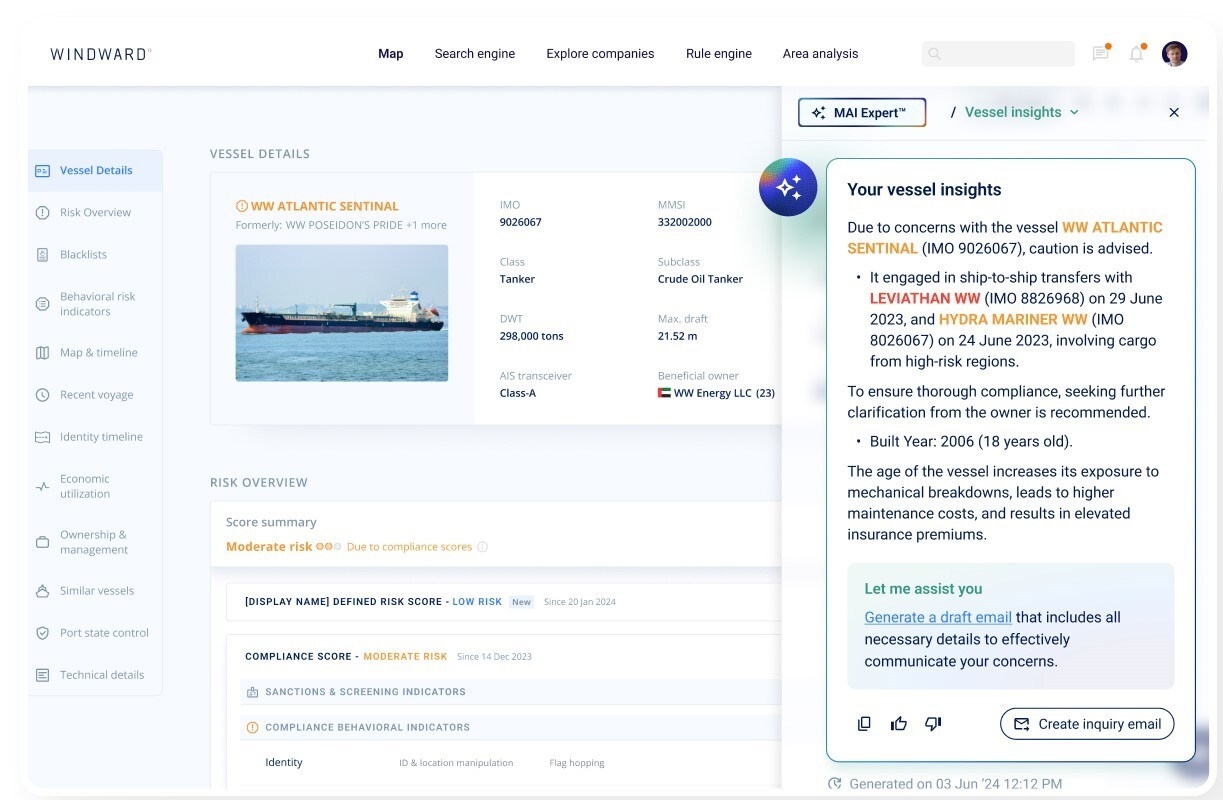
Its products now span risk and compliance, government maritime awareness, entity management, cargo and ocean-freight visibility, remote sensing, critical-infrastructure protection and an API. MAI Expert, introduced in 2024, adds generative AI to summarize risk, draft communications and automate routine investigations. Importantly, the company says the generative layer is optional. The detections still come from maritime models; the chatbot is the interpreter, not the lookout.
That architecture separates Windward from a raw AIS feed and from a generic language model. MarineTraffic and Kpler are common alternatives for tracking and trade visibility. Spire supplies maritime data from space. Pole Star, Lloyd's List Intelligence and Starboard address compliance, ownership or domain awareness. Windward's pitch is a wider decision layer: multi-sensor evidence, identity resolution, behavioral prediction and workflows for both national security and commerce.
What someone actually does with it
Consider the compliance desk at a commodity trader. A broker proposes a vessel. The analyst enters its IMO number or lets an internal system call Windward's API. A name may be clean while the behavior is not: recent flag hopping, a suspicious ownership change, a dark interval beside a sanctioned tanker, or a voyage that contradicts the cargo papers. Windward can map those events against the organization's own rules, produce a go, stop or escalate recommendation, and preserve the evidence for an auditor. The promised saving is not only fewer bad approvals. It is fewer harmless ships trapped in a false-positive queue.
Now move to a freight forwarder. Thousands of containers create thousands of milestones, most of them boring. Windward predicts arrivals and warns when a route, port call or carrier pattern makes the official schedule doubtful. Staff manage by exception instead of phoning everyone about everything. The practical outputs are mundane in the best possible way: tell a customer early, change an onward booking, focus on a vulnerable shipment, or reduce demurrage before a container begins charging rent at the terminal.
A government investigation starts with a different question: what activity do we not already know to search for? Models surface an unusual vessel or cluster, link it to companies and prior encounters, and let analysts bring in satellite or radio-frequency observations when AIS cannot be trusted. Imagery can confirm that a supposedly empty patch of water contains a ship. Link analysis can expose repeated meetings. A case file can move from detection to verification to an operational team without rebuilding the story in email.
These jobs explain why Windward keeps adding delivery methods. A web platform suits investigation. An API suits screening at scale. Alerts suit fleet monitoring. WhatsApp suits a broker or port officer away from a desk. Retained analysts and forward-deployed engineers suit agencies whose data cannot simply be poured into a public cloud. The product strategy is less about inventing another maritime data point than putting a defensible answer wherever the customer's decision already happens.
The cost of earning a place in the workflow
Windward raised $5 million in 2013, $10.8 million in 2015 and $16.5 million in 2018. The Series C took disclosed private funding to roughly $39 million and paid for an insurance push, talent and London expansion. Its 2021 AIM listing raised more than $45 million for the company and selling shareholders. Public-market capital funded product, data and commercial growth, but also exposed an awkward mismatch: a specialized company with long government sales cycles living on a small London exchange.
By 2023, revenue had reached $28.3 million, up 30.9 percent. The first half of 2024 produced $17.6 million, 37 percent higher than a year earlier, while losses narrowed. In December 2024, FTV Capital agreed to pay 215 pence a share, a 47 percent premium to the previous closing price. The £216 million acquisition closed in March 2025, removed Windward from AIM and made it a U.S.-majority-owned private company.
The deal did more than reward shareholders. It changed the company's operating theater. In 2026 Windward bought Prominent Edge, a U.S. defense software firm with geospatial engineering and government delivery credentials. It also paired with Vantor to combine persistent space-based monitoring with Windward's identity and behavior layer. The direction is plain: move from maritime dashboard to mission software, particularly for U.S. national security.
“We were absolutely blown away by Windward's data.”Ian Powell, Metro Shipping
What to steal - and when it sinks
The replicable idea is not “add AI to an old industry.” Start with an expensive exception, not a broad promise. Windward does not need to predict every ordinary voyage perfectly; it must surface the few vessels, documents or shipments that merit scarce human attention. Then it shows why. This turns expertise into a repeatable product without pretending the expert has vanished.
The Windward playbook
- Choose a domain where raw data is fragmented, adversarial and tied to costly decisions.
- Encode behavior and context before polishing the interface.
- When the first market stalls, preserve the engine and test adjacent buyers with larger consequences.
- Enter the workflow through APIs, alerts and embedded specialists, not another lonely dashboard.
- Keep evidence visible. In regulated work, an answer without a trail is merely a suggestion.
It will not work everywhere. A small ship operator with little compliance exposure and ten decisions a month probably does not need enterprise maritime intelligence. The model also weakens when customers cannot integrate data, define risk appetite or assign people to act on alerts. Poor sensor coverage, manipulated inputs and rapidly changing sanctions can never be wished away. Windward itself tells users to review generative outputs. Human judgment remains in the contract, whether or not it appears on the invoice.
There is also a strategic condition: proprietary context must compound. If a competitor can recreate the answer from a commodity feed and a general model, vertical AI becomes a thin interface. Windward has spent more than 15 years collecting vessel histories, ownership relationships, labeled behavior and customer feedback. Its claimed edge is not that it uses AI. It is that the system has watched enough ships behave badly to recognize the choreography.
That is why the failed fishing market matters. It forced the founders to learn the difference between a worthy problem and a durable buyer. Windward kept the hard-won machine, found customers for whom uncertainty carried a budget, and kept moving closer to the decision. The ship may disappear from the screen. The business is built to notice.