A ship appears on a screen. A dot, a course, perhaps a name. It looks reassuringly factual. Ami Daniel has spent much of his working life worrying about everything that tidy picture leaves out. Where has the vessel really been? Who controls it? Does its behavior fit its story? A dot is a wonderfully economical symbol. It can also conceal an expensive amount of uncertainty.
Daniel came to that problem from a ship’s deck. He served as an officer in the Israeli Navy, where he met fellow officer Matan Peled. Together they founded Windward in 2010, bringing maritime experience into a business built around satellite data and analysis. The question behind it was larger than locating vessels: could the movements of ships help people understand what was happening at sea?
That question now reaches into government operations, energy trading, insurance and cargo logistics. It also offers a useful way into Daniel himself. His career contains a community center, a law degree, a public listing and a return to private ownership. Across those changes, he has kept looking for a practical job that information could do.
Before the ships, a community center
At 16, Daniel helped establish a community center bringing children from different backgrounds together. At 18, alongside the start of his naval service, he began another social project for disadvantaged young people. His partner in that venture later became his wife. Entrepreneurship arrived in his life well before anyone had reason to discuss a software subscription.
The distinction matters. His first organizations required people to participate, cooperate and believe that something worth doing could be assembled from the resources available. The business came later. There is something pleasantly inconvenient about this beginning for the familiar founder biography: the youthful venture involved other people’s afternoons rather than a precocious investment portfolio.
He served aboard INS Hanit, the Israeli corvette struck by a missile in 2006. His account of his background puts that experience alongside years of naval service and a subsequent turn toward law. He holds an LLB from Tel Aviv University. The route to running an analytics company was therefore fairly indirect, even by the forgiving standards of entrepreneurs’ career advice.
The ocean had plenty of data. Then what?
One early problem Windward explored was illegal fishing. Coastal monitoring already had tools, including sensors and maritime patrol assets. Satellite technology, meanwhile, was creating a different opportunity and a different headache: more observations than people could readily turn into decisions. Daniel and Peled began working on the gap between collecting information and understanding it.
By 2014, Daniel was describing MarInt, a system that examined historical and current vessel behavior to identify unusual patterns. Its customers included intelligence and defense organizations. The product’s usefulness rested on selection. Out of large quantities of transmissions, which behaviors deserved someone’s attention? The dots could keep arriving. An analyst still needed a reason to look at one of them.
It is a quietly demanding proposition. A map can display what it receives. A risk assessment has to make an argument about what the information means. Daniel’s business grew around that extra step, where maritime experience and software meet. The promise was to help a person decide what to investigate, rather than leave them admiring the quantity of material on the screen.
vessel records
behavior
human decision
A few useful people on board
Windward’s growing circle included people who knew the worlds its software was entering. David Petraeus, the former CIA director, and Dan Senor, coauthor of Start-Up Nation, invested in 2015. Earlier backers included Aleph and Horizons Ventures. Their presence connected a young company with experience in intelligence, technology and international business, fields in which the right interpretation can matter as much as the raw observation.
John Browne, the former BP chief executive, became another consequential connection. He invested in 2016, later joined the board and was appointed chairman in October 2019. For a company extending its work into the commercial maritime world, his background brought an obvious relevance. For Daniel, the relationship also developed into mentorship. Building a board meant finding people whose experience could be put to work.
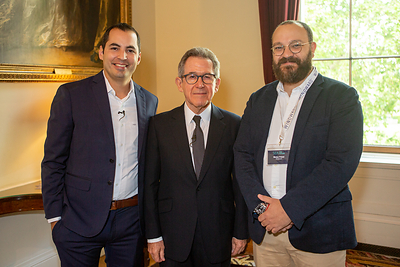
By 2018, marine insurance had become an important expansion. Daniel described a company that had begun with governments and intelligence organizations and was adapting its work for insurers. XL Innovate led a $16.5 million funding round. Its managing partner, Tom Hutton, joined the board after conversations that Daniel said had helped persuade him of the insurance opportunity.
There was a revealing restraint in how Daniel discussed that market. He saw the technology as helping existing professionals do their work and make money. Shipping has enough physical disruption without every software supplier arriving in search of a metaphorical explosion. His stated preference was for doing the work properly, including the slower business of learning an unfamiliar customer’s needs.
Learning to retire the captain’s voice
Daniel has been candid about the limitations of carrying naval habits into a company. A ship’s captain has authority supported by experience across its jobs. A growing software business asks a founder to rely on expertise he may never possess himself. In a conversation with supply chain entrepreneur Brian Glick, Daniel acknowledged that he had initially brought too much of the commanding officer’s approach with him.
He described replacing that habit with regular reviews centered on what people had learned. Participants wrote in advance; the meeting examined the work across functions. He also acknowledged commercial failures, including an oil-flow product the company had been unable to execute successfully. These are useful admissions from someone whose occupation includes convincing people that the next plan deserves their confidence.
Daniel’s interest in improving himself appears elsewhere, too. He has described checking, every three to six months, which capabilities he needs to develop. Research, reading and conversations with advisers form part of the process. It is an unusually concrete answer to the vague corporate obligation to keep learning: choose a weakness, seek help, then return to the work.
“What makes me tick is building things.”
Ami Daniel
There is a smaller, funnier negotiation running alongside the professional one. Daniel recalled teaching his daughter mathematics and explaining that helping her was his job as her father. She pointed out that he had built Windward before she was born, which made the company his job. Founders spend considerable energy explaining what they do to customers and investors. At home, the audience can be less easily persuaded by a revised job description. Daniel told the story while introducing himself as a proud father, giving both claims on his time a place in the conversation.
London was a chapter, not the ending
Windward listed on London’s AIM market in December 2021. Soon afterward, Daniel asked Browne to dinner with a question about how he should run the company now that it was public. The evening lasted three and a half hours. A listing had supplied a new set of responsibilities; it had plainly failed to supply an instruction manual.
The work continued beyond the ceremony. In February 2022, Windward introduced Ocean Freight Visibility, extending its analysis into forecasts of shipment delays and disruption. DSV and Metro Shipping were among the companies already using the offering. The same broad ambition, understanding what happens on the ocean, now had a very ordinary commercial test: help someone explain when a container would arrive.
Public visibility also changed Daniel’s role outside the business. In January 2024, he appeared on BBC News to discuss attacks affecting Red Sea shipping. His advice emphasized repeated assessment and communication as conditions changed. The subject suited the company’s work: a route that looks sensible on yesterday’s information may require another conversation today.
- 2010Windward founded with Matan Peled
- 2021December listing on London’s AIM market
- 2025FTV acquisition returns it to private ownership
- 2026Prominent Edge acquisition and Vantor partnership
Another course correction
In March 2025, FTV Capital completed its acquisition of Windward. The company became privately held, with a stronger American footing. FTV’s relationship with Daniel had begun in 2017, giving the transaction an eight-year prelude. For all the sudden announcements that business produces, this one had been preceded by a lengthy conversation.
Daniel subsequently explained the decision in terms of the pace of AI development and the opportunity to expand in the United States. He wanted flexibility to pursue that work. He also described products as components that could be arranged around a customer’s problem, using his old London house as an analogy: houses share parts without needing identical arrangements. An entrepreneur discussing AI had found a useful example in doors and windows.
The next steps became tangible in April 2026. Windward acquired Prominent Edge, adding a team experienced in delivering geospatial and mission software for American government customers. It also announced a partnership with Vantor to integrate space-based monitoring into its platform. The latter addressed vessels that stop broadcasting their positions, bringing additional observations into the work of maintaining an intelligible picture.
The technical difficulty has a human consequence: someone has to connect observations that arrive through different systems. A signal, a satellite image and a vessel record can each answer part of a question while leaving the rest unresolved. The Vantor collaboration set out to join detection with identity and behavioral analysis. For Daniel, it extends the original task into a more complicated observational world. More ways of seeing the ocean create more possibilities, and more work to make the observations agree.
In June, Robert “Bob” Sharp joined as chief maritime intelligence officer, working directly with Daniel on intelligence strategy. A retired U.S. Navy vice admiral and former director of the National Geospatial-Intelligence Agency, Sharp added another practitioner’s experience to the leadership team. The company’s next stage would involve learning from another navy, too.
That brings Daniel back to the dot, and to the gaps around it. A vessel can transmit a position while leaving questions unanswered. It can also stop transmitting altogether. The work he and Peled began has expanded because understanding a ship keeps requiring another kind of evidence, another specialist and another revision of the plan. Daniel’s own route has followed a similar logic. Each stage has given him something to build with, and a reason to ask what he needs to learn next.