Yoni Shtein
He ran the numbers on more than half a billion dollars. Then he closed the spreadsheet and started over.
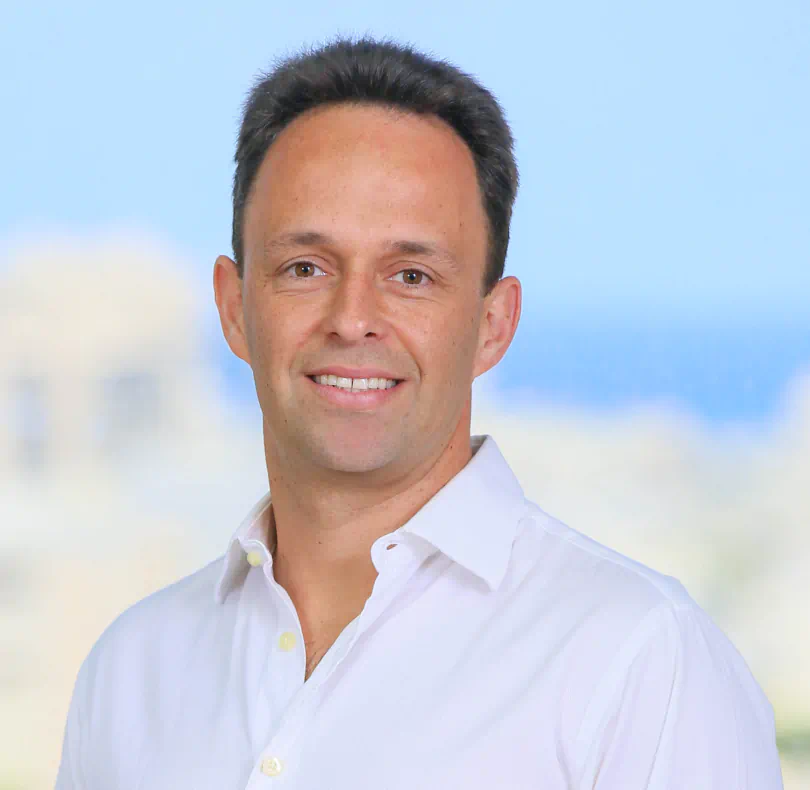
Yoni Shtein, CEO and co-founder, Laguna Health. The look of a man who has read the fine print.
The backwards resume
Most founders write code, then raise money, then learn what money does. Yoni Shtein did it in reverse. He wrote the code first. He learned exactly what money does next, at close range, deploying it by the hundreds of millions. And only then, with nothing left to prove on either side of the ledger, did he decide to build something of his own.
Today he is the CEO and co-founder of Laguna Health, a company split between New York and Tel Aviv that builds conversational AI for the care teams inside health payers. The pitch is not glamorous and Shtein seems to like it that way. While the loudest part of the industry chased hospitals and doctors, Laguna aimed at the people managing care behind the scenes - the ones nobody was building tools for. In October 2024, TIME put the result on its list of the Best Inventions of the year.
He is a founder who talks like an investor and runs like a marathoner, which is to say he distrusts sprints. Ask him what it takes and he will not sell you the dream. He will warn you about the decade.
"You need an innate Northstar, because you're dedicating at least the next ten years of your life to your mission."
— Yoni ShteinEveryone went for the hospital. He went the other way.
There is a crowded lane in healthcare technology, and it runs straight at hospitals and doctors. Shorter waits, better charts, faster notes. Laguna took the exit nobody signaled for. It builds for payers and care management teams - the people who coordinate a patient's recovery from a desk, on the phone, one conversation at a time.
It is a harder sell. A hospital can be dazzled by a demo. A payer wants proof that the outcome moved. That constraint is the whole point. Laguna's products, built on large language models, are designed to let a care team practice at the top of their license - handling the human moments while the software absorbs the administrative weight.
Shtein frames the discipline of building here as holding two ideas at once. Be skeptical, but don't be a cynic. Be idealistic, but don't be naive. It is, not coincidentally, exactly the stance of a good investor who has decided to stop watching from the sidelines.
Laguna's three values
A company you can say in one breath.
The scoreboard
~$28M total raised · $15M Series A in 2023 · ~52 people · TIME Best Inventions 2024.
Chisinau to a commando unit to code
He was nine when the family left Moldova. New country, new language, new everything. He credits that early upheaval with a strange gift: being comfortable when nothing around you is familiar. It is a useful thing to feel at home inside, because the founder's job is mostly discomfort with a title on it.
At twenty he entered an elite unit of the Israeli Air Force and stayed five years - a stretch he describes as deeply meaningful. Then a dual degree in computer science and business from Tel Aviv University, and a job writing software at Microsoft. That Microsoft desk matters more than it sounds: it is where he met Yael Peled Adam, the colleague who would, years later, become his co-founder.
Harvard Business School followed. Then RPX, where he was a founding member of a company that went public on the NASDAQ. Then a fund he helped start that was folded into Fortress Investment Group, where he led over $500M of equity and debt investments. On paper, a finish line. He treated it as a warm-up.
- ~2000
Joins an elite Israeli Air Force unit at ~20. Five years. - University
Dual Computer Science & Business degree, Tel Aviv University. - Microsoft
Software engineer. Meets future co-founder Yael Peled Adam. - Harvard
Earns an MBA from Harvard Business School. - RPX
Founding member of RPX Corporation (NASDAQ: RPXC). - Fortress
Co-founds a fund later integrated into Fortress; leads $500M+ in deals. - 2020
Co-founds Laguna Health. - 2023
Laguna raises a $15M Series A. - 2024
Laguna named to TIME's Best Inventions.
"Take advice, but think for yourself. It keeps you grounded in your own analysis."
— Yoni Shtein, on staying sane while buildingFour rules he actually repeats
Find the Northstar
Ten years is the unit of measure. If the mission can't survive that long inside you, don't start.
Don't quit under fire
"Don't give up in the face of adversity." The line he keeps for the hard days, and there are hard days.
Think independently
Collect the advice. Then run your own analysis. Borrowed conviction breaks under pressure.
Stay values-first
A moral compass, relentless drive, and independent thinking - the three traits he credits for whatever has worked.
Skeptic, not cynic
Hold idealism and doubt in the same hand. Cynicism is lazy; naivety is fatal.
Run the miles
A committed runner who guards work-life balance, because the mission is a marathon and he intends to finish it.
Dissatisfaction as fuel
He points to Shimon Peres and a line he loves: that the greatest gift a people can offer the world is dissatisfaction. Where some hear complaint, Shtein hears the engine. The restlessness that most people spend their lives trying to quiet is, in his reading, exactly the thing that builds companies. It is a tidy summary of a career that kept refusing to stop at the obvious finish line.
"Live with meaning."
— Two words he keeps coming back toIn his own words
Shtein on the Slice of Healthcare podcast, on building Laguna and the thinking behind it.
Five things that stick
01
Born in Chisinau, Moldova. Had lived across several countries before he was a teenager.
02
Five years in an elite Air Force unit before he shipped a single line of production code.
03
His resume runs against the grain: engineer, then financier, then founder.
04
He met his co-founder at a day job, not a demo day. Partnerships get earned across years.
05
He built for the part of healthcare nobody was building for. TIME noticed.