The trouble began with coal. In Tridge’s telling, Hoshik Shin was arranging a 60,000-ton transaction when the seller abandoned the agreement as prices rose. A deal that seemed settled suddenly depended on finding another way through an opaque market. The company dates that episode to 2013. Years later, its products would concern mangoes, coffee and seafood. The underlying question remained familiar: how do you make a decision when the other side knows something you do not?
- Eye organizes agricultural prices, trade records and company intelligence.
- Ark connects buyers and sellers through product-specific opportunities.
- Its growth story includes a $2.7 billion financing valuation and substantial subsequent operating losses.
There is a tempting answer to that question: collect more information. Tridge’s more interesting answer is to make the information comparable. A buyer can have a spreadsheet full of numbers and still misunderstand the market. Sometimes the mistake is hiding in the column heading.
Three fruits walk into a customs code
Consider mangoes, guavas and mangosteens. All three sit under HS 0804.50, a classification used in international customs. That grouping serves tariff administration. For someone buying mangoes, however, a combined trade total is an awkward guide. The fruits have different customers, growing seasons and prices. A perfectly accurate total can answer the wrong question.
Tridge maintains its own classification of products and their relationships. Fresh mango gets its own market identity, with varieties beneath it and processed products linked to it. Tariff codes remain attached, but they stop defining the entire market. The company also reconciles the different spellings and abbreviations under which exporters appear in customs records.
One customs line
Three separate markets in Tridge’s product classification
This is the unglamorous work beneath the AI pitch. Units need checking. Grades need separating. Company names need resolving. Tridge describes specialist review, statistical checks and ongoing source monitoring. The inference for a software buyer is simple: a fluent answer becomes useful only after someone has done the bookkeeping.
Agriculture chose the company
Shin’s initial community platform was broader than food. According to Tridge, more than 70% of inquiries concerned agriculture. That demand helped direct the business toward agricultural supply chains in 2015. The company describes its name as a combination of “Transaction” and “Bridge.” The bridge acquired a fairly specific destination.
Its careers timeline records an agricultural fulfillment business arriving in October 2020. That meant participating in physical trade as well as supplying information. Today, Tridge describes experience in sourcing, shipping, customs, receiving and quality claims. Its stated mission connects agricultural commerce to human development. The practical version is less lofty: help buyers and sellers find opportunities they can actually pursue.
Public careers materials emphasize collaboration and keeping promises to suppliers, buyers and colleagues. Those are employer statements, but the emphasis suits the business. In a market where a broken promise helped inspire the company, reliability is part of the product’s logic.
The fruit exporter’s clock
The customer problem becomes clearer in Vietnam. Hoang Phat Fruit exports fresh produce. In a January 2026 customer story published by Tridge, sales director Nguyen Nam Phuong Thao described difficulty getting useful information soon enough to act. “So sometimes, we were going to lose opportunities.”

The case study describes using competitor insights, forecasting and market monitoring to inform pricing and sourcing. Its value is the concrete decision behind the testimonial: where to sell, what to charge, and when to move. The account reports improvements qualitatively. It should be read as a customer’s experience, rather than a measured return available to every subscriber.
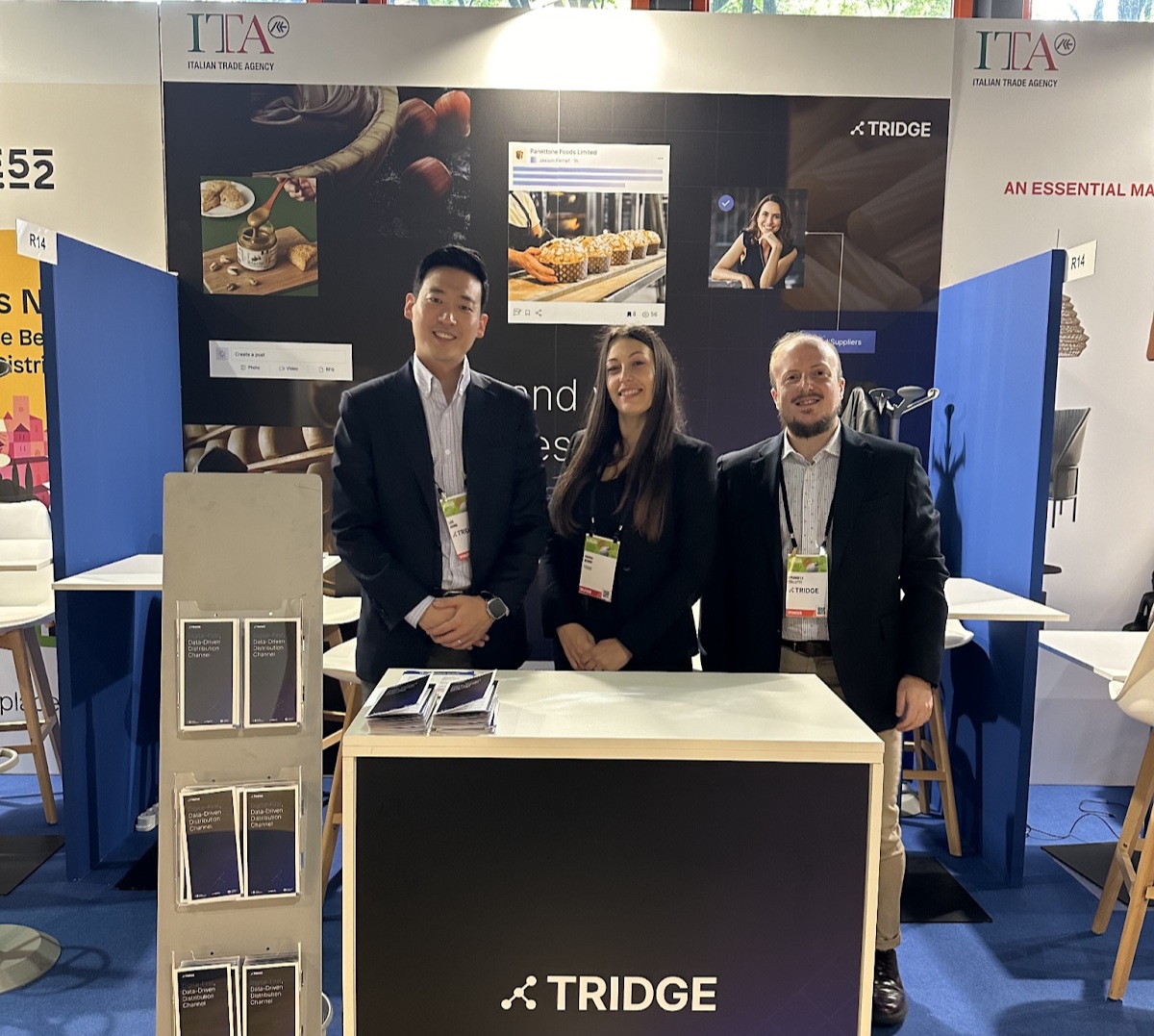
Trade agencies have a related problem at a different scale. Tridge’s 2024 Italian Trade Agency partnership proposed a digital pavilion for Italian agrifood exporters. A January 2025 agreement with Jeju Province covered market intelligence, tailored export strategies and buyer engagement. An exporter wants its next customer; an agency wants more of its producers to reach one.
First read the market. Then meet it.
Tridge Eye, launched in 2025, packages intelligence into market data, company analytics, reports and AI-built research boards. Tridge advertises more than 65 million price records and 682 million trade data points. These are company-reported coverage figures. Shelf shows market history; Speaker carries market signals; Echo offers import-price forecasts in beta.
Ark handles introductions. A seller opens a Network Offer; a buyer opens a Network Request. Opportunities reach companies active on the platform, and contact details open after acceptance. Free accounts and product diagnoses provide an entry point. Paid plans expand reach, with no commission on deals. Ark explicitly declines to guarantee buyers.
Useful information has to arrive while there is still something to do with it.THE PRACTICAL THREAD THROUGH TRIDGE’S PRODUCTS
Tridge AX extends the proposition into operations: purchase orders, supplier follow-ups, documents and supply-chain workflows. Its product materials describe an approval gate for external messages and status changes. This places Tridge between several familiar alternatives: price-reporting services, customs databases, directories and brokers. Its pitch is that intelligence and execution can share a foundation.
The valuation was only one number
Building that foundation required capital. Forest Partners backed a $60 million Series C in 2021. In August 2022, Tridge announced a roughly $37 million Series D led by DS Asset Management at a $2.7 billion valuation. The announcement tied the funding to agricultural intelligence and international expansion.
The later accounts complicate the picture. Korean company-information services report roughly 42 billion won of standalone revenue in 2024, down from about 104 billion won in 2022, and a 2024 operating loss near 23.9 billion won. These figures describe the reporting entity and period. They are neither subscription revenue nor a current valuation. Trading volume and profitable software economics are different achievements.
Rounded historical figures reported by Korean company-information services.
For a prospective user, the sensible experiment is modest. Pick one product, one origin and one purchasing decision. Check whether the grades and prices line up. Test a supplier shortlist against your own knowledge. Coverage is thinner in highly processed and private-label goods; forecasts remain forecasts, and introductions still require a willing counterparty. What readers can copy is the discipline: fix the categories, compare the evidence, then decide what to do.