Hoshik Shin had buyers waiting for 60,000 tons of coal. The coal, unfortunately, had other plans. An American supplier sold the promised shipment to someone else as prices rose, leaving Shin to find a replacement for steel companies in Korea and Japan. A contract existed. So did a deadline. Neither produced another supplier's telephone number.
In Tridge's account of the episode, dated to 2012, Shin spent a month searching across North and South America and paid a premium to secure the coal in time. The revealing detail is the search. He was working in commodity investment, a profession organized around markets, yet finding the next available seller remained a laborious undertaking. Knowing what a commodity cost did not mean knowing who could actually deliver it.
That distinction became the founding problem of Tridge. The name joins “transaction” and “bridge,” a compact description of the gap Shin wanted to close. A bridge is useful precisely when the two sides already exist. Buyers wanted goods; sellers had goods. His idea was to make the route between them easier to see.
A promised coal shipment became a month-long search for another supplier.
An engineer goes looking for a market
Shin's route to entrepreneurship passed through engineering and finance. He earned a bachelor's degree in mechanical engineering at Seoul National University and a master's in financial engineering at the University of Michigan. His professional background includes global credit trading at Deutsche Bank, special investment work at Korea Investment Corporation and leadership of TP Partners. Tridge followed in 2015, with Seoul as its base.
Those credentials explain the kinds of systems he had worked inside. Engineering asks how connected parts behave. Financial markets put prices on uncertainty. Cross-border trade supplies ample uncertainty, occasionally with a delivery date attached. Shin's subsequent business brought those concerns together around a very practical question: how does a buyer find a seller worth trusting?
It would be easy to turn that résumé into a tidy prophecy. The coal episode makes the sequence less tidy and more interesting. A person with institutional experience still encountered a basic information problem. The proposed remedy required a business outside the institutions where he had learned his trade. His new customers would include people whose most important asset grew in a field.
Peppermint, peanuts and a wider address book
By 2019, Tridge's marketplace included Egyptian peppermint leaves, Nigerian peanuts and mangoes from India and Thailand. Shin described an arrangement that connected suppliers with foreign customers, widening their choices beyond local buyers. Sellers paid for the connection; after being introduced, the two parties could transact away from the website. The connection itself was something worth buying.
His explanation was straightforward: “The buyers get cheaper sourcing, and the supplier can get a better selling price.” Removing some intermediaries could leave room for both sides to benefit. The proposition depended on finding a counterparty, rather than persuading a farmer to produce an entirely different crop.
There was human work behind the digital storefront. At the time, Tridge described about 80 employees across 40 countries checking suppliers' reliability and practices. Software could widen the search; someone still had to establish whether a seller deserved a place in the results. A global marketplace needed local eyes.
In his 2021 writing, Shin returned to smaller farms' constraints: language barriers, export-quality requirements and limited access to overseas markets. These obstacles narrowed the pool of possible buyers and weakened a farmer's negotiating position. The important unit in that argument was choice. A seller with another credible customer has a different conversation about price.
“The buyers get cheaper sourcing, and the supplier can get a better selling price.”
Hoshik Shin · 2019
The bridge acquires a balance sheet
Tridge's ambitions expanded beyond introductions. It launched market intelligence in 2020 and added fulfillment, including delivery services for buyers. A database could help someone decide what to purchase; fulfillment took the company closer to the goods themselves. Packing, warehousing and moving products demanded a different kind of organization from displaying market information.
In July 2021, a $60 million investment from Forest Partners valued Tridge at $500 million. The company planned to expand packing and warehousing capacity. Supply-chain congestion and restrictions on business travel had made alternative sourcing more attractive. A service that could stand between a buyer and an unfamiliar supplier addressed an immediate commercial worry.
The next major financing announcement arrived in August 2022: a Series D led by DS Asset Management, roughly $37 million, at a $2.7 billion valuation. Tridge's own blog gave the amount as $37.2 million. The valuation was 5.4 times the previous year's figure. Investors were assigning a much larger price to the same founding question.
The capital was intended to support market intelligence and international expansion. Tridge also described its goal as an end-to-end agricultural trade service. That phrase sounds pleasantly seamless. In practice, every additional step brings another obligation: matching, checking, buying, shipping, collecting. The longer the bridge, the more there is to maintain.
A small fruit and a large policy change
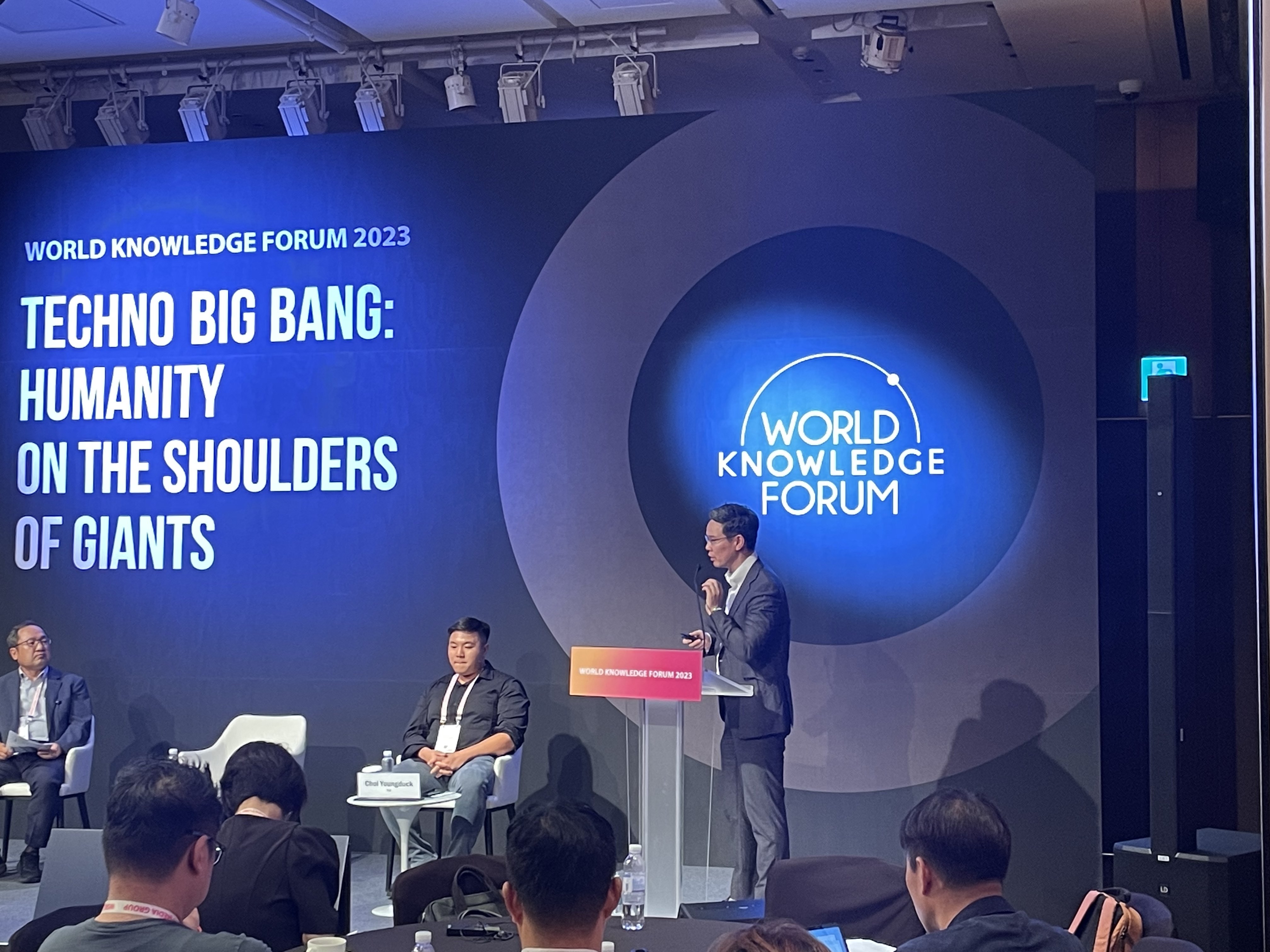
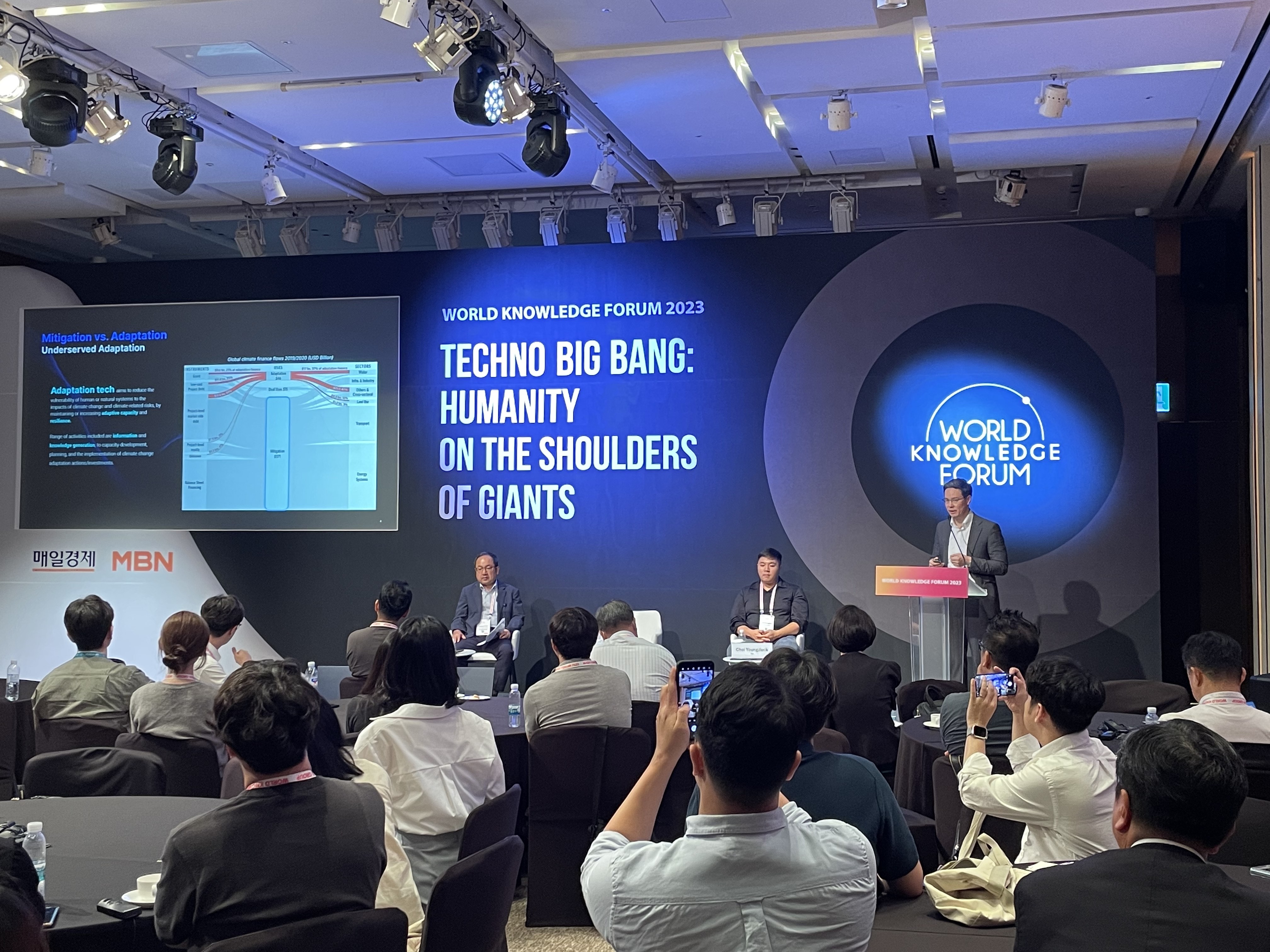
At the World Knowledge Forum in 2023, Shin appeared alongside Youngduck Choi of Togi and Somsubhra GanChoudhuri of AI Palette in a discussion about smarter farm-to-table systems. He presented AI as a tool for responding to disrupted production and supply. Tridge's Transaction Data Solution was part of the argument: clearer transaction relationships could help businesses judge prices and react to changing markets.
He also described work with the Global Green Growth Institute to bring Filipino farmers onto a digital marketplace. Calamansi, the small citrus fruit, was among the products whose visibility could improve. That example gave the platform's global language a useful scale. Sometimes the task is simply to put a particular producer's offering in front of someone who might buy it.
Later that year, Shin spoke at an Ecuadorian embassy forum following the Korea-Ecuador Strategic Economic Cooperation Agreement. He discussed the prospects for products such as shrimp, tuna, bananas and passion fruit, and used Peruvian avocados to explain how changes in trade rules can alter market access.
The lesson extends the coal story. A supplier can be present, capable and still difficult to reach commercially because the rules make access costly. Shin's work increasingly occupied the space between a list of products and the conditions under which they can move. A tariff schedule may look dry. For a seller, it can decide whether a new customer is possible.
Ninety-seven percent elsewhere
In June 2024, Shin delivered the opening keynote at the World FoodTech Conference in Seoul, where he served as a co-president. The event brought together 250 speakers across 40 sessions. His argument centered on price instability, changing supply chains and the role of agricultural data in helping food businesses adapt.
He said 97 percent of Tridge's customers were outside its home market, and described processing two million new data points weekly. Those were company figures, stated at that moment. They capture the geographical intent of the enterprise: a Seoul headquarters serving a customer base largely elsewhere.
Shin pointed to shifting trade routes and changing consumer demand as reasons buyers needed to reconsider familiar arrangements. His stage appearances placed him among entrepreneurs, industry groups and trade officials, all approaching the same question from different directions. Who can supply what, under which conditions, and how quickly can a business change its mind?
His attention to relationships also surfaces in a public recommendation for business contact Dmitry Yudin. Shin recalled an intense, difficult negotiation that developed into friendship through mutual respect, and praised Yudin's sensitivity to doing business in Asia. It is a useful glimpse of his commercial world: even someone building a data business recognizes the value of understanding the person across the table.
The cost of crossing
The funding milestones did not settle Tridge's economics. Its 2024 accounts showed revenue of 42 billion won and cost of sales of 37.5 billion won, leaving 4.5 billion won in gross profit before other expenses. Selling and administrative expenses were 28.4 billion won. Moving considerable value through a business can leave surprisingly little behind.
By the end of 2024, total equity stood at negative 28.8 billion won. The auditor identified material uncertainty over the company's ability to continue as a going concern. These figures concern the company, not Shin's personal wealth. They also describe a particular reporting period rather than a forecast of its fate.
Tridge explained that expanding into experimental product categories had hurt profitability and said it was restructuring around categories where it had strengths. By February 2026, its valuation was being assessed in the venture market at below one trillion won, a marked retreat from the 2022 funding valuation.
For Shin, this added a second test to the first. Helping participants navigate a difficult market has value. Capturing enough of that value to sustain the organization is a separate task. The original insight survives the question; the company has to answer it in cash.
Even a potato chip has a supply chain
Shin's 2025 explanation of agricultural trade used honey butter-flavored potato chips: potatoes from Australia, palm oil from Malaysia, sunflower oil from Ukraine and Argentina, and other ingredients sourced globally. A familiar snack concealed a dispersed commercial network. Its ingredients could travel through several hands while the original producer knew little about the final destination.
He described buyers “not knowing where to turn when supply fails.” That is the coal predicament, translated into food. In his view, better visibility should help businesses find alternatives before a disruption becomes an emergency. Ahead of an APEC food-security workshop, he argued for more predictable, cooperative trade systems.
Tridge EYE packaged that ambition into alerts, a curated library of insights and tools for comparing purchasing patterns with broader market trends. The pitch was increasingly about helping a buyer decide where to look next. The potato chip example works because it makes an abstract information problem small enough to hold, while keeping its international complexity intact.
A better next call
The current Tridge website organizes its approach around data, verified networks and AI. Its diagnosis still includes uneven market visibility and the work involved in finding reliable counterparties. The vocabulary has changed since the missing coal shipment, but the operating question is recognizable. A buyer needs an alternative that is credible enough to act on.
In March 2026, the company described a Tridge Eye feature called My Curation. A user could type a sourcing request into a chat, such as a Canadian importer's search for American beef, and generate a tailored market view. This was the company's product description, an indication of where it was directing its development rather than proof of every promised outcome.
By June, its channel-partner program paired Eye with Tridge Ark, a buyer-discovery platform. Partners would contribute commercial networks while Tridge supplied data and AI tools. That pairing suggests a continuing respect for the work of finding people, even as the interface becomes more automated.
Shin's career has moved from institutional investment to commodities, agricultural commerce and software. The thread connecting those stages is unusually concrete: being able to find someone else when the first arrangement fails. His company's difficulties give the idea a demanding context. Another useful connection is always welcome. So is a business that can afford to keep making them.
Follow the connections
- Tridge
- Hoshik Shin on LinkedIn
- Shin’s professional biography
- The 2019 interview
- 2022 funding announcement
- World Knowledge Forum appearance
- Ecuador trade forum
- 2025 trade interview
- 2024 accounts and company response (Korean)
- February 2026 valuation reporting
- Tridge videos on YouTube
- Tridge on Instagram
- Tridge on X
- Tridge on Facebook