Agridence Made One Boring Question - "Where Did This Come From?" - Answerable
The Singapore company started as a marketplace for physical rubber. Then it noticed the hard part wasn't matching buyers and sellers. It was proof. Today its software traces cocoa, palm oil and coffee from the farm plot to the filed report.
For most of the last century, the world's natural rubber changed hands the way gossip travels: over the phone. A trader in Singapore would call a producer in Indonesia, agree a price for a few hundred tons, and hang up. The deal lived in a notebook, a spreadsheet, maybe a WhatsApp thread. Nobody outside the two parties knew the terms, and nobody could easily say where the rubber had actually grown. In 2018, a small team in Singapore decided that was a software problem. The company they built is called Agridence.
Agridence sells traceability. In plain terms, it helps the companies that buy raw agricultural materials - rubber for tyres, cocoa for chocolate, palm oil for almost everything - prove where those materials came from, and turn that proof into the reports regulators now demand. Its own tagline is unusually literal for a tech company: "first mile to final report."
It started with a rubber tree
The original name, HeveaConnect, was a small in-joke. Hevea brasiliensis is the rubber tree. The first product was a secure business-to-business marketplace where producers, traders and tyre makers could trade physical natural rubber without the phone calls. The clever part was the confidentiality design: each transaction's data was visible only to the two parties involved, which meant fierce competitors could all sit on the same platform without leaking anything to one another.
That trust turned into volume. By September 2023 the platform had facilitated more than a million tons of natural rubber trades, and the roster of institutional participants had grown from 19 at the end of 2022 to 29 the following year. The trade volumes even became a reference point - they feed the SICOM Agridence SIR20 Physical Spread Index published by SGX.
"Traditional techniques in the decades-old natural rubber trade lack transparency, relying often on trades via telephone or messaging applications." Ulrich Antoni, Head of Business Development & Partnerships
The pivot hiding in plain sight
Here is the interesting turn. Running a rubber marketplace, the team kept bumping into a question that had nothing to do with matching buyers and sellers: can you prove this rubber didn't come from cleared forest? Regulators, particularly in Europe, were starting to ask exactly that. So Agridence rebuilt its focus around the answer - capturing origin data at the farm, following it through processing, and packaging it into a compliance report at the end.
The insight is one every founder should steal: the side feature was the real product. The infrastructure built to trace one commodity turned out to work for many. In 2022 HeveaConnect rebranded to Agridence and started pointing the same tooling at palm oil, cocoa, coffee, coconut, cashew, soy and timber.
What you can actually do with it
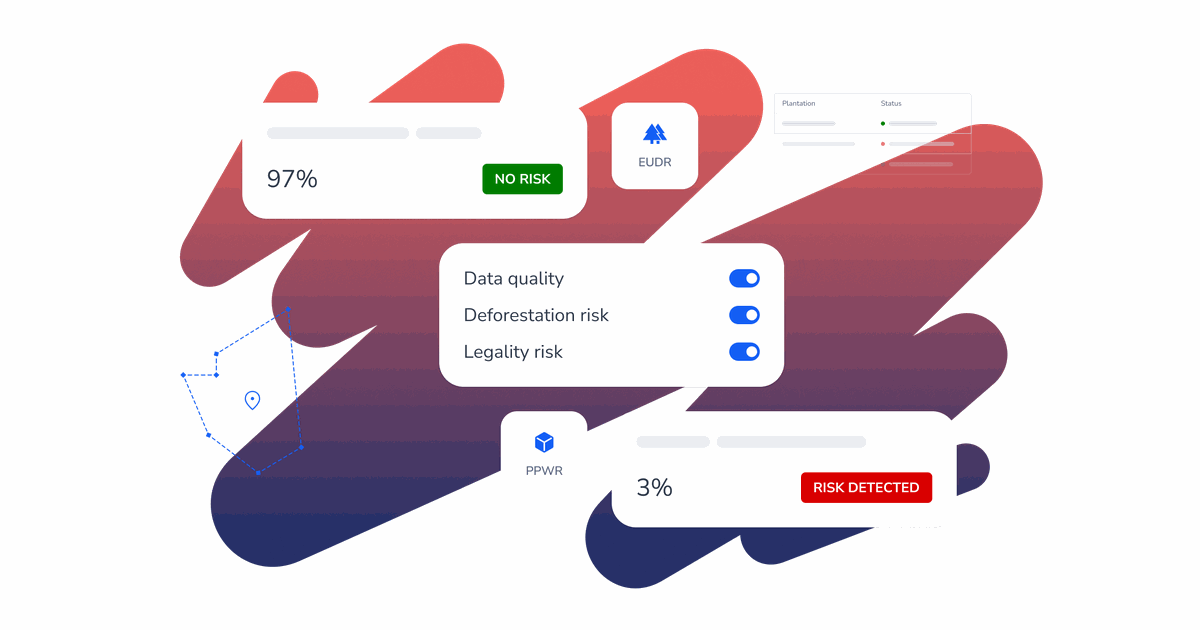
The platform is modular, which is a polite way of saying it is a set of tools you assemble depending on how messy your supply chain is. AgriTrace is a mobile-first app for capturing field data, built to work offline because the first mile of a cocoa supply chain often has no signal. A Supplier Portal walks suppliers through submitting their data. The core Agridence Platform aggregates all of it. ConnectHub plugs into a company's ERP system and assembles the Due Diligence Statements and Declarations of Conformity that regulators want. A Certification & Standards Platform runs the whole thing for entire industry bodies.
The headline use case right now is the EU Deforestation Regulation. If you want to sell coffee, cocoa, rubber or a handful of other commodities into Europe, you have to demonstrate they didn't drive deforestation. Agridence traces the goods from farm plot to shipment and files the paperwork - it claims this can be done in weeks rather than the scramble most companies expect.
Who's actually paying
Agridence is business-to-business SaaS. Its customers are the companies for whom "we're not sure where this came from" is now a legal liability: global tyre makers, food and beverage multinationals, commodity traders and processors. The public roster includes Mondelez, Continental, Goodyear, Itochu, Sucafina and Segafredo.
But the shrewdest part of the model is the neutral-infrastructure play. Agridence built and runs the sustainability reporting platform for the Global Platform for Sustainable Natural Rubber, whose members represent roughly half the world's rubber market. It is the technology partner behind the RSPO's prisma traceability system - expected to reach nearly 20,000 users - and it built the SCP Links platform for the Sustainable Coconut Partnership. When you are the neutral rails an entire industry runs on, you are very hard to rip out.
"The modular traceability infrastructure we built for natural rubber is now powering compliance for palm oil, cocoa, and beyond." Gerald Tan, CEO & Founder
The founder bought back the company
Agridence raised a US$7.1 million Series A in 2022, with Provident Capital and DeClout Ventures joining a shareholder list heavy on strategics - SGX, DBS Bank, ITOCHU and Halcyon Agri. That is the profile of a company built inside the corporate world it serves.
Which makes the 2025 move notable. CEO Gerald Tan put in his own capital to become the single largest individual shareholder, shifting Agridence from a corporate venture-built startup to a founder-owned, founder-led business. A fresh round led by Cercano Management, with returning backers EXEO Innovation Fund and Provident, followed. In the same stretch, Agridence acquired farmer connect - another traceability company - to stitch its cross-commodity tooling into one line.
Where it sits in the market
Supply chain traceability is a crowded and increasingly noisy category - names like Sourcemap, TrusTrace, Optel and Koltiva chase the same regulatory tailwind, and every large trader has some in-house tooling. Agridence's edge is depth in commodities others treat as an afterthought. It went deep on rubber first, one of the least-digitized commodity trades on earth, earned the trust of the industry's bodies, and only then expanded. Depth before breadth, in a field where most competitors chase breadth first.
"Trust is everything in this business. We deliver proven regulatory and risk frameworks." Gerald Tan, CEO & Founder
The quiet giants of software are rarely the apps you photograph. They are the companies making a single dull question - where did this come from? - answerable for an entire industry. On that measure, a 34-person team in Singapore has quietly become one of the more consequential names in the pantry.