Kelvin Kim went to see shopkeepers in the afternoon. Lunch and dinner belonged to the customers; the stretch between them offered a chance to talk. He wanted to understand what occupied the person behind the counter. The answer included staffing, payments and the ordinary difficulty of finding time to examine the business while also running it. A founder’s appointment book can look rather grand. His product brief began in the gap between two meals.
There was another obstacle. Someone arriving at a shop with a service to sell was asking for trust before offering much reason to give it. Kim also had a smaller, domestic example in mind: his mother sometimes asked him to install mobile apps because remembering the app-store password was troublesome. Owning a smartphone did not make every new application convenient. Cashnote would have to reach people through something they already knew.
A second start, with unfinished homework
Kim’s first company had already tested the possibilities of a phone. In 2011, while studying at Yonsei University, he co-founded ID Incu, the business now known as Opensurvey. Two fellow members of the Korea Science Academy’s first cohort joined him. They considered several ideas before concentrating on mobile surveys, collecting consumer responses and turning them into information companies could use.
That early chapter included a 2013 meeting with Masayoshi Son at SoftBank’s headquarters. Kim presented a ten-year vision for the business. By 2016, he was ready to give the next chapter to someone else: Hwang Hee-young took over as CEO. Kim also completed the undergraduate course he had put on hold. The sequence has an agreeable untidiness. He had already been running a company before finishing the studies that might have prepared him for one.
His second venture, Korea Credit Data, was incorporated on April 27, 2016. The new subject was the information surrounding small businesses. There was a continuity beneath the change of customer: in both ventures, Kim was interested in making data accessible enough to become useful. Consumer responses had been one version of the problem. A shopkeeper’s sales and financial position offered another.
The password was part of the problem
Cashnote launched in April 2017 through KakaoTalk. Its early proposition was modest enough to explain quickly: help an owner understand sales and the money due to arrive. Card networks had different settlement dates and fees. A day’s trading could therefore produce a less straightforward answer to the question of what would actually reach the bank account.
Choosing a familiar messaging service reduced the effort of trying a new tool. It also respected the circumstances Kim had been observing. A busy owner should not have to become enthusiastic about software before receiving something useful from it. The interface had to fit into an existing day. There is a certain courtesy in a product that does not demand a ceremony of arrival.
By February 2019, Cashnote had passed 200,000 business establishments. Kim was thinking about the transition from early adopters to a mainstream audience. He described a company with slightly more than ten people collecting and analyzing a large volume of offline payment information. The size of that team interested him because a small organization could leave more value with customers and give individual colleagues more room to learn.
Those are related choices: make the customer’s first step easier, solve a question that returns every day, and keep the organization capable of delivering the answer. They do not guarantee that a company will grow. They explain why its customers might keep coming back. A daily habit is earned in daily installments.
A racing driver in the business plan
Kim has a taste for an analogy with corners. In a July 2016 essay, he wrote about revisiting a moment from the 1995 Grand Prix when Michael Schumacher overtook Jean Alesi. He used the racing scene to think about business timing: a change in conditions could create an opening that a long straight stretch would not.
He saw his first company in relation to the spread of smartphones. The second concerned a financial sector whose legal and technical constraints were changing. His point was about when an opportunity becomes practical. An idea may wait for the circumstances that let it work. The founder still has to recognize the turn and decide what to do there.
The racing comparison adds a useful wrinkle to the patient tone of his later writing. Kim can value persistence while remaining alert to timing. Waiting and moving quickly are both available choices. The interesting part is the judgment between them, particularly when the customers are busy people unlikely to applaud a strategy until it makes their work easier.
The bill that waited
When Kim looked back at KCD’s ninth anniversary in 2025, he described decisions that changed the business’s direction. Cashnote moved from accounting management toward sales management, closer to the questions owners were asking. KCD chose a platform with free core functions over the prevailing paid enterprise-software approach. It later shifted the center of the experience from a chatbot to its own app.
One choice involved postponing the launch of Cashnote Plus for more than two years as customers faced severe trading difficulties in the early 2020s. The decision gave customer understanding priority over the company’s immediate plans to earn more money. That carries a cost. Good intentions do not pay salaries merely by being good intentions.
The postponement belongs in Kim’s story because it makes the language of trust more concrete. Trust has a calendar and sometimes an invoice. A company can tell owners that it understands their circumstances; deciding when to charge them is one way that claim meets a real test. The choice also left KCD with a harder question about how to build a durable business around the relationship.
“From a distance, it seems like a movie, but up close, it’s a documentary.”
Kelvin Kim, in a 2022 interview
What comes after the daily number?
The answer gradually became a broader set of services. In November 2025, Kim described Cashnote as an owner’s portal, with bookkeeping, payments, supplies, connections to service providers and a community. The group’s work also included POS systems and credit assessment. Each addressed another task that sits around the central business of serving customers.
Credit assessment matters to the sequence. A company cannot understand an owner’s business simply by declaring that it wants to help. It needs information about how that business operates. KCD’s expansion connects everyday operating tools with a longer view of the business they serve. The route runs through repeated use, accumulated information and decisions about how that information can assist the owner.
- Daily toolsSales and operating information
- Business dataA record built through use
- Credit assessmentUnderstanding the business
An editorial schematic of KCD’s approach, rather than a measure of lending outcomes.
By August 2026, Kim’s personal biography put Cashnote at 2.3 million establishments and the KCD group at approximately 3.6 million. The two figures describe different scopes. The broader group includes businesses using its other services. For Kim, the ambition is to help through the moments of starting, operating and growing a business, with the daily tool becoming a place owners turn when another question arises.
A wine shop is a stern instructor
Customer understanding has found an unusual place inside KCD’s employee experience. The company has described an onboarding program in which colleagues experience being a wine-shop owner. Kim shared an account by the people-team manager responsible for developing it. The manager’s telling began with the surprise of joining to work in HR and finding himself in charge of a shop.
The exercise makes sense alongside those early afternoon visits. A software organization can spend all day discussing owners while remaining insulated from the work of ownership. A shop makes the discussion less comfortable and more specific. Someone has to deal with the tasks that arrive together. The lesson can be more memorable when the counter belongs to you.
Kim’s public advice goes further than listening to admirers. In a note to colleagues after attending Davos in 2024, he urged them to meet customers who disliked their services and ask what more KCD could do. He connected that practice to keeping the company’s purpose clear while allowing the product to change. An unhappy customer has a way of making an abstract commitment wonderfully explicit.
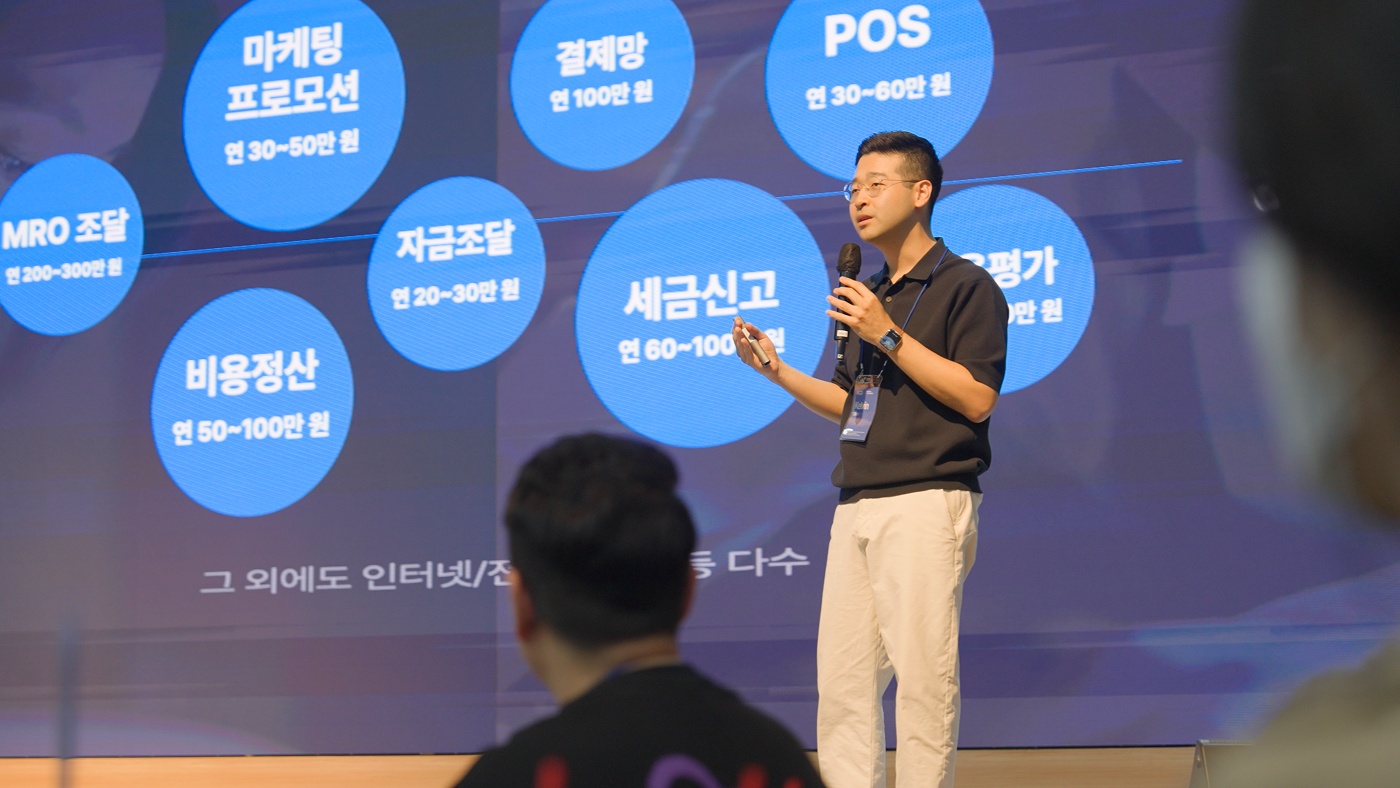
The founder’s job gets larger too
The external recognition has grown. Kim was selected as a World Economic Forum Young Global Leader in 2025. He has appeared in a New York Stock Exchange Floor Talk interview discussing KCD and international growth. Those stages offer a different audience for a company built around Korean neighborhood businesses.
His own reading of growth remains practical. In April 2026, he published notes from a conversation with Atlassian co-founder Scott Farquhar. The subjects included communication as an organization expands and the decisions about where to allocate resources. Kim favored regular individual check-ins with direct reports, while seeing value in bringing several people together when they needed shared context.
There is a familiar problem beneath that discussion. The founder who once knew the whole business directly cannot assume that everybody else has the same picture. Explaining becomes part of operating. Writing down what matters can give colleagues something firmer than a passing remark, especially as acquisitions add teams with their own ways of working.
KCD’s tenth-anniversary memo reported monthly operating profit at the end of 2025 and set a goal of the first annual profit in 2026. Kim also described AI as a way to accelerate work using the group’s accumulated business data and considered eventually serving owners in other countries. The profit target and the international ambition remain goals, with work still attached.
That work has already encountered a substantial setback. KCD’s effort to secure a new internet-bank license in 2025 did not succeed. In a July 2026 interview, Kim continued to argue for small business finance based on understanding the businesses themselves. He also explained why he valued remaining independent when considering acquisition approaches: the ability to offer owners useful choices could become harder inside another group.
It is an ambitious position for a company that began with a daily sales question. Yet the afternoon visits still make a good test of what comes next. Does the owner have time? Does the answer help? Can the company keep providing it? A founder can take those questions to a trading floor or an international forum. Their meaning is settled closer to the counter, between one customer and the next.