The maps disagreed. In RSQUARE’s early days, a group of roughly ten people would spend a weekend visiting buildings, sometimes taking the KTX out of Seoul. They compared ten maps to check what each had missed. A business that would eventually sell property intelligence began with a familiar question: had anyone actually been there?
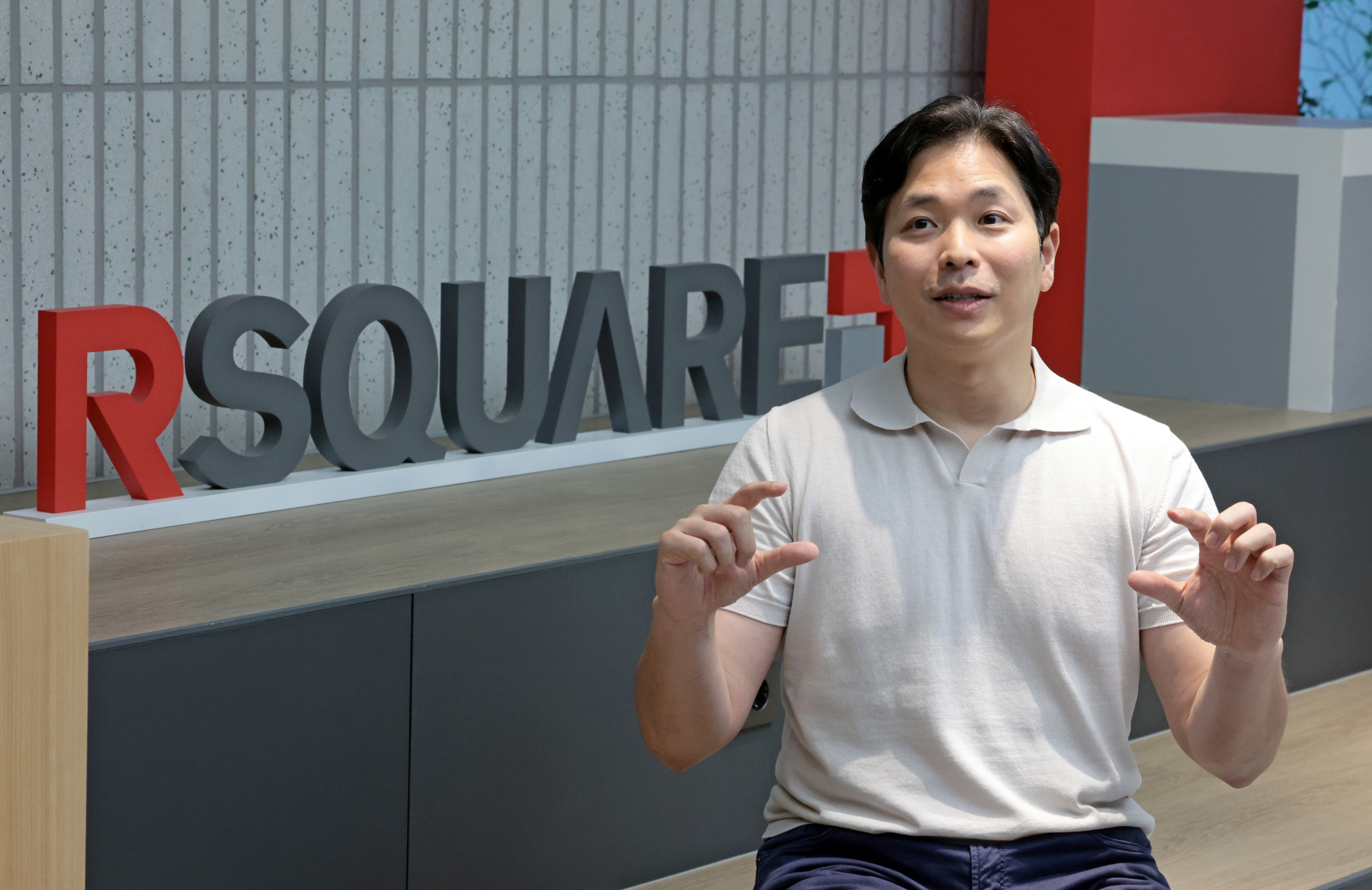
John Lee, the Seoul-based CEO also known publicly as Johnwoo Lee and Lee Yong-gyun, describes a company built around the answer. Buildings could be located on a screen. Their useful secrets required a visit. An empty floor, a landlord’s expectations, the facilities around the corner: these were things a tenant might need before signing a lease. They were scattered among people who had little reason to assemble them for a stranger.
There is a pleasing awkwardness to this origin. A technology business boarding a train to count buildings sounds rather like an airline beginning with a walking club. Yet the walking was the work. Software would become useful once somebody had gathered information worth putting into it.
A consultant inherits a longer assignment
Lee studied business administration at Sogang University. He started at Booz Allen Hamilton in 2006 and spent six years in consulting. In 2012, he took over the existing business behind RSQUARE; the RSQUARE service launched in 2014. The company’s earlier incorporation and his arrival as its leader belong to different chapters.
That distinction matters. Entrepreneurship is often presented as an immaculate beginning: a blank document, an idea, a company born fully named. Taking over an existing operation is less tidy. It asks a new leader to decide which parts deserve to survive and which parts need another purpose. Lee’s purpose became making commercial property information usable.
The field offered a practical problem large enough to occupy him. An office search requires several judgments at once. Location must suit the workforce. Space must fit the business. Terms must be acceptable. A list of addresses helps with only the beginning. Each subsequent question can send the customer back into another conversation.
Twenty motorcycles, one prospective tenant
In 2016, Lee told a story about a food delivery company seeking an office. It needed ground-floor room for about twenty delivery motorcycles. The landlord had concerns about traffic and appearance. RSQUARE brought the two sides together and helped arrange protective measures on the paving. A contract followed.
It is a wonderfully inconvenient detail. An office building can look excellent in a photograph while being entirely wrong for twenty motorcycles. The business arriving at the door changes the meaning of the property. A service that ignores those details can produce an impressive shortlist and a disappointing move.
Lee’s language reflected the same concern. He preferred to call the people on both sides of a lease customers, rather than allowing the labels landlord and tenant to swallow the service relationship. Someone paying for help deserved help proportionate to the payment. In that early account, RSQUARE was already providing information on roughly 80,000 buildings through its website.
The motorcycle episode gives his data project a human scale. A database can identify a possibility. People still have to work out whether the possibility will survive contact with its future occupants. The final obstacle may be waiting outside, resting on a kickstand.
“We personally visit office buildings, interview the owners”
Johnwoo Lee, April 2022
The office search follows you indoors
Once a customer has found a building, the next questions are remarkably predictable. Who can fit it out? Who can supply the furniture? Who can make the place ready for work? A successful lease gives the customer another to-do list.
RSQUARE’s range grew to include interior work, furnishing, and advice on purchases and sales. The sequence makes commercial sense: the moment a business decides to move is also the moment it starts deciding what its new space should contain. Finding that moment is valuable. Serving it well can open another line of work.
There is also a burden in accepting the next assignment. A brokerage recommendation ends differently from a construction project. Delivery becomes more physical, deadlines more visible, and mistakes harder to conceal behind a polished presentation. Offering several services means assuming several kinds of responsibility.
By 2022, the company’s public ambition had widened well beyond arranging an office lease. Its website later reported 184 billion won in 2022 annual revenue. That is a company figure, encompassing a broader operation; it should not be mistaken for Lee’s personal income or for the revenue of a single brokerage service.
A thousand employees have to get there
For shipping company HMM, an office move meant accommodating more than a thousand employees and finding a location with workable transport. Staff were accustomed to commuting to Jongno. In the relocation account published in 2023, RSQUARE used its property records to identify candidates and negotiated with landlords. HMM moved to Parc1 in Yeouido.
That example raises the stakes of the search. Moving an office moves a daily habit for a large group of people. A building has to accommodate a company’s headcount, but its location also affects journeys, routines, and the practical willingness of employees to arrive there every morning.
Price negotiation adds another layer. A suitable building at unsuitable terms remains an unsuitable offer. The value of a larger set of options is partly the ability to keep looking, compare alternatives, and approach a negotiation with more than one possible outcome.
Lee’s company occupies this space between a searchable record and a decision somebody must live with. The software makes comparison possible. The service must carry the comparison through to an agreement. A property search is complete only when the customer can use what has been found.
When the information becomes the product
By late 2024, Lee was describing a different customer relationship. Institutions could subscribe to RSQUARE’s system and examine property data themselves. Asset managers, securities firms, pension funds, and other corporate users were the intended audience. Instead of waiting for a transaction to generate a fee, the company could charge for continuing access.
The shift is easy to miss because the raw material remains the same: buildings, leases, owners, prices. The commercial arrangement changes. A broker needs information to complete a deal. A subscription customer may need information to decide whether a deal deserves to happen at all.
In July 2025, RA, short for RSQUARE Analytics, was supplying detailed information on about 7,000 commercial assets selected from the company’s much larger property database. Its records included rent histories, tenant details, vacancy, and building specifications. Field checks could establish practical details such as warehouse temperature categories and truck access.
At its December 2025 event, the company reported 150 clients for RA and more than 100,000 cumulative uses of detailed data. Those figures describe the analytics product at that date. They are different measures from the number of buildings in RSQUARE’s wider database or the total value of properties changing hands.
That distinction is useful for understanding Lee’s next assignment. Accumulating records and persuading customers to pay for them are related challenges. They are still separate challenges. The subscription has to earn renewal by answering questions that remain worth asking.
Planned additions included automated valuation and rent forecasting, along with wider coverage of residential and retail property. A forecast carries a different promise from a checked vacancy. One describes a possible future; the other establishes a present fact. An attractive interface should leave room for the difference.
- 01 / VisitBuildings, owners, facilities
- 02 / VerifyOrganize and update records
- 03 / ApplyLeasing, advice, analytics
A local business takes its method abroad
Lee’s overseas plans face an obvious difficulty. Property is rooted in a place. Rules, working relationships, and customer expectations change when a company crosses a border. A useful address in Seoul tells a prospective tenant almost nothing about an address in Hanoi.
By 2024, RSQUARE had offices in Hanoi and Ho Chi Minh City. Lee described demand from manufacturers looking for facilities and regional offices in Vietnam. Singapore and Indonesia featured among his next target markets. These were ambitions with destinations attached, rather than a declaration that every country already belonged to the business.
The exportable part is the method: gather local information, organize it, and use it to make decisions easier. The information itself has to be collected again. That makes international growth a repeated exercise in learning a place, with all the costs and patience that implies.
In January 2026, overseas revenue was described as roughly five to ten percent of the company total. Another January account put Korean companies at about thirty percent of the Vietnam customer mix, local businesses at forty percent, and other global companies at thirty percent. The mix matters because an overseas office eventually needs customers beyond those who already know its home market.
The next door still needs knocking
Growth has supplied complications as well as customers. In September 2026, Lee described losses following expansion and a property downturn, a profitable second half of 2025, and an expected return to annual profit in 2026. The last of those was a forecast. His account also put the wider building database at about 400,000 records across Korea and overseas.
Earlier that year, he had emphasized recurring income from subscriptions and ERP software, operational efficiency, and stronger data businesses. An IPO remained an option rather than the stated purpose of the work. The priorities give a more useful picture of his current role than a funding announcement alone.
Lee also participates in the venture community: RSQUARE announced his appointment as the first chair of the Venture Business Association’s Startup Committee in 2024. Advising a broader ecosystem sits beside the less ceremonial job of deciding what his own company should do next.
The maps at the beginning of this story were imperfect. So is any database that describes a world still changing. Tenants arrive, owners sell, and yesterday’s available floor acquires a new occupant. Lee’s project therefore has no final edition. Its usefulness depends on returning, checking, and keeping the record alive. The next door is a small thing to knock on. Repeated across a city, it becomes a business.
Keep reading
- RSQUARE’s website
- John Lee on LinkedIn
- RSQUARE on LinkedIn · Company Facebook
- The 2022 interview: offices, data and interiors
- The 2016 interview: the motorcycle lease (Korean)
- Lee’s January 2026 data strategy interview (Korean)
- The September 2026 interview (Korean)
- RSQUARE Analytics: the December 2025 announcement