property-data
(23)
RSQUARE found the gap between buildings
The Seoul company built its commercial property business by collecting what the internet missed. Now it sells both the expertise to close a deal and the data to question one.

John Lee and the buildings the maps missed
Before RSQUARE could put commercial property on a screen, someone had to knock on the door. John Lee built his business around that unglamorous task, then found more than one way to sell what it revealed.

Yad2 sells secondhand. Its $950 million price tag tells another story.
Israel’s familiar classifieds site has become a business built around homes, cars and jobs. Behind the orange branding sits a valuable habit: knowing where to look when life gets expensive.

Domain’s A$3 billion deal came with a new floor plan
CoStar bought Australia’s property challenger, then started clearing space. Domain’s next chapter puts richer listings, 3D home tours and a narrower business at the centre of the contest for buyers and agents.

Two Brothers-in-Law Turned a Birdhouse Into a 3.5-Billion-Image Property Machine
Eagleview began with one roofer trying to avoid a ladder. Eighteen years later, its planes, patents and property models sit inside decisions about claims, construction, taxes, solar panels and disaster response.

Anir Prativadi Is Teaching a Phone to Read a House
The ValueMate co-founder is betting that three minutes of phone-based LiDAR can remove hours of appraisal paperwork - while leaving the judgment to the appraiser.

Duane Andrews Built a Property Data Company the Slow Way - Then Chose a Faster Second Act
An accounting student learned to stand out, a property operator learned to code around paper, and a patient founder learned when outside capital could widen the map.

Teranet's $700 Million Lesson: The Boring Software Behind 10 Million Property Transactions a Year
Ontario set out to turn filing cabinets into infrastructure. The conversion ran years late and its estimate climbed past C$700 million - but the system that emerged now sits beneath millions of property transactions, lender decisions and legal searches.

They Burned $550,000 Selling Trust. Then The Lifetime Value Co. Learned to Sell Curiosity
Josh Levy and Ross Cohen spent 11 months pitching an identity badge nobody would buy. Their pivot - from asking people to verify themselves to helping customers investigate the world around them - became a portfolio of data products used by millions.

The founder teaching insurers to read a house from the sky
He runs an intelligence unit's worth of pattern recognition on the roofs of 160 million buildings. The question that started it was not about roofs at all.

The Appraisers Who Got Tired of Their Own Software Built a Better One
Four appraisal veterans spent six years quietly building the tool they wished existed, bootstrapped it to profit, then raised money only after the customers showed up. Here is how Valcre turned the industry's most tedious paperwork into software.

The Startup Betting Your Bank Knows Your House Better Than You Do
Chimney put a home-equity meter inside 180+ banking apps. The pitch to lenders is blunt: your customers are richer than they realize, and you are the last to tell them.

The Quiet Machine That Helps Insurance Price the Unthinkable
Before an insurer prices a hurricane, spots a suspicious claim, or estimates a ruined kitchen, there is a good chance Verisk is somewhere in the workflow. The 55-year-old data company has become part utility, part software network, and part laboratory for risk.

ValueMate
ValueMate is a Y Combinator (X25) startup rebuilding the residential real estate appraisal stack around AI. Its smartphone app uses LiDAR to capture a property in a roughly three-to-five minute walkthrough, generating a 3D model, 2D floor plans and a near-final, regulator-ready appraisal report that complies with the new UAD 3.6 and ANSI standards. The company says it makes appraisers about 80% more efficient, cutting turnaround from days or weeks to hours, and also runs its own in-house appraisal firm, VM Appraisals.

OpenAgent
OpenAgent is a Sydney-based proptech company that helps Australians choose the right real estate agent to sell their home. Founded in 2013 by former McKinsey consultants Zoe Pointon and Marta Higuera, it analyses every property sale in Australia and pairs that data with human consultants to give sellers a free, personalised shortlist of local agents. The service is free for homeowners and monetises through referral fees paid by agents on successful sales, and it also runs free consumer tools such as OpenEstimates, property reports and suburb profiles used by more than two million visitors a year.
CompStak
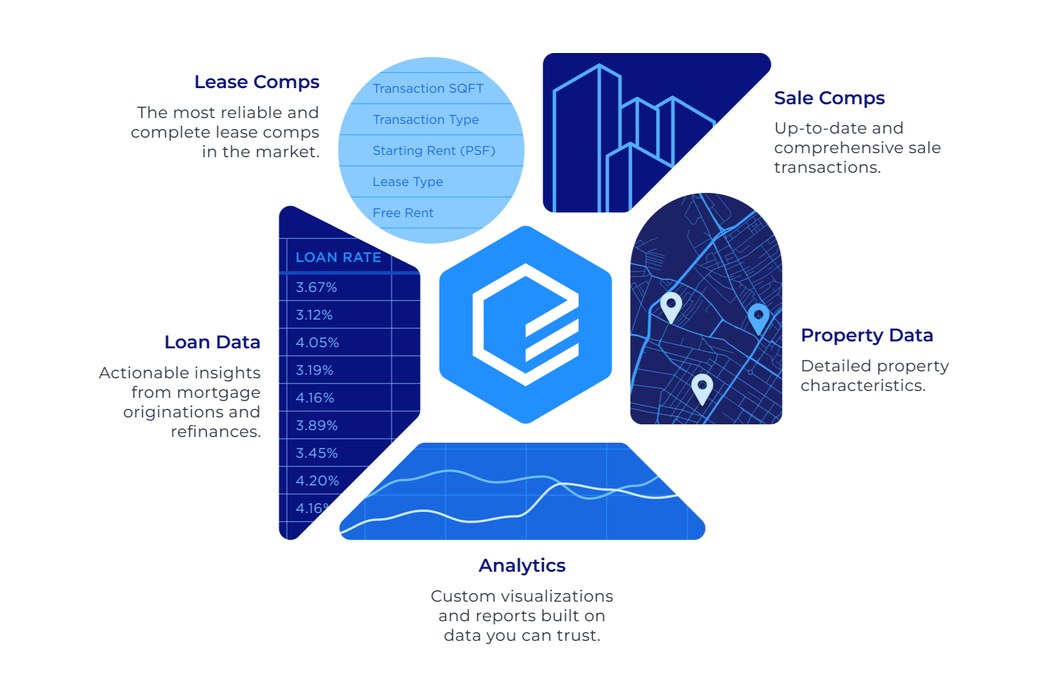
CompStak is a New York-based commercial real estate data and analytics company that runs a crowdsourced marketplace where brokers, appraisers and researchers trade verified lease and sale comps for credits. Founded in 2012 by former broker Michael Mandel and engineer Vadim Belobrovka, it turns hard-to-find transaction details - starting rents, net effective rents, cap rates, net operating income - into structured, analyst-reviewed data used by many of the largest CRE investors, lenders and banks in the U.S.

Orbital
Orbital (formerly Orbital Witness) is a London- and New York-based legal AI company building software that automates the paperwork-heavy work of real estate law. Its flagship product, Orbital Copilot, is a domain-specific AI agent that reads title reports, leases, surveys and contracts the way a real estate lawyer would - extracting key terms, flagging risk and drafting reports in a fraction of the usual time. Founded in 2018 by Will Pearce and Edmond Boulle, Orbital supports around 200,000 property transactions a year for more than 5,000 professionals at firms including Clifford Chance, Slaughter & May, Mishcon de Reya and BCLP, and raised a $60M Series B in January 2026 to expand in the United States.

GeoX
GeoX is an Israeli-founded geospatial AI company that turns aerial imagery, satellite data and ground-level images into detailed 3D models of individual buildings. Insurers, reinsurers, banks and public agencies use its property database - covering roughly 160 million US properties and expanding across Europe, Japan and Australia - to assess roof condition, elevation and exposure to fires, floods and storms without sending anyone into the field. The company raised a $19M Series A in 2024 (led by Flashpoint), bringing total funding to $23M.

Tolemi
Tolemi is a Boston-based govtech company whose flagship platform, BuildingBlocks, stitches together scattered municipal data - property records, ownership, code violations, tax liens - into a single map-based interface. State and local governments use it to run spatial analysis, spot problem properties, and make faster, data-driven decisions about housing, land use, and neighborhood revitalization. Formerly OpportunitySpace, the company rebranded to Tolemi after Y Combinator and today serves cities from New York to small towns across the U.S.

Andrew Kieve
Andrew Kieve is the co-founder and CEO of Tolemi, a Boston civic-technology company whose BuildingBlocks platform stitches together the messy, siloed property data that cities sit on and turns it into maps and insights officials can actually act on. Originally launched as OpportunitySpace in 2013 and rebranded after a 2017 run through Y Combinator, Tolemi now helps state and local governments fight blight, enforce housing codes, and protect affordable housing across dozens of American cities. A Stanford and IESE graduate and former Innosight consultant, Kieve has spent more than a decade convincing governments that the answer to neighborhood decline is hiding in their own databases.

HouseCanary
HouseCanary is an AI-powered real estate analytics company and licensed national brokerage that turns messy, paper-based property records into structured, predictive intelligence. Founded in 2013 by Jeremy Sicklick and Christopher Stroud, it provides automated valuation models (AVMs), home-price forecasts, property data APIs, and the consumer-facing ComeHome platform to lenders, investors, capital-markets firms, and mortgage institutions. Its models cover roughly 136 million properties with a reported 2.7% median absolute valuation error.

Jeremy Sicklick
Jeremy Sicklick is the co-founder and CEO of HouseCanary, a San Francisco proptech company that uses machine learning to value and forecast residential real estate across more than 136 million U.S. homes. A former partner and managing director at Boston Consulting Group, he started HouseCanary in 2013 after the 2008 housing collapse exposed how paper-bound and opaque the largest asset class in America really was. His pitch: replace a two-to-three week human appraisal with an instant, data-driven valuation, and bring stock-market-grade transparency to homes.

Archipelago
Archipelago is an AI-powered risk data platform that connects large commercial property owners with their insurance markets, turning messy schedules of values, loss runs and engineering reports into clean, broker-ready submissions. Founded in 2018 by RMS co-founder Hemant Shah, the San Francisco-based company digitizes property risk for portfolios totaling trillions of dollars in insured value.