The dessert was supposed to be the experiment. At Tufts University, Benedetto Marelli tried putting silk around strawberries for a laboratory cooking competition. The fondue did not work out. The strawberries, however, had a rather better evening. Left on the bench, the coated fruit remained fresh while the untreated fruit spoiled. An unsuccessful pudding had produced a useful question: what, exactly, was the silk keeping out?
Mori grew from that question. The company extracts protein from silk cocoons and turns it into edible protection for food. Its proposition is pleasingly odd: borrow the material a silkworm uses to protect itself, then give a perishable product a little more time before nature collects it.
- The product: food-grade silk protein, applied as a coating or integrated into processing.
- The buyer: food businesses with freshness, waste, and handling problems.
- The test: whether extra usable time earns more than the treatment costs.
A cocoon is already a packaging idea
Silk is usually sold as a luxury. Mori treats it as a functional material. Water, salt, and heat extract the protein from cocoons; the resulting material can protect food without becoming an obvious part of dinner. The company describes Mori Silk as invisible, tasteless, and odorless. Nobody ordering a salad needs to admire the tailoring.
The science concerns the passage of gases and moisture. In the 2016 proof-of-concept paper, Marelli and colleagues dip-coated strawberries and bananas with silk fibroin. The thin membranes reduced respiration and water evaporation. Changing the protein’s structure changed its barrier properties. The useful discovery was therefore more specific than “silk preserves fruit”: a controllable material could influence the processes that make fruit deteriorate.
loss slows
transfer slows
Conceptual mechanism, not a measured performance chart.
The customer already owns a washing line
A strawberry on a bench has a simple itinerary. Commercial food has appointments: harvesting, processing, packing, transport, storage, display. A preservation invention must survive that itinerary and find a place in it. Mori’s answer is to integrate into steps where businesses already wash, dip, spray, glaze, or formulate their products.
That choice matters. A producer considering a new ingredient must consider the machinery, labour, throughput, and cleaning around it. Mori’s 2022 funding announcement argued that its approach could require little or no additional capital expenditure. That is a company proposition to test on a particular line, rather than a universal installation promise.
The business model follows the setting: sell proprietary food protection to other businesses and work on its application. Grower-shippers, processors, and retailers are the relevant audience. A consumer encounters the outcome downstream, when food reaches the kitchen in better condition. The commercial conversation begins much earlier, beside a production process that already has a schedule to keep.
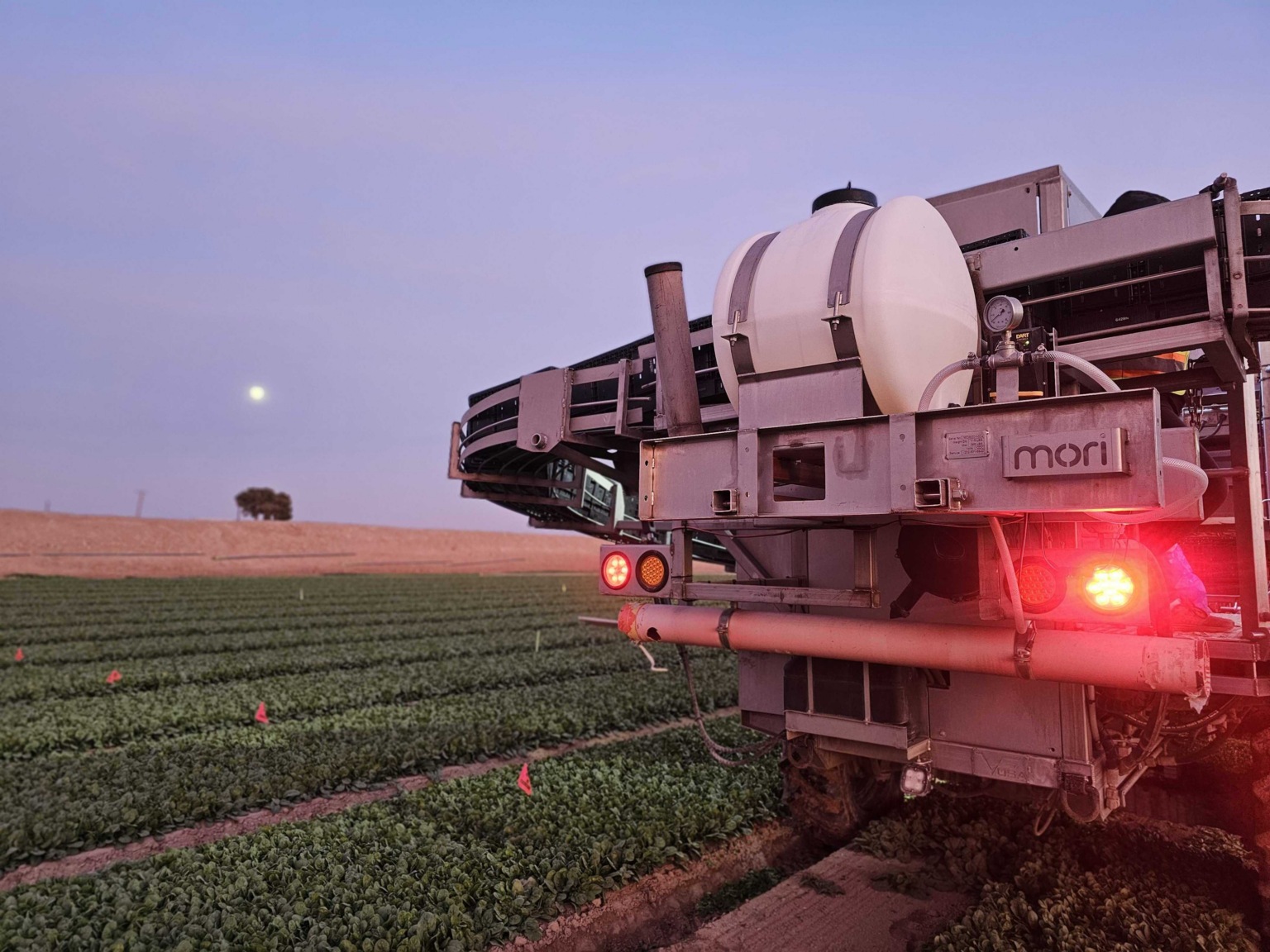
The strawberry was only the opening act
Mori’s current product page ranges from romaine and broccoli to fish, poultry, gummies, nuts, and baked goods. Its FAQ says the company has worked on more than 50 food types. That breadth helps explain the 2020 change of name from Cambridge Crops: the technology’s ambitions had outgrown the produce aisle.
But breadth also creates work. Keeping water inside a leaf and managing moisture in a snack are different assignments. In a 2022 AQUALAB podcast, product development manager Nadia Hallaj described using water-activity measurements and moisture-sorption analysis to understand how protection behaves. The apparently simple coating sits atop a less picturesque task: measuring what each food actually needs.
Its market neighbours include Apeel’s plant-derived produce coatings and Hazel Technologies’ shelf-life treatments. Conventional refrigeration and packaging also compete for the preservation budget. Mori’s distinctive bet combines silk protein with applications across multiple food categories. The relevant comparison depends on the product and the processing step, rather than a general contest for the freshest avocado.
A small layer, a substantial funding bill
Moving from bench science to ingredient production required outside capital. Mori announced a $12 million Series A in July 2020, followed by a $16 million Series B in April 2021. In March 2022, it announced another $50 million through a Series B1 led by Prelude Ventures.
Selected rounds, not a lifetime funding total or a customer price.
That last announcement described a recently opened silk-protein manufacturing facility and plans to launch initial commercial products in several segments. Capital was being directed toward making the material, developing categories, and expanding geographically. Funding tells us the resources investors supplied; it does not tell us the cost of treating a crate of greens.
“I fell in love with developing solutions out of seemingly unsophisticated materials.”Adam Behrens · Engine Ventures
The paperwork had to catch up
The regulatory record supplies another instructive detail. Mori’s earlier GRAS submission was withdrawn from evaluation, with correspondence identifying concerns about publicly available safety information and the precision of exposure estimates. The company submitted a revised notice. That sequence shows how a food ingredient’s evidence must be made legible beyond its own laboratory.
On August 11, 2022, FDA closed GRN 1026 with a no-questions response for specified uses of silk fibroin. The distinction matters: this was a response to a particular safety conclusion and intended uses, rather than blanket approval for any application a product developer might imagine.
What one more day is worth
The practical lesson for a food operator is to start with the point where value disappears. Run a controlled trial through the actual route to market. Measure saleable yield, sensory quality, handling, and total cost alongside shelf life. A beautiful laboratory sample is encouraging; a repeatable result after shipping is commercially useful.
If deterioration has already occurred, or the application cannot fit the production process, a coating’s promise offers little comfort. Each food and storage condition needs its own evidence. Mori’s opportunity lies in making that evidence pay: more food sold, more choices about movement and packaging, and fewer products reaching the bin before anyone reaches for a fork.