He sold Mexican avocados before he sold software. Now his AI tells the world's biggest buyers when the next food shock is coming - and what it will cost.
Most people meet climate change as a headline. Procurement managers meet it as a phone call: the cocoa is short, the strawberries are late, the line stops.
Francisco Martin-Rayo built Helios AI for that phone call - the one that comes too late. Helios is a climate-risk and price-forecasting platform that watches agricultural commodities the way a meteorologist watches the sky. It aggregates billions of data points and reads the weather, the news, and the markets to tell buyers a deceptively simple set of things: when to buy, how much to buy, and where to buy it from.
The pitch he gives procurement teams is not a comfortable one. "If you're a procurement manager, this is the worst time in your professional career," he says. Disruptions that used to arrive once every couple of years now arrive several times a year, across different regions and different crops. The job got harder. The tools, until recently, did not get better.
So Helios does the part that used to eat weeks. Its newer multi-agent system, Helios Horizon, fields a procurement question and returns an answer in minutes. "These are tasks and analyses that would have taken weeks before, and now it takes you a couple of minutes," Martin-Rayo says. The platform tracks dozens of commodities - from cocoa to strawberries - across roughly 90 countries.
What makes the company unusual is that it refuses to pick a lane. Plenty of firms forecast prices. Plenty model climate risk. Helios does both, on purpose. "We're the first company to do both climate risk and price forecasting, which is what we're hearing the market wants," he says. The bet is that the two are the same problem wearing different hats: the weather moves the crop, the crop moves the price, and a buyer needs to see the whole chain before it snaps.
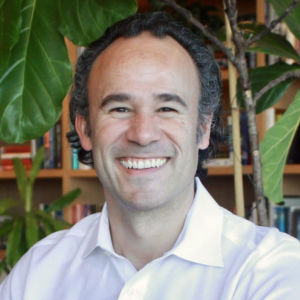
"Eden and I joke that I'm probably the only CEO of an AI company that can also tell you where the best avocados come from." - Francisco Martin-Rayo, on his unlikely resume
After graduating from the University of Pennsylvania, Martin-Rayo did not go straight into software. He ran an import/export business for Mexican avocados. It is the kind of detail that sounds like a punchline until you realize it is the whole thesis: he learned how a perishable, climate-sensitive crop actually moves from a farm in one country to a shelf in another - the timing, the spoilage, the weather, the bets.
From there the path turned corporate. He became a Principal at Boston Consulting Group, running digital transformations for Fortune 100 companies, then Chief Commercial Officer at Deep Labs, an AI fintech. Along the way he collected degrees that read like a dare: an MPP from Harvard, a B.Sc. in Economics from Wharton, and a B.A. in International Relations from Penn.
The trade instinct never left. When he and co-founder Eden Canlilar - a former Google AI/ML engineer - started talking in 2022, the conversation kept circling back to food. "Eden and I had these unique backgrounds in tech and food," he says, "we were really worried about the impacts of climate change, especially on agriculture." One of them could build the models. The other could tell you where the best avocados come from. They launched Helios in December 2022.
The validation came in chocolate. After eighteen-plus months of building, the platform predicted a rise in cocoa prices weeks before the market caught on. "By that point we'd spent 18+ months building out our AI platform and it was so validating," he says. It is one thing to build a forecasting engine. It is another to watch it call a shot that traders missed.
Helios runs a separate machine-learning model for each commodity it covers - dozens of them - rather than one model trying to explain every crop at once.
The system scrapes about 250,000 global news sources on a fifteen-minute cycle, vectorizes tens of thousands of USDA reports, and tracks thousands of price series.
Climate risk is mapped across roughly 14 million hyper-granular hexagons and 81 proprietary climate archetypes - a fine-grained view of where the weather actually bites.
Helios Horizon is a multi-agent platform of specialized virtual analysts that answer procurement questions in minutes instead of weeks.
By telling them precisely when to buy, Helios helped Libby's cut its mandarin procurement costs by 15%.
Helios won Walmart's open call and became a partner and customer - a useful stamp for a young company selling to cautious buyers.
"These are tasks and analyses that would have taken weeks before, and now it takes you a couple of minutes." - On what Helios Horizon does to the job
Runs an import/export business trading Mexican avocados.
Principal at Boston Consulting Group, leading digital transformations for Fortune 100 companies.
Chief Commercial Officer at Deep Labs, an AI fintech.
Co-founds Helios AI with Eden Canlilar and becomes CEO.
Helios launches its AI platform to predict agricultural supply chain disruptions.
Wins Walmart's open call; becomes a Walmart partner and customer.
Announces a $4.7M seed round led by Collide Capital and S&P Global Ventures.
The goal isn't to predict the next shortage and watch it happen. It's to stop food supply shortages before they happen - and hand buyers the warning while it still matters. - The Helios thesis, in plain terms