Breaking
BEARING AI predicts per-voyage fuel burn to 98%+ accuracy 'K' LINE deploys the platform across 300+ vessels FUNDING $10M total, backed by Andrew Ng's AI Fund & Mitsui HAPAG-LLOYD co-builds the Fleet Deployment Optimizer MISSION cut shipping's carbon with better math, not just new ships PLATFORM Ask · Reason · Decide for the era of LLMs BEARING AI predicts per-voyage fuel burn to 98%+ accuracy 'K' LINE deploys the platform across 300+ vessels FUNDING $10M total, backed by Andrew Ng's AI Fund & Mitsui HAPAG-LLOYD co-builds the Fleet Deployment Optimizer MISSION cut shipping's carbon with better math, not just new ships PLATFORM Ask · Reason · Decide for the era of LLMs
COMPANY PROFILE MARITIME & AI PALO ALTO, CALIFORNIA EST. 2019

Bearing AI

Teaching the world's oldest industry to compute. Bearing builds deep-learning models that tell a shipping company - before the lines are cast off - exactly how much fuel a vessel will burn, how much carbon it will emit, and which schedule keeps the fleet compliant.

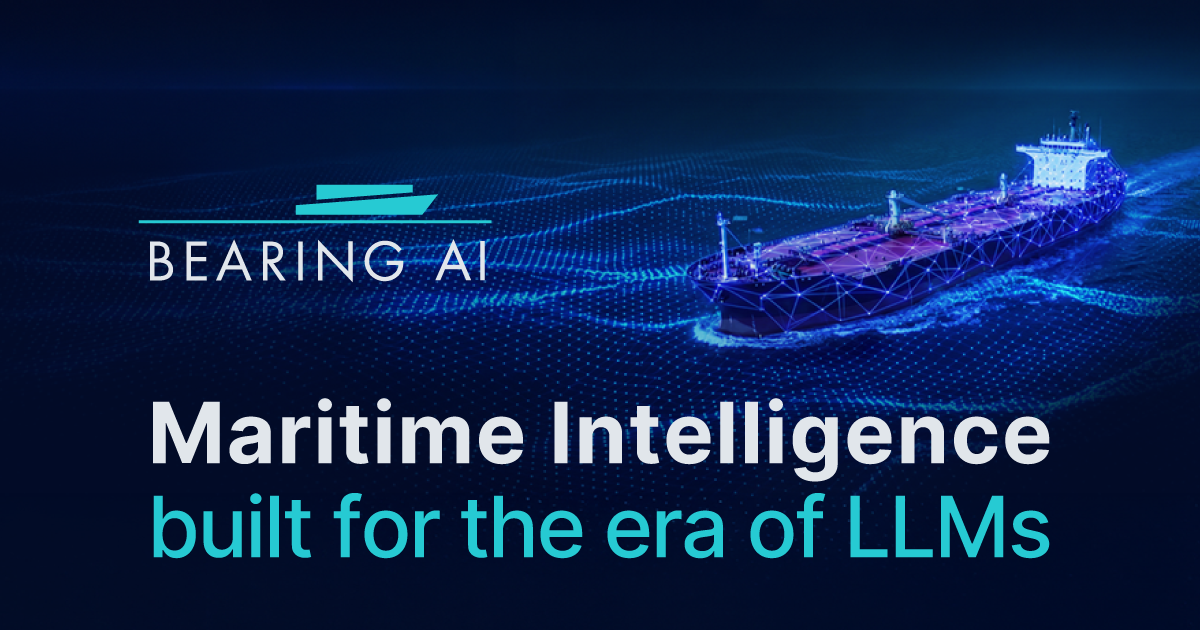
Bearing AI - Maritime Intelligence built for the era of LLMs
The pitch, in one frame. A tanker sits on a grid of glowing data points - the ocean, rendered as something a model can read. It is a company that looked at 90% of world trade moving on water and decided the missing ingredient was arithmetic.
98%+
Fuel Prediction / Voyage
300+
'K' Line Vessels
$10M
Total Raised
~33
Team Members
The Story

A Silicon Valley Answer to a Very Old Question

The shipping industry is enormous, ancient, and - to an outsider with a machine-learning background - improbably analog. Roughly 90% of everything that gets traded across the planet spends part of its life on a boat, and yet the question of how much fuel any given boat will burn on any given voyage has historically been answered with rules of thumb, sea-trial curves from decades ago, and a captain's feel for the weather. The industry-standard prediction, if you can call it that, is right about 80% of the time. That 20% gap is fuel, money, and carbon, poured into the ocean.

Bearing AI was founded in 2019 by Dylan Keil and David Liu, both alumni of Stanford's AI Lab, on a fairly direct thesis: the gap is a data problem, and data problems have solutions. Keil had done this dance before - his previous company, Chronos, built a contextual-awareness engine for mobile devices out of noisy real-world sensor data and was acquired by Cisco. A ship, viewed a certain way, is just a very large, very expensive sensor platform floating through weather.

So Bearing built models that eat the things a vessel actually experiences - onboard sensor readings, satellite positioning, and weather data - and learn how that specific hull, in that specific condition, from a flat calm to a storm, converts fuel into distance. The company claims per-voyage fuel-consumption accuracy above 98%, against the industry's roughly 80%. It is an unglamorous number that happens to be the entire business, because once you can predict fuel that precisely, you can predict emissions, cost, and the smartest way to deploy an entire fleet.

The company came out of stealth in early 2021 with a genuinely load-bearing customer: Kawasaki Kisen Kaisha, better known as 'K' Line, which agreed to put Bearing's Analysis Dashboard on more than 300 vessels after concluding its numbers were simply more accurate than the tool it already had. That is the kind of validation that money can't buy - a conservative Japanese carrier telling its fleet to trust a startup's math.

Then the regulators arrived, which for Bearing was less a threat than a tailwind. The International Maritime Organization's Carbon Intensity Indicator, or CII, began rating ships on their emissions efficiency. Every operator suddenly needed to know, ship by ship, how a rule would grade its fleet - and most had no rigorous way to find out. In 2022 Bearing shipped a CII Optimization product for exactly this, and raised $7 million from its existing backers, AI Fund and Mitsui & Co., bringing its total to $10 million. AI Fund is the venture studio of Andrew Ng, which is a sentence that explains a lot: one of the most recognizable figures in artificial intelligence decided a shipping-software startup was worth a board seat.

The product line kept climbing the value chain. In 2023 and 2024 the company released a Fleet Deployment Optimizer - built with in-depth feedback from Hapag-Lloyd - that simulates future emissions and instantly compares how different vessels perform across candidate schedules. It is the difference between predicting one ship's fuel and orchestrating an entire fleet against compliance deadlines, service requirements, and cost, all at once. More recently Bearing has recast itself for the moment, describing its platform as "maritime intelligence built for the era of LLMs," with an Ask-Reason-Decide interface that lets a planner pose a question in plain language and get a modeled answer back.
Companies know the new regulation will affect their business, but they have no way to accurately assess its impact on a ship-by-ship basis. By combining our AI models with data from around the world, our product permits shippers to see what we see. Dylan Keil - Co-Founder & CEO, Bearing AI
By the Numbers

The Gap Is the Whole Business

Per-Voyage Fuel Prediction Accuracy

Bearing AI models98%
Typical legacy tools~80%

Figures per company statements; accuracy varies with the quality of onboard vs. public data.

2022 Post-Seed Round$7M
Total Capital Raised$10M

Backed by AI Fund (Andrew Ng) and Mitsui & Co., capital that pairs frontier-AI expertise with 350 years of maritime trading history. Latest round: Seed / Post-Seed, August 2022.

What You Can Do With It

Six Models, One Ocean

01

Fuel & Vessel Performance

Predict how much fuel a specific ship burns across routes, speeds and sea states - the model everything else is built on.

02

CII Optimization

See how the IMO's Carbon Intensity Indicator grades each ship, and find the moves that improve the rating without wrecking the schedule.

03

Fleet Deployment Optimizer

Co-built with Hapag-Lloyd. Simulate future emissions and compare vessels across candidate schedules, instantly.

04

Freight Rate Prediction

Forward-looking market forecasts to sharpen chartering and commercial decisions.

05

Port Congestion & Fouling

Anticipate delays and model the drag of hull fouling before it quietly eats your fuel budget.

06

Ask · Reason · Decide

A natural-language layer over the models - pose a maritime question, get a modeled answer for the era of LLMs.

The Log

How It Got Here

2019

Dylan Keil and David Liu found Bearing in Palo Alto, out of Stanford's AI Lab.

FEB 2021

Emerges from stealth with a platform launch and a 300+ vessel partnership with 'K' Line.

AUG 2022

Raises $7M from AI Fund and Mitsui; launches CII Optimization ahead of new IMO emissions rules.

OCT 2023

Releases the Fleet Deployment Optimizer to simulate future emissions and compare vessel efficiency.

APR 2024

Launches the first AI-powered planning tool for shipping liners, developed with Hapag-Lloyd feedback.

The File

Company at a Glance

Legal Name
Bearing, Inc.
Founded
2019
Headquarters
Palo Alto, California, USA
Category
Maritime AI • Logistics • Climate
Founders
Dylan Keil (CEO), David Liu (CTO)
Investors
AI Fund, Mitsui & Co.
Key Customers
'K' Line, Hapag-Lloyd, IINO Lines
Ecosystem
ClassNK, StormGeo, ABB
Fun Facts
  • A single voyage's fuel forecast typically lands within about 1-2% of what the ship actually burns.
  • Andrew Ng - one of AI's most recognizable names - has sat on the board of a shipping-software startup because of Bearing.
  • The founders came out of Stanford's AI Lab; CEO Dylan Keil earlier built a sensor-data startup, Chronos, acquired by Cisco.
  • Bearing's thesis: shipping's fastest emissions cut isn't new ships - it's better decisions about the ships already at sea.
Spread the Word

Share Bearing AI

Quick facts: Bearing AI

Bearing AI is a Palo Alto-based maritime technology company that builds AI models to predict and optimize how ships perform at sea. By combining real-world vessel sensor data, satellite positioning and weather with deep learning, its platform forecasts fuel consumption, emissions, fleet deployment and market conditions - helping shipping companies cut carbon output, comply with tightening emissions rules like CII, and make better operational decisions. Founded in 2019 by Dylan Keil and David Liu and backed by Andrew Ng's AI Fund and Mitsui & Co., Bearing counts leading carriers such as 'K' Line, Hapag-Lloyd and IINO Lines among its users.

Founded
2019
Headquarters
Palo Alto, California, United States
Founders
Dylan Keil (Co-Founder & CEO), David Liu (Co-Founder & CTO)
Team size
Approximately 33 employees
Products
Vessel Performance & Fuel Consumption Prediction, CII Optimization, Fleet Deployment Optimizer, Maritime Intelligence Platform (Ask-Reason-Decide), Freight Rate & Market Prediction
Notable
Achieved per-voyage fuel consumption prediction accuracy above 98%, versus a typical industry accuracy around 80%., Signed 'K' Line to deploy its platform across 300+ vessels at platform launch in 2021., Launched an industry-first Fleet Deployment Optimizer for shipping liners (2024), co-developed with Hapag-Lloyd.

Last updated: