A 40-year-old laytime firm that taught itself to read cargo documents - and turned the dullest line item in shipping into an AI product.
Somewhere right now a bulk carrier is sitting at a berth, idle, burning the clock. Every extra hour past the agreed window is money - a charge called demurrage. For decades, settling that bill meant a human cross-checking a faxed Statement of Facts against a charter party by hand, line by line, in a spreadsheet that nobody fully trusted. Burmester & Vogel built the machine that does it in seconds.
The company is small - around 15 people - and almost invisible to anyone outside shipping. That is exactly the point. It works on a problem so specialized that most software companies never learned the vocabulary, let alone the math. Laytime. Demurrage. Notice of Readiness. These are the words that move money across oceans, and B&V has spent forty years learning to count them.
Demurrage is the most expensive word in shipping you've never heard of. Burmester & Vogel built the AI that argues it for you.
- The pitch, in one breathHere is a statistic the company likes to repeat, and it is genuinely hard to believe: roughly four billion pieces of paper are circulating on the world's ships at any given moment. Notices, manifests, statements, certificates. The most digitized supply chain on the planet has, at its operational core, a filing cabinet.
Demurrage is where that paper turns into conflict. When a vessel is delayed loading or discharging, the contract says someone pays - but proving exactly how long, against which clauses, with which exceptions for weather and holidays, is slow, manual, and adversarial by design. Claims drag on for weeks. Disputes calcify. Money sits still, which in shipping is the one thing it should never do.
The irony: an industry that can route a 200,000-ton ship across the Pacific to the hour still settles its delay bills like it's 1985. B&V noticed.
There are about four billion pieces of paper floating around on the world's ships. We decided to read all of them.
- The founding observationBurmester & Vogel started in Hamburg in 1983, a traditional laytime-calculation house in a port city that takes shipping seriously. For most of its life it was a domain expert, not a tech company. Then under CEO Evangelos Efstathiou it made a bet that the forty years of accumulated demurrage knowledge - the edge cases, the clause interpretations, the formats - was not a museum. It was training data.
The bet had a constraint baked in, and it's the smart part: do not ask a demurrage analyst to become a software user. Slot the AI into the workflow they already have. Read their documents, do their math, flag their disputes - and let them keep working the way they always did, only faster and with an audit trail.
We can now support diverse processes, formats, and data-intensive workflows... that streamlines, automates, and audits the demurrage process without changing the workflows of the people working in the field.
- Evangelos Efstathiou, CEOTranslation: the rare AI pitch that promises to leave your job description alone. That restraint is probably why several hundred shipping companies actually said yes.
Born as a specialist laytime-calculation firm in one of Europe's busiest ports.
Raises capital to fund the move from spreadsheets toward machine learning.
After two years of development, B&V launches its AI demurrage platform (Dec 2023).
Document processing and laytime calculation in seconds, with side-by-side claim comparison.
Buys the Windows-based Laytime2000 software and migrates ~200 dry-bulk users to the cloud.
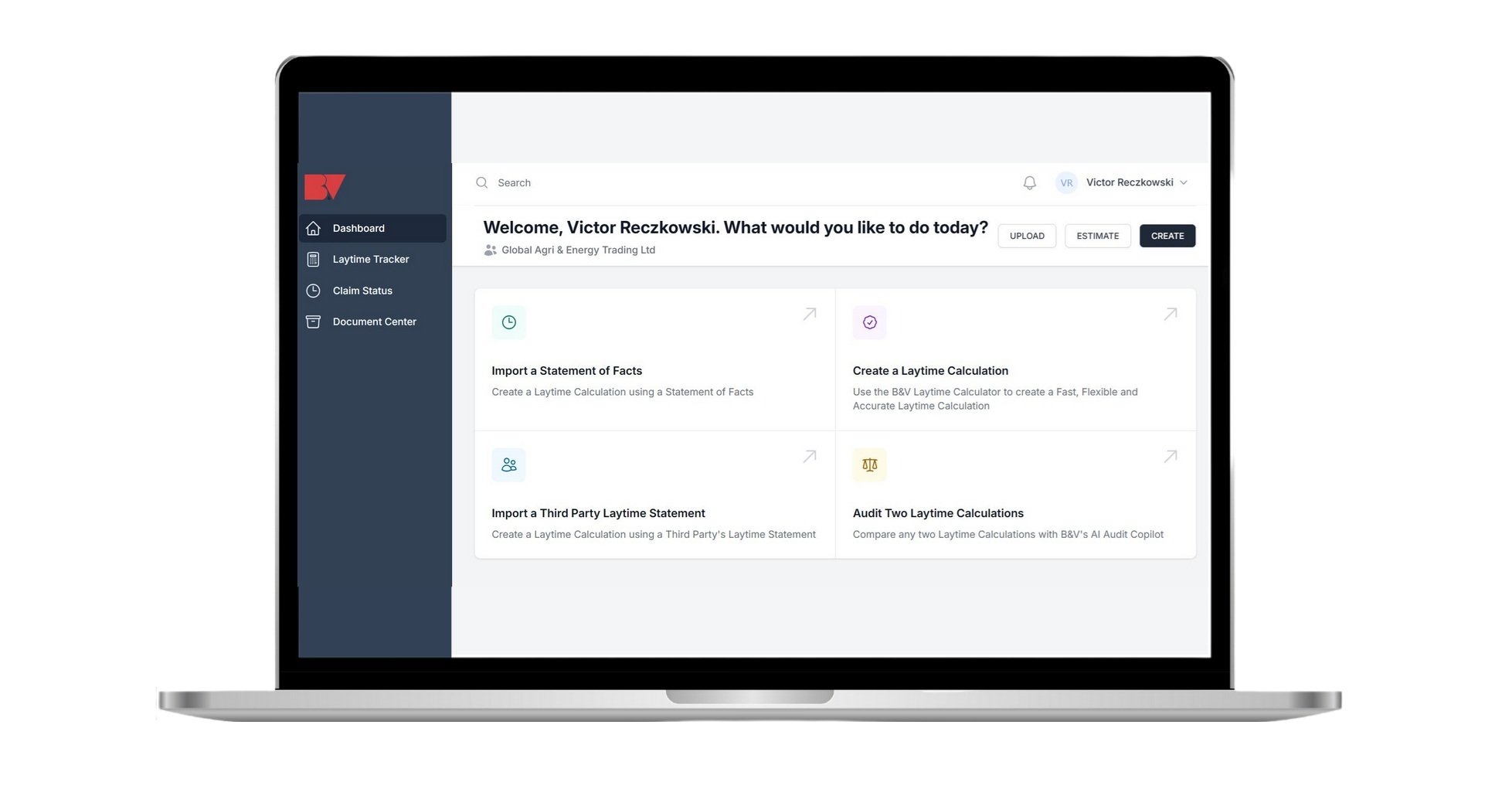
The flagship is the Demurrage AI Copilot: feed it the documents, and it digitizes and standardizes them in seconds, compares a Statement of Facts against a demurrage claim, and lays the two side by side so a dispute can be settled instead of debated. Around it sits a suite with names that read like a fleet roster.
AI-powered laytime automation - the calculation engine, on autopilot.
Analytics and a data-lake platform, with port intelligence baked in.
Document AI and audit services for bills of lading and cargo paperwork.
Voyage optimization and satellite vessel tracking.
There are also open APIs - an integrated laytime and demurrage portal - so the Copilot doesn't live on an island but plugs into the trading and operations systems shipping companies already run.
Read a Statement of Facts in seconds, then tell you who owes whom. That's the whole product in one sentence.
- What the Copilot actually doesSkeptics should note: these are the company's own figures, and shipping loves a round number. But the shape of the claim is consistent across its site and press coverage - deep history, real scale, broad client base.
Reading the chart: two million voyages dwarfs everything else, which is the point - the moat isn't the software, it's the decades of demurrage examples feeding it.
The customer list leans industrial: sugar refiner ASR Group, UME Shipping, the family-run terminal operator A.R. Savage and Son, and building-materials giant Titan America. These are the producers, traders, terminals and shipowners who feel demurrage in their margins.
The stated mission is supply-chain visibility - using maritime AI to accelerate global trade. But there's a second argument the company makes, and it's the one that ages well: less time stuck in port means lower fuel burn and fewer emissions. Settle the delay faster, and the ship moves sooner.
It's a tidy alignment. The thing that helps a trader's profit-and-loss also trims a vessel's carbon footprint. Whether that's the headline reason anyone buys the software is a fair question - but it's a real co-benefit, not a bolt-on.
The acquisition of a successful, niche application such as Laysoft further consolidates B&V's position serving several hundred companies in the maritime industry.
- Evangelos Efstathiou, CEO, on buying LaysoftReturn to that idle bulk carrier from the opening. In the old world it generates a demurrage claim that someone will fight about for a month. In the world Burmester & Vogel is building, the documents are read on arrival, the math is done before the lines are off, and the dispute - if there even is one - is two columns on a screen instead of two lawyers on a call.
That's the whole bet, scaled. Not a flashier interface for shipping. A faster clock. The company that learned demurrage by hand in Hamburg in 1983 now wants every delayed ship in the world settled before it leaves the dock. Small company, narrow problem, oceans of paper. It's a good place to point an algorithm.
The ship is still late. The difference is that nobody has to spend three weeks proving it.
- The closing argumentSearch for these, since maritime tech keeps its videos scattered across conference channels and LinkedIn: