The cargo was British. The destination was California. The proposed second career for the red telephone boxes was, improbably, poolside showers. When the shipment’s whereabouts became a problem, a conversation helped seed what became Pole Star Global. It is a pleasingly eccentric beginning for a business now concerned with some decidedly unfunny questions: whether a tanker is concealing its movements, whether a bank should finance a shipment, and whether a ship can make its next port safely.
Founder Darrel Sheinman came from financial trading. In a December 2000 interview, he described putting in his own money and persuading City contacts to invest, raising £1 million. His early idea was accessible tracking through the web. His observation about building it was less glamorous: “Things always take longer than you think.”
Pole Star dates its establishment and the launch of Purplefinder to 1998. Today its customers include shipping businesses, public authorities and financial institutions. The recurring commercial question is easy to understand: what can you confidently do with the information you have about a vessel? The answer may determine whether cargo moves, a charter proceeds or an investigation begins.
01 / The dot on the map has a backstory
Early adoption was not automatic. Pole Star’s retrospective describes resistance to increased visibility and doubts about the young internet’s reliability. More receptive shipping companies bought first; others followed. The market later widened as security requirements and sanctions created new reasons to examine vessels. PurpleTRAC’s arrival in 2014 took that expertise into financial markets.
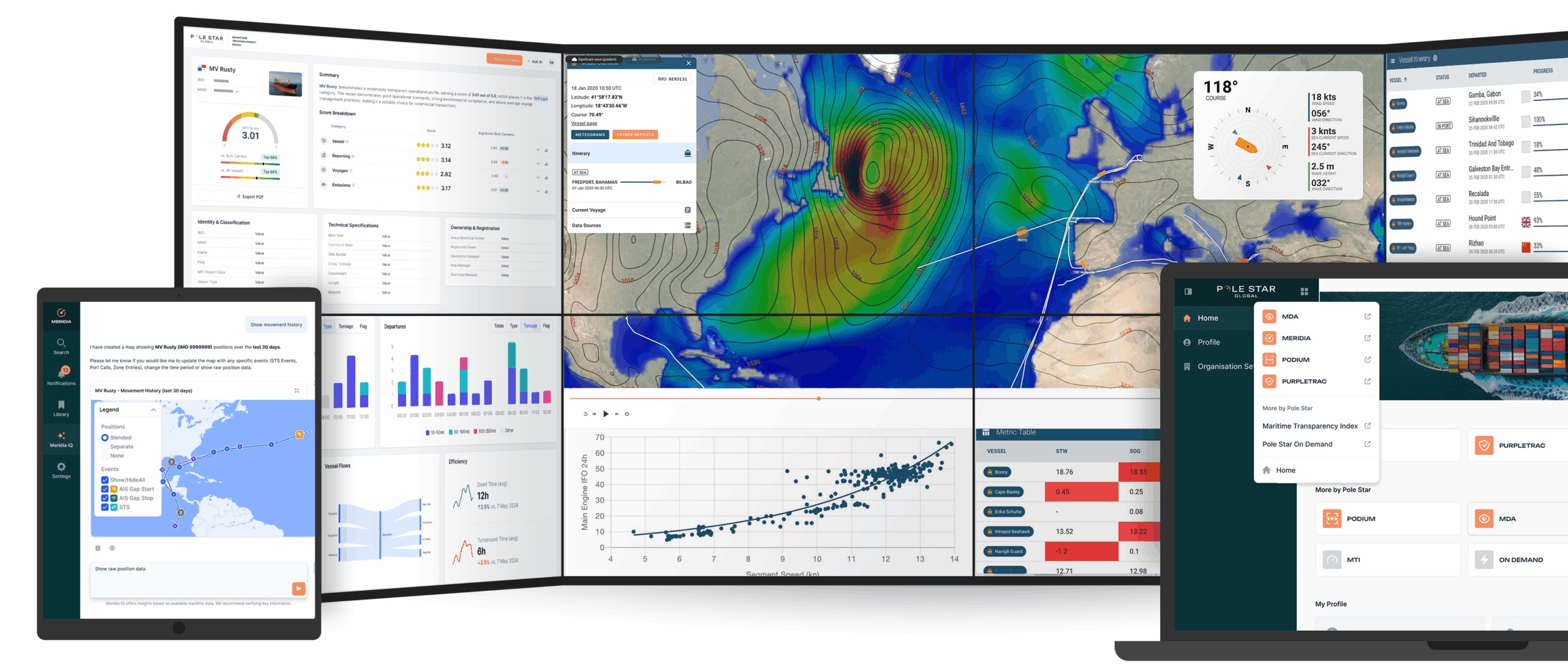
Ship tracking can look deceptively simple on screen. A position marker moves; a trail follows. Pole Star’s business reaches into the evidence around that marker: ownership, port calls, reporting gaps, weather, performance and sanctions exposure. Different customers need different pieces. An operations manager cares about arrival and fuel. A lender cares about the parties and voyage behind a transaction. A registry has its own ships and reputation to protect.
PurpleTRAC is the compliance product. It screens vessels and associated owners and managers, monitors activity and produces reports for an audit trail. The service is available through software or an application programming interface, allowing checks to live inside a customer’s existing systems. Dow Jones Risk & Compliance supplies screening data through an alliance.
The need for corroboration is tangible. In a published case involving the San Marino Ship Register, Pole Star says an investigation combined AIS information, persistent tracking and satellite imagery to uncover more than 236 days of falsified location data on a tanker. The warning signs included inconsistent positions and implausible anchoring patterns. The company’s account illustrates the danger of accepting a plotted location at face value.
Reported in Pole Star’s San Marino tanker investigation. One vessel, not an industry-wide estimate.
A reporting gap deserves attention, but its existence alone does not explain its cause. Pole Star’s tracking products use additional communications sources because AIS can be switched off, manipulated or interrupted by coverage problems. That distinction matters to an innocent operator as much as to an investigator. A useful system must help people examine conflicting evidence without turning every missing signal into an accusation.
02 / Before the charter, run the check
Gunvor offers a concrete example of how the software becomes part of a working business. The energy trader says PurpleTRAC is integrated into its Counterparty Management System, or CMS. Its chartering teams screen approximately 15 vessels on a typical day. Screening is connected to operational vetting, and comprehensive checks must happen before chartering.
That placement is the important detail. A report in an inbox is easy to postpone. A check inside the system used to conduct business has a better chance of changing a decision. Gunvor describes a centralized process in which vessels and owners are screened daily and compliance staff can respond to new information.
The lesson readers can copy is procedural: identify the moment when risk becomes a commitment, put the check there, and give someone responsibility for exceptions. Buying data is only one part of that work. The organization still needs rules for escalating an ambiguous result and recording the eventual decision. Otherwise, the dashboard becomes another place to look while the actual transaction happens elsewhere.
- 01IdentifyVessel + associated parties
- 02ExamineLists + movement history
- 03ResolveReview + record a decision
03 / The forecast has a financial consequence
Podium serves a different desk. Its remit includes voyage monitoring, performance analysis, reporting and optimization. Weather advice sits beside questions about fuel use, timing and contractual performance. The product can work with instrumented ships, but Pole Star also describes performance monitoring that does not require additional onboard sensors.
StratumFive brought Podium and FleetWeather into the group through an acquisition announced in October 2023. FleetWeather added an established marine forecasting and routing operation. That combination explains why Pole Star is more than a compliance vendor: it sells assistance with running a voyage as well as checking its commercial acceptability.
Routing also exposes the limits of tidy software promises. A recommendation depends on the vessel, forecast, arrival requirement and operating priorities. A percentage saving advertised for a route cannot sensibly be treated as a fleet-wide guarantee. The practical test is whether an operator can compare the recommendation with the voyage actually sailed and understand the assumptions behind the difference.
There is less visible infrastructure in the portfolio, too. Pole Star offers Long-Range Identification and Tracking services, known as LRIT, including terminal conformance testing and data center management. Its testing page reports more than 40,000 completed tests and provides a flag-by-flag table of available services. Eligibility is specific: testing, certification and data center support are not interchangeable offerings for every registry.
04 / Following the money around the ship
The expansion has attracted investors interested in specialized business software. Wavecrest Growth Partners and Abry Partners completed a growth investment in April 2021. The announced uses included hiring, sales expansion and product development. Delta-v Capital announced its investment in November 2024, discussing both the rollout of Podium and opportunities for further acquisitions.
The next significant addition came in August 2025: Clearwater Dynamics, developer of the Coral marine insurance risk platform. This extended Pole Star into underwriting intelligence. Read together, the acquisitions suggest a strategy of selling more services around the same moving asset. A voyage produces operational questions for an owner, compliance questions for a trader and exposure questions for an insurer.

The business model follows those needs: enterprise software, data and API access, alongside hardware, testing and specialist services. Procurement is sales-led. A buyer needs to specify the products, fleet or investigation scope, integration requirements and support involved. The economic case should include the labor required to connect systems and act on alerts, as well as the contract itself.
That makes the early £1 million a useful historical number, not a guide to today’s purchase price. For a prospective customer, the relevant calculation is the cost of the present workflow: repeated research, delayed approvals, duplicated subscriptions and decisions made with incomplete information. Those costs differ sharply between a small operator and a global trading desk.
05 / A score is an invitation to investigate
In January 2026, Pole Star announced its Maritime Transparency Index. The scale runs from zero, labeled “Hard Dark,” to five, labeled “Transparent.” It compresses vessel information into a rating intended to make comparison and prioritization easier. The company’s product page identifies vessel and voyage factors, while marking emissions, border security and supply-chain dimensions as being in development.
The distinction between prioritization and proof is essential. A low score can prompt a closer look; it cannot supply every fact behind a transaction. The product’s usefulness rests on whether analysts can understand the inputs, examine discrepancies and explain their next step. The number should make the investigation easier to start, without making curiosity seem unnecessary.
Meridia addresses the assembly work. It brings vessel, ownership, port and trade intelligence together, with APIs for connecting that information to other software. An August 2026 product account describes Meridia IQ, a conversational assistant in beta. The attraction is straightforward: asking which tankers arrived at a port is easier than assembling a query across several disconnected feeds. The answer still needs scrutiny.
06 / The revealing detail in the release notes
The July product release notes, published in August 2026, offer a more candid view of progress. Pole Star disclosed that Meridia’s Events tab had silently limited results. The revised design distinguishes a recent-events view from a fuller export. That is a consequential fix for anyone who might otherwise mistake a screenful of records for the complete history.
Podium’s crew reporting also received attention. Optional fields had made reports longer and less relevant to individual vessels. The update lets shore teams configure them. The lesson is plain: establish whether a report is complete and whether a form asks useful questions before celebrating how much data a platform collects.
Pole Star operates in a contested market. Windward sells maritime behavioral intelligence and sanctions screening. Kpler’s MarineTraffic combines tracking with risk and compliance tools. Pole Star’s distinguishing commercial combination is its operational software, regulatory services, hardware and financial-risk products. Buyers should compare the particular workflow they need, rather than assume that every maritime intelligence supplier does the same job.
07 / Someone ashore still has to think
The company names innovation, collaboration, caring and growth as its values. Its more concrete organizational details are a workforce spanning more than 19 nationalities and 25 languages, and a support operation available around the clock. Serving crews and offices across time zones gives those arrangements a practical purpose.
In a TradeWinds interview published in September 2026, shipping and offshore executive Ollie Raymond discussed the role of meteorologists and experienced shore teams in interpreting information. His point cuts through the temptation to equate a bigger feed with a better decision.
“We can’t keep adding data to a situation and hope that it’s going to improve the clarity.”
Ollie Raymond / Pole Star Global
TradeWinds interview, September 2026
Pole Star’s opportunity lies in making maritime evidence useful at the moment it matters. Its products can help people investigate a suspicious track, evaluate a voyage or document a screening decision. They work best when the customer has someone ready to interpret the result. The telephone boxes needed a reliable location. Their modern successors need a reliable explanation, too.