The first thing to notice about Shift4’s old anti-money-laundering system is how industriously it could be wrong. In a case study published by ThetaRay, the payments company reported an 89% false-positive rate. A machine could raise a concern in an instant. A person then had to spend part of the working day explaining why the concern amounted to very little.
Multiply that arrangement across an expanding payments business and a curious inversion appears: the tool intended to help the detectives becomes one of their chief sources of work. ThetaRay sells financial crime compliance software into precisely this predicament. Its pitch begins with patterns in money movement and ends with a practical question: which cases deserve a human being’s attention?
- The job: detect suspicious payment behavior, screen counterparties and assess customer risk.
- The buyers: banks, fintechs and payment providers such as Santander, Payoneer and Shift4.
- The wager: better context can reduce wasted review without sacrificing useful investigations.
- The next move: Ray automates parts of the investigation after an alert arrives.
01 / The alarm that eats the working day
Shift4’s problem was concrete. Its existing tools generated low-quality alerts and had data-ingestion limitations that interfered with new product launches. The published account says ThetaRay’s deployment brought context and rationale into alerts, reduced duplication and involved weekly optimization meetings. After seven months, Shift4 reported 80% fewer alerts and 70% more productive alerts. Those are customer results published by the vendor, rather than a controlled comparison.
The two figures belong together. A quieter alarm can be wonderfully pleasant and completely useless. A quieter alarm that gives investigators more productive leads is a different proposition. For a reader running any operation with a review queue, the lesson travels well: count the work that proves useful, alongside the work you eliminated.
A separate metric, not the bar’s denominator.
02 / Mathematics before the marketing
ThetaRay’s scientific founders, Amir Averbuch and Ronald Coifman, came from Tel Aviv University and Yale. Their expertise involved finding structure in complicated data. Founded in 2013, the company initially described a much wider field of application. An early corporate overview put industrial predictive maintenance and Internet of Things security beside banking problems. There were many places an unexpected pattern might matter.
That background helps explain ThetaRay’s preferred starting point. A fixed rule looks for a condition someone has already decided to inspect. Behavioral anomaly detection looks for departures from learned patterns. Neither approach turns suspicion into proof. But the second can surface relationships the author of a rule did not anticipate.
Consider a hypothetical business account. One unusually large payment may be perfectly ordinary for its trade. A series of smaller payments, spreading across connected counterparties in an unfamiliar rhythm, may deserve attention. Amount alone cannot tell the whole story. The useful question concerns the payment’s place in a pattern.
The commercial focus narrowed toward financial crime. In May 2021, ThetaRay publicly launched SONAR as a SaaS solution for cross-border payment monitoring. The attraction of this market is easy to understand: legitimate money and criminal money share the same rails, while institutions are responsible for examining the traffic. A detector’s value rests on what the institution can do with its findings.
03 / A name, a payment, a case
The current portfolio separates several jobs that a casual observer might collapse into “catching fraud.” Transaction Monitoring studies activity and relationships. Screening checks customers and transactions against sanctions, watchlists, politically exposed persons lists and adverse media. Customer Risk Assessment maintains risk profiles to support onboarding and continuing due diligence. Ray handles investigation work. Each answers a different question.
In July 2024, ThetaRay acquired Screena, a screening specialist it had partnered with since 2022. The deal put an existing partner’s technology inside the product suite. This is a revealing choice. A company that began by detecting unusual behavior was investing in the identity and context needed to make that behavior intelligible.
The customer roster includes established banks and businesses whose principal occupation is moving money: Santander, ClearBank, Payoneer, Travelex and Onafriq, among others. ThetaRay reports more than 100 institutional customers. These institutions bring different geographies, customer types and payment flows. A remittance provider’s ordinary Tuesday need not resemble a corporate bank’s.
The market is crowded. Feedzai, Napier AI, Hawk and other specialists offer overlapping financial crime capabilities, while NICE Actimize offers a broad established suite. ThetaRay’s distinctive positioning combines its mathematical detection heritage, cross-border payment experience and a growing set of connected compliance products. A buyer should compare the relevant modules and actual workflow; the words “AI-powered” scarcely narrow the shopping list anymore.
04 / The cost lives in the queue
AirPak, a Central American payments and remittance business, offers another view of the problem. Its case study describes static country risk matrices, excessive enhanced due diligence and onboarding delays. After deploying ThetaRay’s Customer Risk Assessment in early 2024, AirPak reported a 60% reduction in enhanced due diligence case volume and a 40% reduction in manual analysis time per case within six months.
“We chose a solution that adapts to our operations, not the other way around.”
Carlos Zúniga Nuñez / Chief Legal Officer, AirPak
The expenditure a buyer must judge extends beyond the software contract. It includes connecting data, configuring risk policies, checking model behavior, training reviewers and maintaining the system as the business changes. Time saved in one queue is valuable only if the work has not quietly migrated into another. That is an evaluation principle, not a claim about a particular ThetaRay contract.
ThetaRay sells enterprise SaaS through direct and partner relationships, with a demo-led sales process. Microsoft and Finastra appear in its partner network. Its financing is a separate matter: a $57 million growth round announced in September 2023 was led by Portage with JVP and OurCrowd participating. That capital was intended to accelerate expansion; it says nothing about the price an individual customer should pay.
05 / Ray inherits the unfinished case
An alert is a beginning. Santander’s published ThetaRay case study describes the discovery of a human trafficking network, including payment patterns connected to advertising adult services, and faster escalation to the UK’s National Crime Agency. The account illustrates the distance between finding an oddity and producing something an investigator can act upon.
“AI has made the haystack smaller, allowing us to find more needles that we might have historically missed.”
Stephen Jennings / Head of Transaction Monitoring, Santander UK
Ray, launched in 2026, addresses the work in that interval. ThetaRay describes a suite that gathers case data, compares activity with customer profiles, correlates historical alerts and prepares structured findings. An assistant can summarize documents and explain context. The product description explicitly keeps analysts in control. The promise is less repetitive preparation and more consistent documentation.
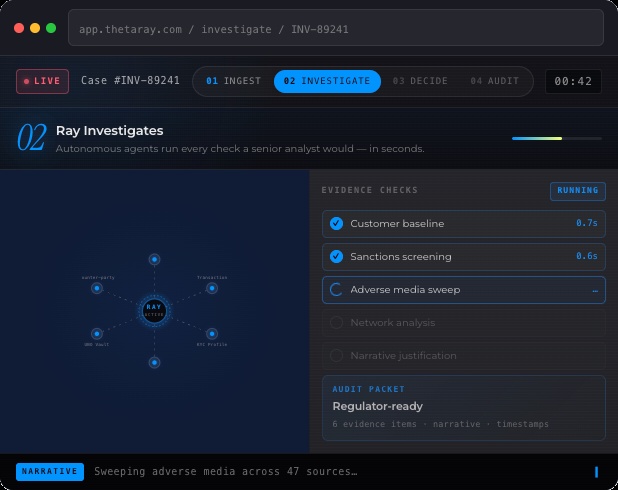
This expansion makes strategic sense. Once a company helps a customer find suspicious activity, it has an opportunity to help that customer resolve the resulting cases. It also inherits a harder burden: an explanation must hold together when another person examines it. A polished paragraph cannot compensate for a missing transaction, an incorrectly matched name or an unsupported inference.
06 / What the buyer should borrow
The repeatable idea is to begin with the bottleneck. If false alarms consume the team, measure alert quality and investigation time. If onboarding is slow, examine the risk matrix and due diligence workload. If evidence gathering is the problem, test investigation assistance on a bounded set of real cases. The product should earn its place against the work people actually do.
These ideas require conditions. Customer and transaction records must be usable; policies must reflect the relevant business and jurisdictions; reviewers must be able to challenge the recommendation. Weekly tuning in the Shift4 account is a reminder that deployment is an ongoing relationship. Simply suppressing alerts could improve a dashboard while leaving the underlying risk untouched.
There is a pleasantly unglamorous standard for all this sophisticated mathematics: can the investigator explain what happened, show the supporting evidence and decide what to do next? ThetaRay’s trajectory from detection to case resolution puts that standard at the center of its business. The important object is the case someone can finish.
Follow the money, then the conversation
Explore ThetaRay’s products, customer stories, its blog and latest news.
Watch the Ray product walkthrough and Shift4 customer interview, or listen to The Banker’s Santander conversation.