Bitcoin keeps a public ledger. That sounds wonderfully transparent until a compliance officer has to explain who is behind a wallet, where its money came from and whether a withdrawal should proceed. The numbers are visible; their meaning takes work. Elliptic built a business in that gap, selling the intelligence that turns a trail of crypto transactions into something a bank, exchange or investigator can act on.
In May 2026, that business attracted a $120 million Series D led by One Peak, with Nasdaq Ventures, Deutsche Bank and the British Business Bank participating. Elliptic put its valuation at $670 million. For a company whose earliest product was a bitcoin vault, the destination is telling: some of the institutions at the heart of conventional finance are financing better ways to scrutinize digital money.
The vault was only the beginning
Co-founder James Smith did not immediately catch bitcoin fever. When his friend Tom Robinson mentioned it in 2011, Smith ignored him. A price jump caught his attention in 2013, while he was working as a derivatives trader. Buying bitcoin involved a forum and a purchase from Robinson. The experience was awkward enough to suggest a business opportunity.
Smith, Robinson and Adam Joyce founded Elliptic in 2013. They considered an exchange and launched a custody product. Conversations with exchanges then revealed a sharper problem: those businesses were fielding questions about whether their customers' funds were legitimate. The founders built an early analytics product, showed it to exchanges and saw usage climb.
“We saw that as a data problem.”
James Smith / Co-founder, recalling the early pivot

The first idea gave way to a more urgent customer need. That makes the origin useful beyond crypto: talk to the people trying to operate the new technology, then identify the question they cannot answer. Elliptic's eventual product grew around the exchange's compliance desk. The dull-sounding question about provenance turned out to have considerably more staying power than a price chart.
Following money that changes trains
Elliptic collects blockchain data, attaches intelligence about entities and activity, and applies configurable risk rules. An address can become more informative when linked to an exchange, a service or known illicit activity. The output helps analysts assess exposure to financial crime and sanctions risk. It gives public transaction records a context that the ledger alone cannot supply.
Crypto also moves between networks. A trail may pass through a bridge or a decentralized exchange, changing assets along the way. Elliptic's Holistic technology follows activity across those boundaries. Its platform is designed to preserve the connected history instead of forcing an investigator to reconstruct each network transition manually. Think railway connections, with considerably less helpful station signage.
Follow the connections. Then ask what they mean.
The company's product catalogue advertises coverage of more than 65 blockchains, more than 250 bridges and over 100 billion data points. Those are company-reported coverage measures, not a promise that every transaction's purpose is knowable. Their commercial significance is practical: each additional supported route can spare a team another blind spot or another separate investigation tool.
Four jobs, one underlying dataset
Lens handles wallet and transaction screening. An exchange can examine a destination before processing a withdrawal; a payments business can assess incoming activity. Teams set their own risk thresholds and alert rules. That flexibility matters because the useful question is whether activity breaches a particular organization's policy, with a record of the reasons behind the decision.
Discovery moves the lens outward to businesses. It combines on-chain risk information with off-chain profiles, licensing information, peer comparisons and historical activity for crypto exchanges and other virtual asset service providers. A bank evaluating a potential counterparty can examine both its current profile and how its activity has changed. A single score gains meaning when placed alongside comparable firms.
Investigator is the tracing workspace. It generates visual maps of connections, follows funds across chains and exports graphs, timestamps and entity labels. That makes it useful to investigators building a case and to compliance staff escalating an alert. Ecosystem Monitoring takes a wider view again, showing exposure trends across a portfolio or token ecosystem rather than concentrating on one wallet.
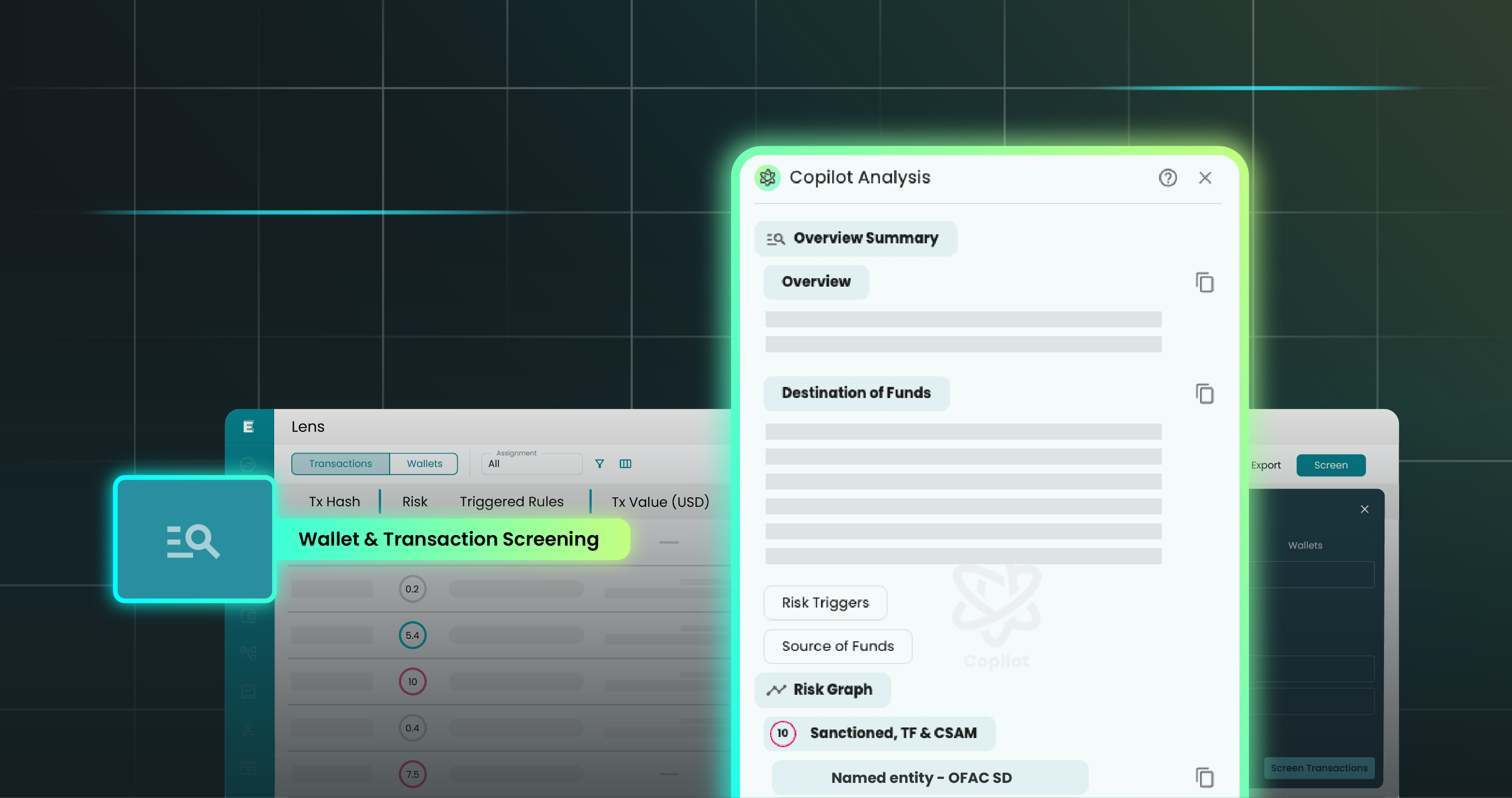
The common dataset is part of the pitch. Screening and investigation should draw on the same underlying intelligence and risk logic, so a handoff does not require reconciling incompatible answers. Elliptic also provides API access. Its developer documentation describes submitting wallets or transactions from internal systems and retrieving analysis, with SDKs for Python, Node.js and PHP.
The spreadsheet was the bottleneck
In February 2026, Elliptic announced a rebuilt Lens that brought wallet and transaction screening into one interface. Its account of the old process is familiar enterprise-software misery: screen in one application, investigate in another, track progress in a spreadsheet and document the result somewhere else. The work could be technically sophisticated while the handoffs remained painfully ordinary.
The revised product added assignments, screening statuses, structured notes and audit history. Escalation to Investigator carries the context and notes forward. Elliptic says its data shows teams resolving 99% of alerts in under five minutes. Treat that as a reported operating result for its users, not a universal service guarantee. A complicated investigation is still a complicated investigation.
One anonymous global-exchange case study makes the workflow argument in dollars. Elliptic reports more than $3.1 million in annual efficiency gains after standardizing compliance tools, reducing duplicated work and tuning risk rules to regional requirements. The emphasis is on redeploying resources toward intelligence and investigations. Automation becomes valuable when it removes work that someone otherwise has to repeat.
Annual efficiency gain reported by Elliptic for one unnamed global exchange.
Company case study. An operating outcome, not a product price or guaranteed return.For another compliance team, the copyable move is to map the handoffs before buying more software. Count duplicate reviews, reconcile conflicting rules and record where cases wait. Then test whether a combined workflow reduces those costs without losing meaningful escalations. This is an inference from the implementation described, not a claim that another exchange will reproduce the savings.
Who pays for the questions?
Elliptic sells enterprise software and data access to crypto businesses, financial institutions, payment providers and government agencies. Its partner page says the suite serves more than 700 customers. Public customer material names Coinbase, Revolut, Banking Circle and HSBC, among others. These are organizations that need to explain and control crypto exposure, including when digital assets are only one part of their business.
Its commercial route runs through demonstrations and sales conversations, supported by integration, training and compliance expertise. The buyer is purchasing an ongoing intelligence service and working tools. For the 2026 Lens transition, Elliptic explicitly said existing customers with both Lens and Navigator would receive the upgraded Lens at no additional cost. That commitment describes a migration, not general pricing for a new customer.
Partnerships help put that service where money already moves. Fireblocks appears in Elliptic's integration network, alongside Travel Rule provider Notabene. In July 2026, Elliptic announced that Circle had joined its Agentic Design Partner Program following an investment from Circle Ventures. Circle was already a customer. The program brings operational feedback and real transaction challenges into the development of AI-assisted compliance.
More money, more homework
The financing history follows Elliptic's widening ambitions. A $23 million Series B announced in September 2019 supported expansion into Asia, including Japan and Singapore. In October 2021 came a $60 million Series C led by Evolution Equity Partners, with SoftBank Vision Fund 2 and J.P. Morgan among the participants. By 2026, the Series D was funding a further push into data and AI-led operations.
Individual announced rounds; not revenue or a cumulative funding total.
There is research beneath the AI sales language. A 2024 paper co-authored with researchers from the MIT-IBM Watson AI Lab studied the shape of money-laundering activity using connected groups of transactions. Its Elliptic2 dataset contains 122,000 labeled subgraphs within a much larger Bitcoin transaction graph. The work asks whether patterns in connected activity can reveal illicit behavior beyond already identified addresses.
That expertise spans data science, blockchain tracing and regulatory policy. Elliptic lists empowerment, openness, positive impact, connections and curiosity as company values. Those are declared aspirations; the public research and released dataset offer a more concrete window into its habits. The company has also received World Economic Forum Technology Pioneer recognition. Its authority depends on explaining the data, not merely accumulating it.
A risk score still needs a reader
Elliptic operates in a competitive market. Chainalysis sells transaction monitoring, address screening and counterparty-risk products aimed at many of the same buyers. Elliptic's case rests on connected cross-chain analysis, configurable rules and a shared path from screening to investigation. A sensible comparison would test those capabilities against the buyer's actual assets, casework and integrations. A coverage headline alone cannot settle the choice.
The limits are visible in Elliptic's own product development. Its July 2026 Continuous Monitoring release addresses a basic problem: a wallet that appeared low risk at onboarding can change afterward. The system combines event detection with scheduled rescreening and configurable notifications. A one-time check cannot provide continuing reassurance when the underlying activity keeps moving.
Nor can a graph supply every fact about intent. Elliptic's Copilot helps summarize risk and analyze connections, while the company says people review and approve recommendations before they become case outcomes. The useful conditions are therefore specific: supported data, carefully configured rules, a functioning review process and analysts who can question the output. Remove those conditions and speed can simply deliver weak decisions sooner.
On September 4, 2026, Elliptic announced Dror Avieli as chief customer officer, drawing on his experience at Consensys and enterprise technology companies. The appointment fits its current challenge: make specialist intelligence usable inside larger institutions. Elliptic began by discovering which question exchanges needed answered. Its next test is whether it can keep that answer useful when the queue gets much longer.
Follow the trail
Explore Elliptic, its product suite, newsroom and research and analysis.
Find the company on LinkedIn, X and Facebook. Watch its blockchain analytics overview or explore the Elliptic video channel.