A bank alarm has a strange job. It must be suspicious enough to catch the criminal and polite enough not to accuse everyone else. The ordinary solution is to set rules: flag a transfer above a threshold, a payment to an unusual destination, a name that resembles one on a sanctions list. Then someone must inspect the resulting queue. The machine can be quick; the human hours are expensive. SymphonyAI Sensa-NetReveal is a business built around that gap.
- It sells financial crime software to banks, insurers and other large institutions.
- NetReveal supplies monitoring, screening and case workflows; Sensa adds AI that ranks and explains risk.
- Absa says a pilot cut false alerts by 77% while preserving the suspicious activity its prior system found.
- The buying decision is a trade: fewer wasted investigations, with models that still need oversight and defensible evidence.
The name itself is a small corporate history lesson. NetReveal was a mature financial crime platform inside BAE Systems. Sensa grew out of Ayasdi, a Stanford-linked analytics startup founded in 2008. SymphonyAI closed its purchase of NetReveal in October 2022, then combined its bank footprint with Sensa’s machine learning. The first joint suite arrived around the deal; a generative AI investigator copilot followed in 2023. This was less a laboratory invention than a marriage of two useful, incomplete things: a place where bank work already happened, and a way to make the alarms more discriminating.
The expense of being suspicious
False positives sound like a technical nuisance until one imagines the desk behind them. An alert can require a person to inspect customer details, review transactions, check names and write a decision that may later be read by an auditor. A clumsy system turns vigilance into paperwork. And if the queue is too crowded, the genuinely unusual case risks becoming one more item with a number. The company’s central product argument is that detecting risk and managing the investigator’s attention are the same problem.
Its menu reflects the whole journey: anti-money-laundering transaction monitoring, know-your-customer and due diligence tools, sanctions and name screening, payment fraud scoring, case management and reporting. SensaAI can also sit over an existing monitoring or screening stack. That matters in a bank where replacing every rule, integration and approval process would be a heroic and unpopular project. The enterprise buys software and deployment support; prices are negotiated, and SymphonyAI does not publish a public price list.
Absa asked for proof on its own data
The company’s best public example comes from Absa. The South African bank did not accept a general claim about clever algorithms. It supplied masked data for proof-of-concept work and asked whether AI could find more risk while reducing needless reviews. According to the published case study, false-positive alerts fell by 77%, while the test still captured all the suspicious activity identified by Absa’s existing transaction monitoring system. The bank also reported a 10.5% hit rate for newly identified risks and selected 200 high-scoring cases for closer inspection.
Those are case-study numbers, not a promise to every buyer. They do, however, show what changed Absa’s mind: performance against its own data and its own existing system. A bank contemplating the same move can copy the test design. Start with masked historical data, preserve a baseline of known suspicious cases, count the alerts humans must examine, and inspect the new cases the model surfaces. A broad accuracy score would miss the labor cost; a labor-saving score alone could conceal missed crime.
“We take risk management extremely seriously and by working with SymphonyAI, we are improving our productivity, becoming more effective, and reducing risk.”Nic Swingler, Head of Financial Crime, Absa
A map of the person behind the payment
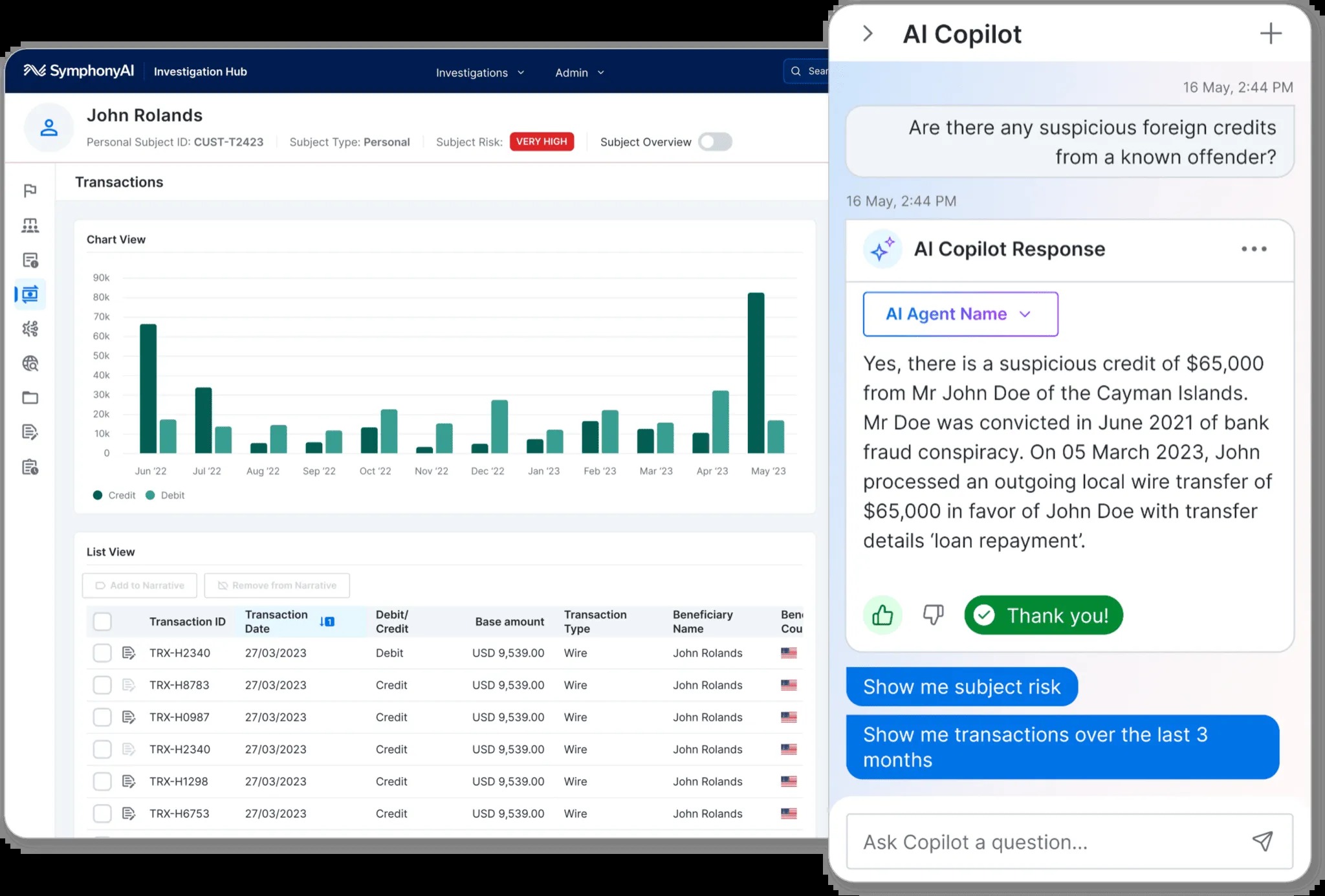
The investigation product gives the other half of the answer. Sensa Investigation Hub gathers information around an entity, bringing a person or organization, connected transactions and risk signals into one case view. Its Copilot can summarize evidence in natural language and help draft reports. The attractive claim is speed; the useful question is whether an investigator can trace every sentence back to evidence. In a regulated business, an explanation is part of the product, not a decorative caption pasted over a score.
Cecabank offers a different illustration. The Spanish bank needed sanctions screening that could be configured for both retail and wholesale banking, whose alert volumes and operating rhythms differ. Its published account emphasizes adjustable watchlists and a single interface for investigators. Munich Re is another publicly named user of SymphonyAI’s financial crime platform, applying it to sanctions and anti-money-laundering work across a global insurance group. These are not identical customers. The common need is to join detection to an auditable decision.
An old platform learns a new market
NetReveal said it served 200 leading financial institutions at the moment SymphonyAI bought it. That installed base is an advantage a new model vendor cannot conjure up with a demo. It also imposes discipline: banks demand integration, security, steady releases and an answer when a model changes its mind. SymphonyAI’s competitors range from broad suites such as NICE Actimize, SAS and Oracle to more focused fraud and AI vendors such as Feedzai and Quantexa. The contest is partly about detection quality, partly about whether the software can survive life inside a large institution.
By September 2026, the company’s pitch had moved beyond isolated models. Its new Symphony Risk Intelligence platform is meant to keep controls updated as risks and regulations change, with governed AI agents involved in the workflow. The timing is telling: a SymphonyAI and AML Intelligence survey reported that only 4.7% of responding institutions continuously updated their monitoring and controls as risk changed. The figure comes from the company’s own research, but the practical tension is easy to recognize. Criminal behavior has no reason to respect a quarterly review calendar.
This approach has limits. A small institution without usable transaction history, stable identifiers or a team to review outputs may get less from sophisticated models than from repairing its basic data and rules. A bank that cannot explain why a case was raised will struggle to defend the result, however impressive the score. And no pilot percentage should be smuggled into a purchase order as a universal forecast. The sensible sequence is the one Absa followed: test on local data, measure both missed risk and investigator time, then deploy with humans able to challenge the machine.
The joke, if there is one, is that financial crime software sells the virtue of suspicion while trying to make suspicion less indiscriminate. SymphonyAI Sensa-NetReveal’s real achievement will be judged in the quiet moments: the routine alert nobody had to read, and the unusual one somebody did.
Keep reading
- SymphonyAI Financial Services - products and platform
- Absa case study - the bank’s reported pilot results
- Cecabank case study - sanctions screening in practice
- Symphony Risk Intelligence announcement - the 2026 platform
- LinkedIn · X · YouTube
- Video: Absa on financial crime prevention